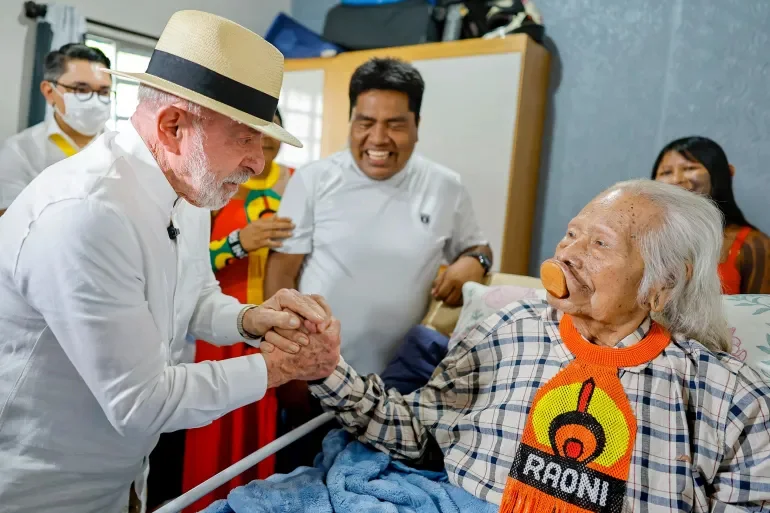
On November 20, Brazilian President Luiz Inácio Lula da Silva made a poignant visit to 94-year-old legendary indigenous leader and lifelong Amazon conservation advocate Raoni Metuktire — globally known as Chief Raoni — at a medical care facility in Peixoto de Azevedo, Mato Grosso state, where the ailing leader is receiving palliative treatment for digestive tract cancer, recovering from a recent lung infection and unstable blood pressure episode that landed him in hospital just days prior.
The high-profile visit coincided with a landmark regulatory announcement from Brazil’s Ministry of Justice: the official preliminary recognition of Kapôt Nhĩnore, a sprawling 362,000-hectare ancestral territory straddling the Mato Grosso and Pará state borders along the Xingu River basin, as designated permanent indigenous land for the Mebêngôkre (Kayapó) and Yudjá peoples. This milestone marks a critical breakthrough in a demarcation process that stretched across nearly 70 years of systemic delays, colonial dispossession, and conflicting economic interests.
President Lula disclosed that he accelerated the administrative proceedings for the territory after learning of Raoni’s latest hospitalization while attending the COP31 climate summit in Türkiye, prioritizing finalizing this long-unresolved claim tied to Raoni’s birthplace while the iconic activist is still alive. “There is no more authentic Brazilian than our comrade Raoni,” Lula stated during their meeting, framing the lifelong campaigner as a living bridge between the indigenous communities’ ancestral past and their envisioned sovereign future.
The Kapôt Nhĩnore territory holds profound cultural and spiritual significance for the two communities, hosting sacred sites, centuries-old traditional burial grounds, and 83-84% of its original old-growth Amazon forest still intact, according to official government data. The land was seized from indigenous groups during mid-20th century colonial expansion, and was deliberately excluded from earlier rounds of adjacent indigenous territory demarcation. Formal procedural work to reclaim the land relaunched in 2004, with Brazil’s national indigenous affairs agency FUNAI completing rigorous anthropological and ecological impact assessments in 2023, before facing a wave of legal challenges from non-indigenous stakeholders.
The path to full demarcation remains fraught with obstacles: roughly 200 private agricultural properties and non-indigenous settlements currently operate within the newly recognized zone, with local soybean farmers and cattle ranchers mounting fierce pushback over fears of lost land access and disrupted livelihoods. Lula’s administration has committed to mediating negotiated solutions with affected parties and the judiciary, while reaffirming that indigenous constitutional land rights are non-negotiable, regardless of non-indigenous occupancy levels in the designated zones.
Chief Raoni, who rose to global fame in 1989 after partnering with British musician Sting to launch an international Amazon conservation advocacy campaign, has spent six decades campaigning to defend the rainforest and indigenous sovereign rights, meeting dozens of world leaders across five continents to raise awareness of rampant deforestation. He notably stood alongside Lula at his 2023 presidential inauguration, cementing their decades-long collaborative alliance for indigenous justice and climate action.
Environmental researchers and conservation groups widely confirm that formally demarcated indigenous territories have the lowest deforestation rates across the Brazilian Amazon, as indigenous communities’ traditional stewardship practices preserve critical forest carbon sinks, protect endangered biodiversity, and safeguard freshwater river systems. While the preliminary Ministry of Justice recognition marks a hard-won victory for Raoni and the two communities, full legal protection of Kapôt Nhĩnore will require resolving outstanding legal appeals, finalizing physical boundary surveys, and deploying enforcement resources to curb illegal logging, land grabbing, and encroaching agribusiness activity in the ecologically sensitive zone.
Lula bezoekt Raoni en zet stap in bescherming van 362.000 hectare Amazonegebied