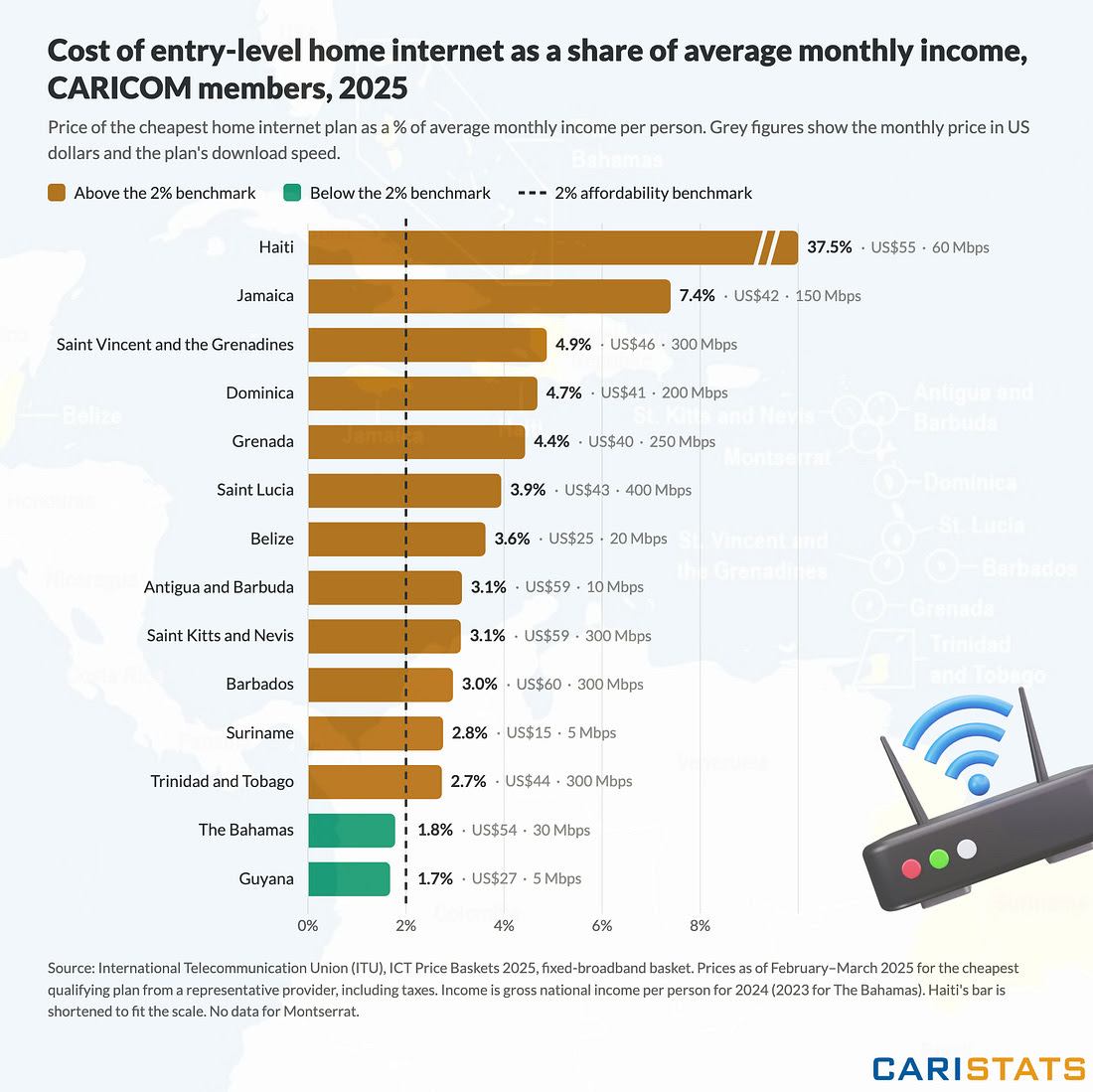
Home broadband has evolved from a discretionary luxury to an indispensable backbone of modern daily life across the Caribbean, powering K-12 remote learning modules, hybrid work operations, digital banking transactions, government public service portals, and nearly every facet of routine personal and professional activity. As a result, the cost of entry-level fixed home internet has emerged as a core component of regional cost-of-living pressures for households across the Caribbean Community (CARICOM). The global standard set by the International Telecommunication Union (ITU) and UN Broadband Commission defines affordable baseline broadband as an entry-level plan that accounts for no more than 2% of a household’s average monthly income. Newly published 2025 data from the ITU’s annual ICT Price Baskets report, which tracks fixed broadband pricing across 14 CARICOM member states with complete verified data, reveals a stark regional gap in meeting that global accessibility target. Only two CARICOM nations – The Bahamas at 1.8% of average monthly income and Guyana at 1.7% – fall below the 2% affordability threshold. The remaining 12 member states not only miss the UN benchmark, but all exceed the 2.5% global median for broadband cost as a share of income, with disparities that vary dramatically across the region. Jamaica’s cheapest qualifying fixed broadband plan costs USD 42 per month, equivalent to 7.4% of the country’s average per capita monthly income. In the Windward Islands nations of Saint Vincent and the Grenadines, Dominica, Grenada, and Saint Lucia, entry-level broadband costs represent between 3.9% and 4.9% of average monthly earnings. The most extreme disparity appears in Haiti, where far lower national average incomes push the cost of the cheapest home internet plan to 37.5% of per capita monthly earnings, putting even baseline connectivity out of reach for the vast majority of local households. The affordability gaps are compounded by vast inconsistencies in the quality of service delivered at comparable price points across the region. Entry-level plan speeds range from a bare minimum 5 megabits per second (Mbps) in Guyana and Suriname – a speed only sufficient to support basic single-user web browsing and video calls – to 300 Mbps or higher in five CARICOM member states including Barbados and Trinidad and Tobago. For context, a 10 Mbps entry plan costs USD 59 per month in Antigua and Barbuda, while a USD 60 monthly plan in Barbados delivers 30 times that speed. Analysts note that the ITU’s affordability metric calculates costs against national average per capita gross national income, meaning low-income households across every CARICOM nation spend a far larger share of their actual earnings on broadband access than the reported national averages suggest. The full 2025 dataset draws on pricing collected between February and March 2025, capturing all-inclusive tax-inclusive costs for the lowest-priced qualifying fixed broadband plan from each country’s primary representative service provider, with 2024 per capita GNI data used for all nations except The Bahamas, where 2023 income figures were applied.
Antigua and Barbuda missed global benchmark for affordable home internet in 2025