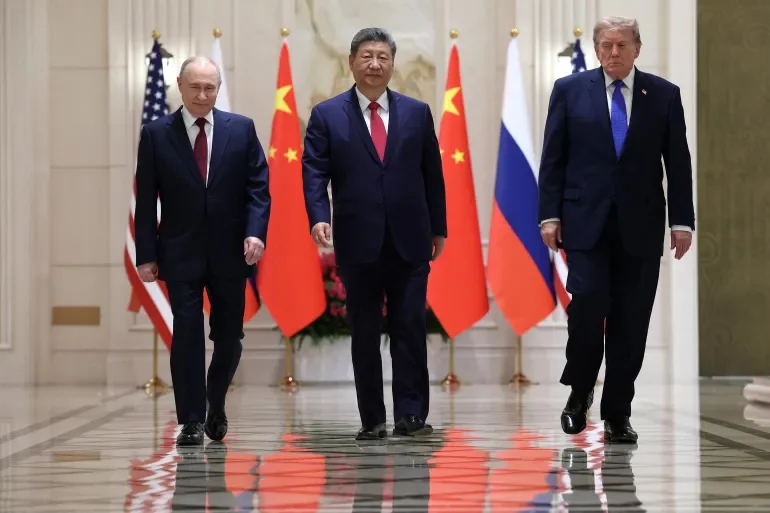
On November 19, on the sidelines of the ongoing APEC Leaders’ Meeting in Shenzhen, China, an unprecedented diplomatic milestone unfolded at Kylin Villa, where U.S. President Donald Trump, Chinese President Xi Jinping, and Russian President Vladimir Putin gathered for the first ever standalone trilateral summit of the heads of state representing the world’s three largest nuclear powers. The three leaders issued a four-point joint communiqué outlining shared commitments to advancing global stability, reforming the United Nations, expanding cross-border energy cooperation, and launching structured consultations to curb nuclear risk proliferation. While the gathering marks a historic first for coordinated high-level engagement between the three nuclear heavyweights, negotiators did not deliver tangible, actionable breakthroughs to resolve long-simmering major international conflicts. The core clauses of the joint declaration open with a unanimous, explicit affirmation that a nuclear war can never be won, and must never be waged under any circumstances. The three nations pledged to sustain ongoing dialogue frameworks to scale down nuclear risk and prevent the further spread of nuclear weapons technology, alongside shared commitments to advance structural reform of the United Nations system, ramp up production and global supply of refined petroleum products, and prioritize unobstructed, stable global energy flows to underpin broader economic resilience. That said, the document remains a broad, declaratory political statement with no binding timelines, formal implementation mechanisms, or enforceable accountability measures to turn its stated goals into concrete action. Notably, the full text of the joint communiqué makes no reference to the ongoing war in Ukraine, despite widespread pre-summit expectations that the conflict would top the agenda for the three leaders. The Kremlin confirmed that the Ukraine crisis was raised during a separate bilateral closed-door discussion between Trump and Putin, with talks focused on potential pathways to a negotiated end to the fighting. Following the trilateral session, Putin told reporters that Russia remains open to continuing peace negotiations, though no date has been set for the next formal round of discussions. He also stated that, from Moscow’s perspective, Kyiv and its European partners have not demonstrated willingness to make sufficient compromises, and that Russia will not shift from its longstanding positions on territorial security and broader European security architecture. Ukrainian President Volodymyr Zelenskyy has repeatedly emphasized that no negotiations determining Ukraine’s future can proceed without full, direct representation from Kyiv, while European Union member states have uniformly rejected any framework that would allow global powers to dictate Ukraine’s status without the country’s direct input. The Shenzhen summit has amplified growing anxiety among European policymakers that the continent risks being sidelined from high-stakes diplomatic decisions that directly shape its security. No European leaders were invited to the three-way talks, even as European nations remain the largest collective provider of military, humanitarian, and financial support to Ukraine, and form the backbone of the continent’s post-Cold War security order. Simultaneously, a gathering of the informal “Coalition of the Willing” nations convened in Berlin to coordinate ongoing support for Ukraine and draft formal bilateral security guarantees for the country, with U.S. envoys Steve Witkoff and Jared Kushner traveling directly from Shenzhen to Berlin to hold face-to-face consultations with Zelenskyy and European heads of government. The sequence of events has fueled widespread concerns that critical decisions over war, peace, and the future of European security are increasingly being negotiated in narrow, exclusive diplomatic blocs, leaving directly affected parties to receive finalized outcomes after they have already been agreed in principle. Another high-profile clause in the joint communiqué addresses the International Criminal Court (ICC), with the three nations asserting that the court and analogous international judicial bodies must not overstep their statutory mandates and abuse their jurisdictional powers. The statement also reaffirms the core principle of state consent for ICC jurisdiction, and the functional immunity of sitting state officials from the court’s proceedings. The unified position aligns with longstanding, separate criticisms of the ICC held by Washington, Beijing, and Moscow: neither the U.S. nor Russia has ever ratified the Rome Statute that established the court, while Russia is directly targeted by an existing ICC arrest warrant issued against Putin over actions related to the Ukraine conflict, and China has never formally recognized the ICC’s authority. The coordinated public statement makes clear that the three leaders are not only negotiating over shared global stability goals, but also setting boundaries on the scope of authority that international institutions can exercise over sovereign national leaders, a position that is poised to reshape global debates over international jurisprudence, accountability frameworks, and the balance between national sovereignty and binding international law. The energy cooperation pledges outlined in the communiqué carry significant strategic weight beyond narrow energy security concerns. The three nations’ commitment to expand refined petroleum output and ensure unimpeded global energy flows reflects their overlapping and complementary core interests: Russia is one of the world’s top crude and refined fuel exporters, China is the largest global importer of energy resources, and the U.S. holds a dominant position in global energy trading and global energy market governance. Despite the stated commitments, no coordinated implementation roadmap has been released, leaving industry analysts uncertain about which regional markets will see increased fuel supplies, and whether the three nations will align their policy positions to offset persistent market volatility driven by geopolitical tensions, cross-border sanctions, active conflict zones, and disruptions to critical shipping and trade routes. While the Shenzhen summit is widely framed as a landmark diplomatic turning point, it does not signal the birth of a new formal global governance order. The high-profile gathering gives Russia a prominent platform to reassert its status as a core global power, countering years of diplomatic isolation imposed by a large segment of the international community over the Ukraine conflict. For China, hosting the summit allows Beijing to position itself as a neutral, credible diplomatic broker capable of facilitating constructive dialogue between traditionally rival major powers. For the Trump administration, the high-level face-to-face meetings deliver a tangible public diplomatic win, creating a direct channel for negotiations with both Xi and Putin on core global security priorities. Deep, structural divergences between the three nations remain unaddressed, however, with conflicting national interests over the status of Taiwan, the resolution of the Ukraine war, nuclear arms control frameworks, global trade rules, and the long-term role of multilateral institutions. The summit’s joint statement does not erase these long-running geopolitical frictions. For now, the most material outcome of the Shenzhen gathering is the explicit commitment from Washington, Beijing, and Moscow to sustain high-level trilateral dialogue on global security issues. The long-term impact of the unprecedented meeting remains uncertain, as observers await follow-up actions to assess whether the declaratory commitments will translate to reduced global tensions, tangible progress on nuclear risk reduction, or inclusive diplomatic processes that leave space for smaller nations, multilateral institutions, and parties directly impacted by ongoing global conflicts to contribute to final negotiated outcomes.