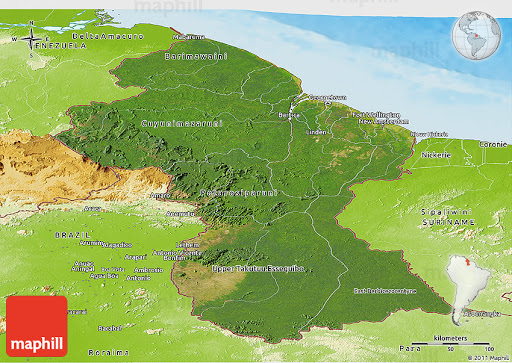
A previously undisclosed diplomatic interaction from September 2026 has sent shockwaves through Guyana’s foreign policy circles, after a senior official in the Trump administration reportedly floated the idea that the South American nation cede portions of its internationally recognized Essequibo territory to neighboring Venezuela. The Essequibo region, a resource-rich swathe of land spanning roughly two-thirds of Guyana’s total landmass, is formally recognized as sovereign Guyanese territory by the United States and the vast majority of global nations, though it has been the subject of a long-running territorial claim by Venezuela for more than 180 years.
According to verified reporting from Reuters, the controversial proposal was raised during a closed-door Washington meeting between then-serving State Department policy chief Jeremy Lewin and Guyanese Foreign Secretary Robert Persaud. Lewin, who left his post at the State Department at the end of October 2026, told Guyanese officials he was positioned to broker formal negotiations between Georgetown and the interim Venezuelan government led by acting President Delcy Rodriguez, a move that followed a formal letter Rodriguez sent to U.S. President Donald Trump in May 2026 requesting Washington’s official mediation of the decades-old border dispute. Multiple sources familiar with the discussions confirmed that Lewin referenced pre-existing preliminary talks he had held with Venezuelan officials about the Essequibo impasse in the months leading up to the September meeting.
The revelation of the unorthodox proposal lays bare the rapidly warming diplomatic alignment between the Trump administration and Rodriguez’s interim government, which took control of Caracas earlier in 2026 after a U.S.-led operation ousted long-time former Venezuelan leader Nicolas Maduro. For Guyanese officials, however, the suggestion of any territorial concession over Essequibo was deeply alarming, with senior government representatives immediately reaffirming that the region’s sovereign status as part of Guyana is entirely non-negotiable and off the table for any bilateral negotiation.
In a formal response to media inquiries about the unreported interactions, a current State Department spokesperson sought to distance the official U.S. government position from Lewin’s overtures, noting that department leaders are presented with a wide range of informal policy proposals on a daily basis, and confirming that Washington’s longstanding formal stance on the Guyana-Venezuela border remains unchanged, with no shift in recognition of Essequibo as Guyanese sovereign territory.
The long-simmering Essequibo dispute escalated dramatically in 2015, when energy giant ExxonMobil discovered massive, commercially viable offshore oil reserves in waters adjacent to the region, a find that has catapulted Guyana from one of the region’s slower-growing economies to one of the fastest expanding in the world. To formalize its claim to the territory, Guyana brought its case before the International Court of Justice in 2018, seeking a formal judicial affirmation of the 1899 arbitration award that first delineated the official border between the two nations and granted full sovereignty of the Essequibo region to Guyana. For decades, Guyana has been a close strategic ally of the United States in the Caribbean, with bilateral ties growing particularly strong during the Maduro era as Caracas repeatedly made belligerent public claims to the Essequibo region.
Additional details of Lewin’s undisclosed diplomatic outreach show that during a July 2026 in-person meeting with Rodriguez, the former State Department policy lead also discussed potential pathways for U.S. private sector firms to pursue commercial operations in the Essequibo region, even as the territorial dispute remained formally unresolved. While Reuters was not able to independently authenticate the full text of Rodriguez’s May letter to Trump, Lewin confirmed to associates that he had been tasked with conducting quiet, off-the-record consultations with both governments to assess the feasibility of a mediated settlement to the long-running border dispute. His September pitch to Guyanese officials, however, immediately raised red flags in Georgetown, prompting senior Guyanese diplomatic staff to demand urgent, formal clarification of the Trump administration’s actual policy intentions toward their nation’s territorial sovereignty.