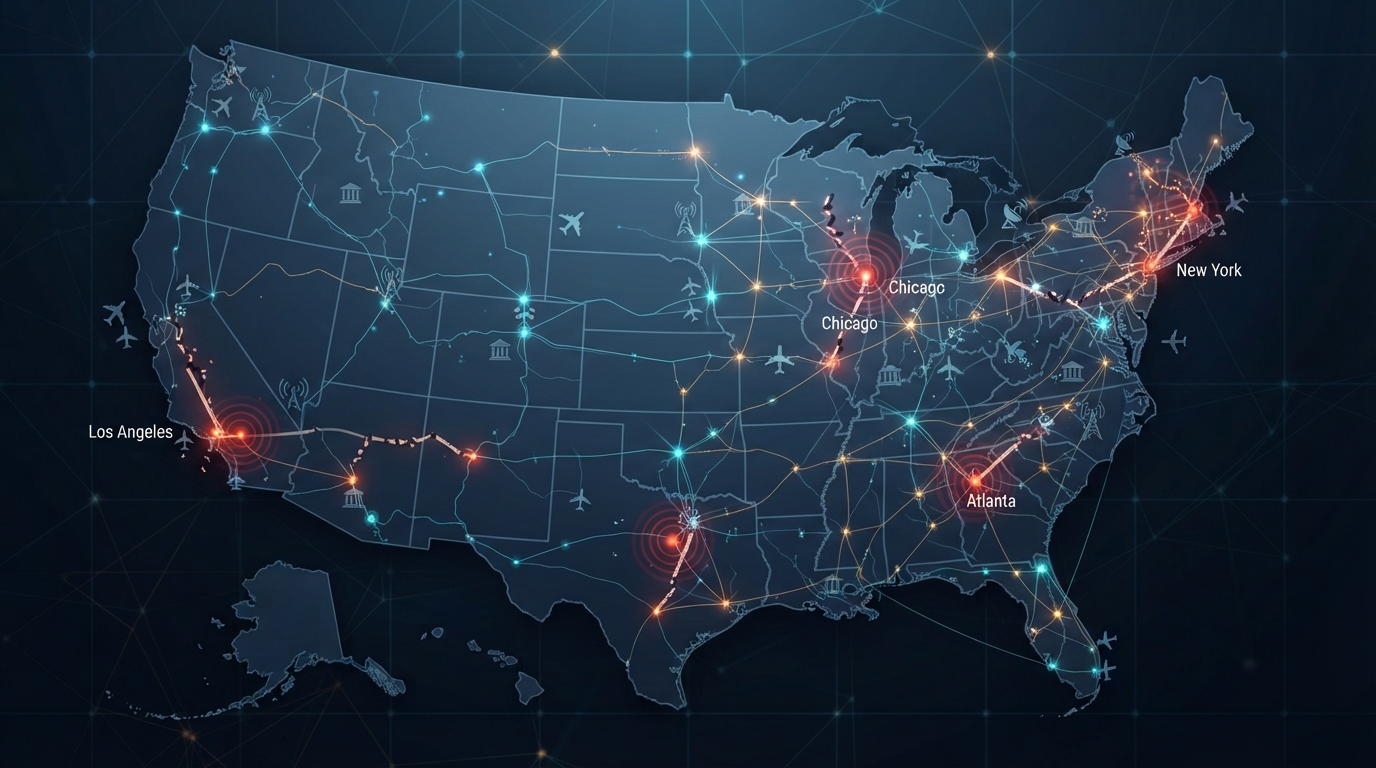
Over a six-day window between November 12 and November 17, 2026, a cascading series of high-impact technical failures rippled across U.S. public and private critical infrastructure, disrupting air travel, financial transactions, corporate productivity tools, and even classified national security operations, triggering widespread public unease and bipartisan congressional calls for greater transparency. The spate of outages kicked off on November 12, when a latent software flaw embedded in Microsoft’s networking gateway servers was inadvertently activated during routine traffic capacity adjustments, spurring a 48-hour multi-day disruption to the Microsoft 365 ecosystem that locked millions of users out of Outlook, Teams, and the Copilot AI productivity tool before engineers fully restored service on November 14. Just 24 hours after that partial resolution, on November 13, a cascading telecom failure tied to overloaded aging analog air traffic control hardware, ongoing copper-to-fiber cable upgrade work, and a misconfigured faulty router in Arkansas forced the U.S. Federal Aviation Administration to implement its first nationwide ground stop for all departing flights since January 2023, stranding passengers for more than four hours across the country. The wave of disruptions continued into the following week: on November 16, United Airlines suffered an isolated internal software error that crippled crew scheduling platforms and flight planning utilities, delaying over 400 domestic departures, while major U.S. financial institutions including JPMorgan Chase, Bank of America, and U.S. Bank reported widespread Zelle transaction processing lags traced to an internal on-premises hardware bug at JPMorgan, with Charles Schwab also resolving a brief public portal loading glitch later that same day. Even classified national security systems were not spared: on November 17, NSANet, the National Security Agency’s top-secret internal communications network, experienced significant service degradation during scheduled routine maintenance, prompting agency leadership to restrict on-campus access at facilities including Fort Meade, Maryland, and Fort Gordon, Georgia to only essential staff, and stagger employee arrival times to reduce remaining system strain. NSA officials clarified in a public statement that built-in redundant backup systems kept all mission-critical intelligence gathering and national defense capabilities fully operational, with Director of National Intelligence Jay Clayton confirming the outage stemmed from a recently deployed software patch intended to remediate previously discovered vulnerabilities, with no evidence of external malicious interference. Additional smaller-scale disruptions were documented across the same period, including temporary glitches affecting Apple’s iCloud and Apple Pay ecosystems, Marriott’s global hotel reservation platform, Workday’s widely used HR management systems, and routine maintenance portals operated by the National Weather Service. Cybersecurity researchers also flagged a separate incident where malicious code was injected into a widely used third-party management tool operated by Optimizely, a platform used by nearly 200 public and private organizations, though the vendor confirmed the vulnerability had been fully patched before widespread exploitation could occur. As viral social media rumors falsely linked a scheduled November 17 FEMA national emergency alert test to a coordinated nationwide cyber blackout, senior administration officials moved quickly to reassure the public in the lead-up to the high-traffic Thanksgiving holiday travel period. President Donald Trump dismissed the cluster of outages as routine, noting that all travel and banking systems had been fully restored to normal function, while Department of Homeland Security and State Department officials echoed statements that all confirmed incidents appeared to stem from unrelated technical errors rather than coordinated foreign cyber interference. On Capitol Hill, however, lawmakers from both political parties pushed for formal oversight, with House Minority Leader Hakeem Jeffries demanding the administration provide a full classified briefing to Congress to ensure full transparency for the American public, and Republican Senator James Lankford of Oklahoma arguing that the unprecedented consecutive wave of disruptions warranted a full, independent investigation. Independent cybersecurity and critical infrastructure analysts who reviewed the series of events confirmed there is no forensic evidence linking any of the outages to a coordinated malicious cyberattack, but emphasized the cluster of failures serves as a stark warning of deep systemic fragility across the U.S. digital backbone. Experts highlighted two interconnected root causes for the rising risk of such cascading disruptions: the growing phenomenon of “patching overload”, where rapid AI-powered discovery of previously unknown software vulnerabilities forces government agencies and tech firms to push out a higher volume of concurrent urgent updates than ever before, drastically raising the risk of human configuration error during deployment; and widespread over-reliance on decades-old legacy hardware for critical public services paired with excessive centralization of cloud and network services among a tiny handful of dominant providers, meaning even a minor isolated technical glitch can rapidly escalate into nationwide service bottlenecks. Analysts noted the events underscore the urgent need for targeted investment in modernized infrastructure, expanded cross-system redundancy, and more standardized maintenance protocols to prevent future cascading failures that could disrupt core national services.
From Flights to Classified Networks: What’s behind the recent U.S. communication outages