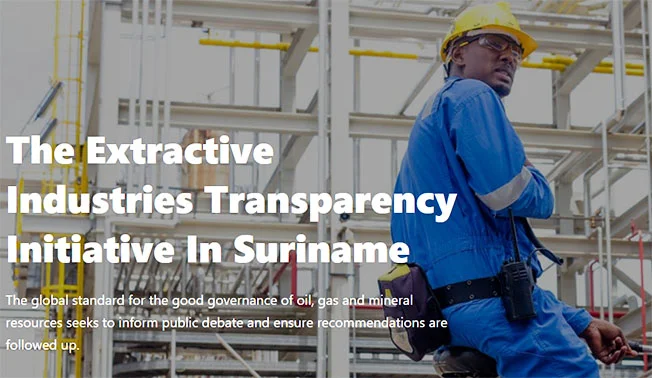
Official data from the 2023-2024 biennial report published by Extractive Industries Transparency Initiative Suriname (EITI-SR) on December 24, 2025, reveals that Suriname’s government earnings from the oil, gas, and mining sectors have skyrocketed from SRD 5.6 billion in 2021 to SRD 13.3 billion in 2024, marking a 137% cumulative increase over the three-year period. The report, which EITI-SR re-highlighted for public stakeholders on a recent Monday, records that public sector receipts from extractive activities hit SRD 12.6 billion in 2023, rising a further 5.5% to SRD 13.3 billion the following year, with royalties (SRD 3.8 billion) and dividend payouts (SRD 3.7 billion) emerging as the two largest revenue streams for the state in 2024.
Parallel to this revenue growth, the extractive sector’s contribution to Suriname’s gross domestic product climbed from 4.35% in 2023 to 4.83% in 2024, even as national gold output saw a year-over-year decline: combined production from large-scale artisanal and small-to-medium mining operators dropped from 30,108 kilograms in 2023 to 27,642 kilograms in 2024, while national crude oil production held steady above 6 million barrels across both reporting years.
Despite the robust top-line revenue gains, EITI-SR’s audit identified systemic shortcomings in data tracking and public disclosure across the high-value sector, prompting the multi-stakeholder body to issue 17 targeted recommendations to strengthen accountability and full visibility of natural resource financial flows. Key identified gaps include the absence of a public, accessible mining cadaster, incomplete public disclosure of all extractive contracts and operating permits, delayed and unaligned audits of national public accounts, and low participation rates among gold export firms in standardized EITI reporting frameworks. To date, only two gold exporters have signed formal cooperation agreements with EITI-SR to submit required transparency disclosures. Oversight of the full implementation of the 17 recommendations falls to the national Multi-Stakeholder Group (MSG), which includes equal representation from government agencies, private extractive industry operators, and civil society organizations.
Suriname has already launched concrete action to address these gaps, most notably kicking off the vendor selection process in March 2026 under the World Bank-backed Suriname Competitiveness and Sector Diversification Project (SCSD) to build a centralized, secure Extractive Sector Revenue Registration System. This digital platform will enable regulated, encrypted submission and cross-verification of financial data from both private operators and government revenue agencies, eliminating data mismatches and drastically improving the reliability of public records on corporate payments to the state and corresponding government receipts. EITI-SR will lead independent cross-checking and public dissemination of the tracked financial flows, while the SCSD project provides technical and financial support for the system’s full development and deployment.
Significant institutional and global recognition milestones have also been achieved in 2026: the MSG has finalized a restructured, more inclusive membership, and Suriname’s Minister of Natural Resources David Abiamofo was elected as an alternate member of the global EITI International Board during the 2026 EITI Global Conference held in Brussels, where he will represent all Latin American and Caribbean nations for the 2026-2029 term. National EITI coordinator Novella Alcantra-Majana also received a formal honorable mention at the global conference for her outstanding work advancing transparency in Suriname’s natural resource governance.
EITI-SR has emphasized that full public transparency of extractive sector revenues is a public good that benefits all Surinamese citizens, and has issued a public call for ordinary residents, civil society groups, independent journalists, and private sector operators to actively monitor published sector data, participate in national public debates on natural resource governance, and hold relevant stakeholders accountable for delivering on the outlined transparency reforms.
Olie en mijnbouw leveren miljarden op, maar transparantie blijft aandachtspunt