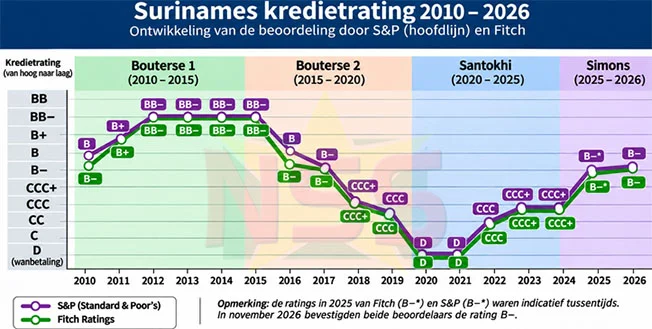
Over the 16-year window spanning 2010 to 2026, Suriname’s sovereign creditworthiness has undergone dramatic, policy-shaped shifts, moving from a low-debt, resource-fueled upward trajectory to a 2020 sovereign default, before staging a gradual recovery that has caught the attention of top global rating agencies. The nation’s volatile credit path has been shaped by a mix of volatile global commodity markets and the fiscal choices of successive administrations, culminating in a dual upgrade from S&P and Fitch in November 2025, when S&P lifted Suriname’s rating to B-, followed shortly after by Fitch assigning an indicative B- grade, with the improved outlook tied to ongoing debt management efforts and projected offshore oil production set to come online in 2028.
The 2010–2015 period opened with Suriname’s national public debt sitting at a modest 22% of GDP, buoyed by robust export earnings from gold, crude oil, and other high-value natural resources. Major global rating firms S&P and Fitch steadily lifted their assessments to BB- during this era, even as the International Monetary Fund (IMF) issued an early 2013 warning about unsustainably high public spending and dangerously thin fiscal reserve buffers. Under the first Bouterse administration, the economy remained overwhelmingly dependent on volatile commodity revenues, leaving government finances extremely exposed when global raw material prices began to slide, triggering immediate budgetary strain.
Conditions deteriorated sharply across the 2016–2019 term of the second Bouterse administration. Export revenues collapsed, the Surinamese dollar lost significant value against global currencies, and consumer prices spiraled, with annual inflation hitting a staggering 77% in 2016. The government initially signed a reform program agreement with the IMF, but later rolled back key austerity measures, leading the fund to conclude that the administration had failed to maintain its commitment to structural fiscal adjustments. S&P and Fitch responded with a series of repeated credit rating downgrades through this period.
The crisis hit its lowest point in 2020, when Suriname’s total public debt ballooned to 146% of GDP, pushing the nation into a sovereign default on selected foreign debt obligations. Both S&P and Fitch moved Suriname into their selective default classification in July 2020, months before the incoming Santokhi administration took office and inherited the crippling debt overhang. The new government immediately launched intensive negotiations with international creditors and the IMF, leading to the approval of a $688 million IMF support program in December 2021.
Between 2022 and 2025, the Santokhi administration implemented sweeping, often unpopular structural reforms: it negotiated large-scale debt restructuring, rolled back untargeted consumer subsidies, and introduced a value-added tax system. While these policies triggered widespread public discontent as cost of living levels rose sharply, they also steadily stabilized national finances: inflation dropped to manageable levels, and broader macroeconomic stability returned. S&P upgraded Suriname’s rating to CCC+ in December 2023, removing the country from the selective default category entirely. By March 2025, the IMF confirmed that nearly all core targets under the nation’s recovery program had been met, though the fund issued a cautionary note against any future relaxation of strict budget discipline.
The Simons administration took office in July 2025, and moved quickly to launch a new round of sovereign debt restructuring. In November 2025, Suriname raised $1.575 billion through a new international sovereign bond issuance, using a portion of the proceeds to repurchase outstanding high-cost legacy debt, and allocating the remaining funds to a dedicated reserve pool for future scheduled debt repayments. In January 2026, the government completed a buyback of controversial legacy claims held by foreign creditors that granted them rights to a share of Suriname’s future oil export revenues, followed by an additional $265 million supplementary bond issuance in February 2026, with a large share of those earmarked for priority social spending programs.
This multi-stage restructuring has delivered significant new fiscal breathing room for Suriname, and eliminated a series of onerous long-term future payment obligations, though it has also introduced new scheduled interest and principal repayment commitments. According to IMF calculations, the refinancing operations have pushed Suriname’s gross public debt back up to roughly 106% of GDP, with the fund emphasizing that new borrowing can never serve as a long-term substitute for prudent, sustainable fiscal policy. The ultimate net benefit of the restructuring will depend on total buyback costs, the level of new interest payment obligations, and the long-term market value of the oil-linked rights that the government has now reclaimed.
Beneath these headline financial shifts lies a decades-long story of competing political priorities, as successive governments have struggled to strike a sustainable balance between delivering on popular electoral promises to voters, managing limited national revenue streams, and upholding strict fiscal discipline. The two Bouterse administrations failed to translate repeated IMF warnings about rising spending and depleted reserves into durable, long-term structural reforms, while the Santokhi government’s aggressive recovery program delivered hard-won financial stability but imposed severe widespread social sacrifices. In the lead-up to 2025’s general elections, public spending surged sharply once more, erasing a portion of the hard-fought fiscal gains, per IMF assessments. The Simons administration’s debt refinancing and oil claim buyback strategy has unlocked new fiscal space, but also created new long-term payment liabilities: the IMF initially flagged insufficient budget oversight in the early months of the Simons term, but later acknowledged measurable improvements in government expenditure controls. This constant tension between popular political pressures and limited fiscal capacity runs as a throughline across all 16 years of Suriname’s credit journey: short-term policies that deliver temporary relief for voters often plant the seeds of future fiscal crisis, and sovereign debt obligations do not disappear when administrations change, forcing new leaders to inherit the consequences of prior policy choices while being held accountable for their own decisions. With the upcoming 2028 launch of offshore oil production set to bring a major new stream of export revenue, Suriname now has a historic opportunity to shore up its long-term financial position — but the critical challenge will be to avoid spending that future revenue upfront, and instead use the new funds to pay down remaining debt and build robust, long-term fiscal reserves. The core lesson of this 16-year period is not to assign credit or blame to individual administrations for shifts in the national credit rating, but to build the institutional capacity to maintain unwavering fiscal discipline even when short-term political pressure to deliver immediate voter benefits rises.