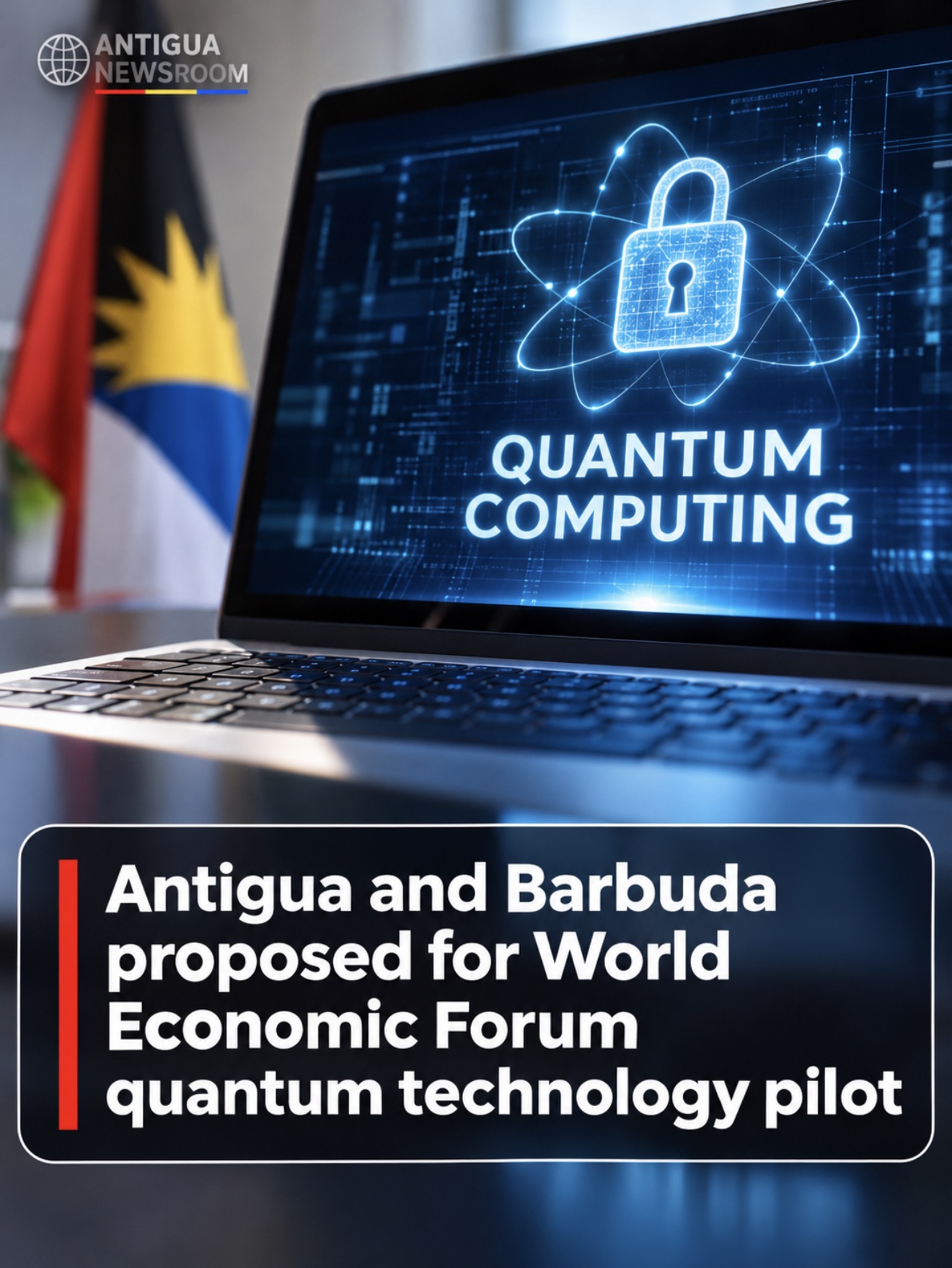
Antigua and Barbuda is on track to make history as the world’s first small island developing state to join a flagship World Economic Forum (WEF) programme focused on building national resilience against quantum computing-related risks, while laying the groundwork to integrate the transformative emerging technology into secure public and financial infrastructure. Under a new 2026 proposal outlined in an internal briefing document from Innovation Network Global, the twin-island Caribbean nation has been shortlisted as one of three new pilot locations for the WEF’s Quantum Economy Blueprint, joining Kenya and Ghana in the next phase of the global rollout, following Saudi Arabia’s successful inaugural pilot of the framework.
Drafted for review by Antigua and Barbuda’s Ministry of Information and Communication Technologies, the proposed 12-month structured programme is designed to address a dual set of realities presented by quantum innovation: the unprecedented computational power that will allow next-generation machines to solve complex, previously intractable problems far beyond the capabilities of conventional computers, and the profound cybersecurity risks posed by sufficiently advanced quantum systems that can crack the widely used encryption protocols that currently shield sensitive government, financial, and personal data.
The briefing underscores that the threat extends beyond future breaches of live systems: sensitive encrypted data collected and stored by government agencies, financial institutions, and public service providers today could be retroactively decrypted the moment high-powered quantum machines become widely accessible, putting banking transaction records, national digital identity databases, confidential government archives, and protected health information at severe risk.
If formally approved by Antigua and Barbuda’s government, the pilot will roll out a multi-stage workplan: first, conducting a full national quantum readiness audit to map existing capacities, gaps, and over-reliance on single technology vendors for critical digital infrastructure; second, convening a cross-sector working group of government agencies, local private tech firms, and global quantum industry partners to define national priority actions; third, developing a full national quantum resilience strategy to guide the migration of high-risk systems, including government payment rails, digital identity platforms, and protected health records, to quantum-proof encryption standards; and fourth, delivering specialized upskilling for 20 to 30 targeted government officials and local tech professionals to build in-country expertise on quantum governance and cybersecurity.
Participation in the pilot will also grant Antigua and Barbuda formal access to global standard-setting conversations, allowing its representatives to contribute to quantum technology and post-quantum encryption rulemaking at the International Telecommunication Union, as well as the joint International Organization for Standardization and International Electrotechnical Commission technical committees. At the conclusion of the 12-month pilot period, the WEF will publish aggregated findings and best practices drawn from the experiences of Antigua and Barbuda, Kenya, and Ghana to share with other national governments around the world.
The proposed initiative builds directly on Antigua and Barbuda’s 2026 National Artificial Intelligence Readiness Assessment, a landmark document developed in partnership with UNESCO and the International Telecommunication Union, extending the country’s existing work on emerging technology governance into the quantum domain. The move comes amid a global race among national governments to transition critical infrastructure to quantum-safe systems, with the European Union mandating full migration of all high-risk public systems to post-quantum encryption by 2030, and the United Kingdom and Canada rolling out their own structured transition timelines in recent years.
As of the publication of the November 2026 briefing, Antigua and Barbuda’s government has not yet issued a formal public acceptance of the pilot proposal, and the document does not disclose details on total programme costs, allocated funding streams, or an official proposed launch date. The initiative is jointly managed by the WEF’s dedicated quantum strategy team and Innovation Network Global, with the firm’s Chief Executive Officer Dr. May Siksik named as the primary point of contact for all related administrative and partnership inquiries.