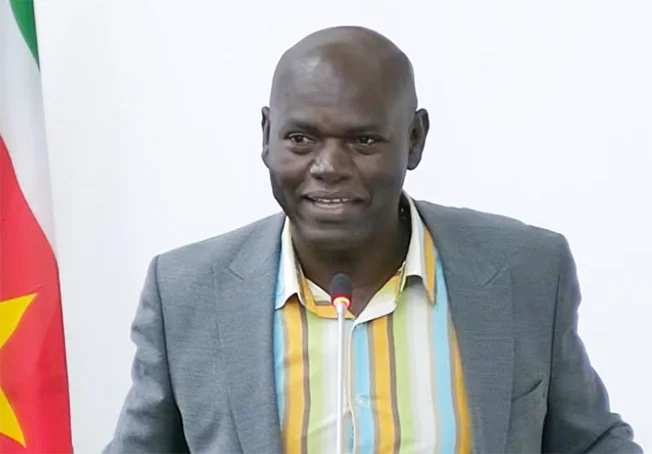
During a formal security interpellation session in Suriname’s National Assembly (DNA) on Friday, November 15, Ronny Asabina, leader of the Basic Party for Renewal and Emancipation (BEP) parliamentary caucus, delivered a stark critique of the administration’s current law enforcement strategy, arguing that rising national crime rates cannot be effectively curbed through expanded police and security service investments alone.
Asabina emphasized that public insecurity is not a disconnected, standalone phenomenon, but deeply intertwined with systemic poverty, structural social inequality, and the lopsided distribution of state public services across the South American nation. He highlighted that marginalized youth, children, and remote inland communities bear the brunt of this unequal resource allocation, often being locked out of basic opportunities that are taken for granted in more affluent urban neighborhoods.
Citing concrete gaps in access to education, Asabina noted that 9th-grade students in the Brokopondo district were only able to return to classrooms in November, even though the national academic calendar officially launched in October, leaving weeks of unplanned lost learning. He added that large cohorts of children in underserved urban neighborhoods remain out of school entirely, or are barred from accessing core subject coursework due to underfunded local education infrastructure. The lawmaker formally requested disaggregated, up-to-date official data on child poverty, broken down by urban zones, populated districts, and remote inland regions, to ensure vulnerable groups are not sidelined in national development policy. He also drew attention to communities facing encroachment on their residential lands, unresolved land tenure disputes, and contaminated drinking water sources, calling for expanded social protection and enforceable human rights safeguards for these populations.
Asabina further raised alarms over widespread public perceptions of class-based justice, noting that many Surinamese citizens believe high-profile, well-connected individuals regularly evade prosecution and legal consequences for their offenses. He demanded that the government prioritize not just violent street crime, but also financial and economic offenses including tax fraud, money laundering, public sector corruption, and breach of public trust. The legislator also pressed for details on existing national anti-human trafficking action plans, regulatory frameworks overseeing the prostitution sector, and dedicated safety protocols to protect local business operators and international tourists from criminal harm.
Turning to operational law enforcement reforms, Asabina questioned the government’s progress in reassigning security personnel currently deployed for exclusive protection of high-ranking public officials back to regular community policing duties. He also raised concerns over the slow rollout of offender resocialization programs and the underutilization of community service sentences, even after legislative reforms to expand their use had been passed. Asabina added that hiring discrimination against former detainees and marginalized groups further entrenches cycles of social exclusion that fuel recidivism.
In his closing remarks, the BEP caucus leader acknowledged that total elimination of crime is an unrealistic policy goal, but emphasized that sustained reductions in criminal activity and improved public safety can only be achieved by targeting the underlying socioeconomic drivers of insecurity. He called on the government to implement a far more equitable distribution of the national budget, to ensure public services, education access, and economic opportunities are spread evenly across all regions and demographic groups, rather than concentrated in privileged pockets of the country.
Asabina: Oneerlijke verdeling nationale middelen voedt criminaliteit