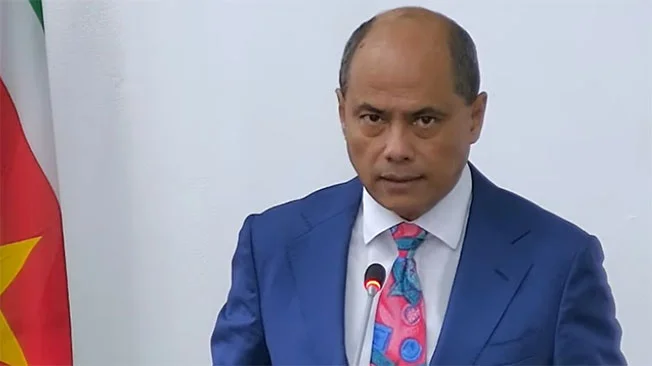
On November 15, during a formal safety interpellation session in Suriname’s National Assembly (De Nationale Assemblee, DNA), National Party of Suriname (NPS) faction leader Jerrel Pawiroredjo laid out a comprehensive critique of the government’s current law enforcement strategy, arguing that overreliance on stepped-up police patrols and stricter punitive measures will never deliver long-term reductions in the country’s surging violent crime rates.
Pawiroredjo opened his address by highlighting widespread public unrest triggered by recent waves of armed robberies and fatal robbery-related homicides, noting that communities across the capital Paramaribo, outlying districts, and remote interior regions all face growing risks of harm, and that the state bears an explicit legal and moral obligation to extend equal protection to every resident regardless of their geographic location. To fill critical information gaps that have hampered targeted safety action, he formally submitted a series of detailed queries to the ruling administration, including requests for full disclosure of any existing official national security framework, verified disaggregated crime statistics sorted by district and local administrative sub-region, and data on the scale of unreported offenses that have skewed official public safety records in recent years. He also pressed for a clear government roadmap to reinforce state authority in under-policed interior areas, and explicit definitions of the operational mandates assigned to national security agencies in those remote territories.
Turning to operational policing capacity, Pawiroredjo demanded transparent figures for the current staffing shortfall in frontline operational police units, alongside a concrete timeline for filling those vacancies to bring patrol and response teams up to full strength. He raised specific questions about the real-world effectiveness of the capital’s existing Safe City surveillance camera network in supporting criminal investigations and suspect apprehension, urging the government to conduct a formal audit of the system’s performance and consider expanding the camera network to cover major arterial highways and high-risk zones in outlying districts. Additional data requests included average police emergency response times, the current clearance rate for serious felonies, and the proportion of repeat offenders among people arrested for violent crimes. The NPS leader also pushed for far stricter enforcement of existing rules banning heavily tinted vehicle windows, pointing out that unmarked cars with opaque windows are regularly identified as the getaway vehicles used in armed robberies and other major violent offenses.
Most notably, Pawiroredjo emphasized that punitive enforcement alone is a short-sighted, unsustainable approach that fails to address the root structural drivers of rising criminal activity. “Repression will never be the full solution to our public safety crisis,” he told fellow assembly members. “It would be deeply irresponsible for the government to act as if more arrests and harsher sentences can solve this problem on their own.” He outlined how pervasive poverty, soaring high school dropout rates, systemic unequal access to economic opportunity, and a rapidly widening wealth gap between the country’s richest and poorest populations create the fertile social ground where violent crime takes root and spreads. To counter these drivers, he called on the government to redirect significant public investment toward broad-based social development programs that level opportunity for marginalized communities, and to implement sweeping reforms to the country’s prison resettlement system. Those reforms, he argued, should guarantee access to formal education, vocational skills training, and ongoing mentorship support for incarcerated people both during their sentences and for a sustained period after their release, to reduce recidivism rates and prevent former inmates from returning to criminal activity out of desperation. He also drew legislative attention to rising traffic-related crime that has claimed the lives of dozens of innocent bystanders in recent months, calling for targeted safety measures to address that often-overlooked public safety risk.
Pawiroredjo closed his address by requesting full details on the total additional public funding the government estimates it will need to fully strengthen national security agencies and roll out the full suite of required public safety and social intervention measures. He noted that building a more equitable, inclusive society is the only reliable foundation for long-term, sustainable public safety for all Surinamese residents, and announced that he would submit a full set of follow-up written questions to the cabinet within the coming week to secure formal, recorded responses to all his queries.
Pawiroredjo: Alleen harder optreden tegen criminaliteit is niet genoeg