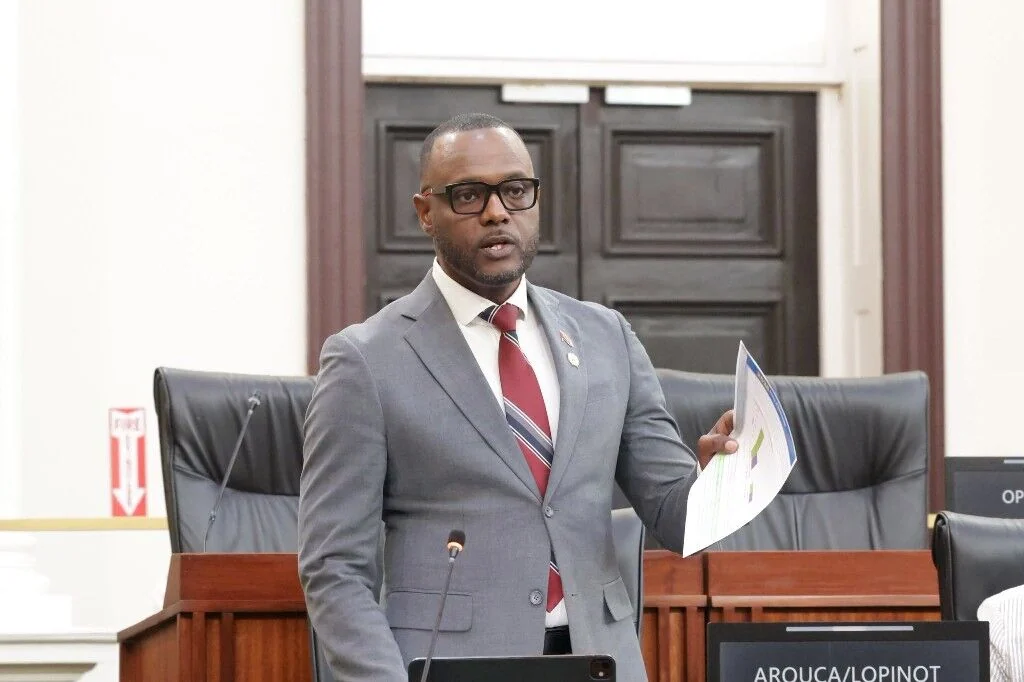
During a formal private motion debate on state-owned enterprise governance in Trinidad and Tobago’s House of Representatives yesterday, Opposition lawmaker Marvin Gonzales laid out explosive findings from a self-described independent investigation into state-controlled telecommunications giant Telecommunications Services of Trinidad and Tobago (TSTT), calling the revelations severe enough to shock the national public.
At the core of Gonzales’ demands is a full criminal investigation targeting former TSTT chief executive officer Keino Cox and every other individual implicated in a sprawling web of alleged corruption, mismanagement and procedural violations uncovered in the probe. He additionally called for the immediate suspension of sitting TSTT director Randy Ramtahal pending a full, independent review of his alleged role in a controversial $49 million sole-source contract awarded to local firm Hummingbird Holdings Ltd.
Gonzales traced the root of TSTT’s governance failures back to the Kamla Persad-Bissessar administration, accusing the prior government of blatant interference in the state firm’s leadership appointment process. He noted that shortly after the administration took office, then-serving TSTT head Kent Western was removed from his post, and Cox was installed as CEO with no public job advertisement, no competitive recruitment process and zero transparency around the hiring decision, a move he said the current government bears full institutional responsibility for. He demanded that the administration provide formal public responses to outstanding questions around fiduciary duty breaches, unaddressed conflicts of interest and systemic governance lapses tied to Cox’s tenure, which has already spawned active litigation: Cox is currently suing TSTT for millions of dollars in unspecified damages, while the state firm has filed a formal countersuit against its former leader.
Turning to procurement malpractice, Gonzales detailed that the $49 million contract awarded to Hummingbird Holdings was initially structured to go through a standard open public tender, before the entire competitive process was abruptly terminated and reworked as a no-bid sole-select arrangement that exclusively benefited Hummingbird. He called on sitting Public Utilities Minister Barry Padarath to launch a formal probe into Ramtahal’s exact involvement in the irregular procurement, and to remove Ramtahal and all other implicated TSTT leadership while the investigation is ongoing.
The Opposition MP also named seven additional local firms – Anga Pay Ltd, NK, Innova Tech, Nasek Technologies Ltd, Rex Kar Ltd, Hummingbird Holdings Ltd and Nimble Mobile – whose commercial transactions with TSTT he argued require full public scrutiny. Gonzales alleged that these entities have direct personal and business ties to former CEO Cox and local fintech firm WiPay, which he further claimed has documented links to key operatives involved in the United National Congress’ 2025 general election campaign.
Drawing directly from the independent investigation’s documented findings, Gonzales laid out specific evidence that Cox deliberately misled TSTT’s board of directors to advance his own agenda. In an August 3, 2026 internal memorandum, Cox selectively shared only the first page of the corporate secretary’s mandatory code of ethics declaration, omitting the critical second page entirely, the probe found. Cox had attempted to frame the corporate secretary as intentionally delaying a moneylender’s licence application, claiming her position as a director at the National Payment Company of Trinidad and Tobago created an unresolvable conflict of interest. But contemporaneous documentary evidence proved that all procurement red flags related to the planned Hummingbird partnership had been flagged long before the corporate secretary was ever assigned to review the licence application. The investigation formally concluded that Cox’s allegations against the corporate secretary were “materially and deliberately misleading” and entirely unsupported by existing records, a breach the probe’s authors described as particularly egregious given Cox’s position as the company’s top executive.
The independent review also flagged widespread irregularities in other TSTT commercial deals: the partnership with Nimble Mobile granted the firm highly preferential commercial terms and disproportionate revenue allocations with no formal documented business case and no binding minimum performance requirements to justify the concessions. A planned property lease agreement with Rex Kar committed TSTT to a large, long-term financial outlay even as core questions about the necessity of the space and its operational use remained entirely unresolved. Gonzales said these scattered irregularities point to far deeper, systemic gaps in internal commercial oversight and executive accountability across the entire state-owned telecommunications firm.
Expanding his probe demands beyond TSTT, Gonzales pressed Finance Minister Davendranath Tancoo to provide full public answers on a separate $4.4 billion contractual dispute involving WiPay and the National Payment and Innovation Company of Trinidad and Tobago. He questioned why the state payment entity signed a 10-year exclusive contract with WiPay covering the 2025 to 2035 period with no formal competitive procurement process whatsoever, noting that WiPay has now filed a $4.4 billion lawsuit against the state entity over a breach of the disputed agreement. The Ministry of Finance has already confirmed it will mount a full legal defence against the claim, citing clear irregularities in how the contract was originally awarded, and Gonzales alleged that the state payment company had no sitting board of directors in place at the time the 10-year agreement was signed.
Gonzales calls for criminal probe