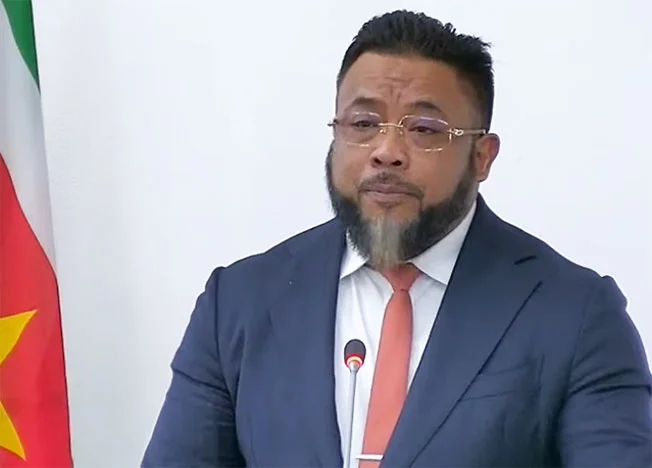
On November 14, local media in Suriname reported that during a Friday security interpellation session in the country’s National Assembly (DNA), Bronto Somohardjo, leader of the Progressive Labour (PL) parliamentary faction, submitted a series of urgent, unaddressed inquiries to the national government regarding two private jets recently intercepted at Johan Adolf Pengel International Airport. Somohardjo opened his line of questioning by referencing confidential, uncorroborated intelligence he had received that raised red flags about the passenger rosters, procedural handling, and partial release status of the two aircraft. First and foremost, the lawmaker pressed the administration to confirm whether authorities had verified if Jos Leijdekkers — a high-profile, internationally wanted drug trafficking suspect widely known by the nickname “Bolle Jos” — had been aboard either of the two detained planes. He explicitly framed the claim of Leijdekkers’ possible presence as unconfirmed, rather than a proven fact, and demanded full transparency on what related investigative steps had been completed and what findings had been yielded. Somohardjo further called on the government to release full, aircraft-specific details including each jet’s official registration records, exact arrival date, and current operational custody status. A core portion of his inquiry centered on the reported decision to release one of the two private jets while the other remains impounded. He sought to identify the official or body that authorized the release, the exact date the approval was issued, and the full set of investigative findings that formed the legal basis for the call. Citing unconfirmed reports that the national Prosecutor General had signed off on the release, Somohardjo asked for official confirmation of this claim, and to verify whether a formal directive or no-objection statement had been issued by the public prosecution office to support the move. The session’s presiding officer, NDP representative Rossellie Cotino, interrupted Somohardjo mid-testimony to note that the Prosecutor General was not present in the assembly to defend himself against potential unsubstantiated insinuations, and requested that the lawmaker rephrase his questions to avoid suggestive framing. Somohardjo complied by adjusting his wording, but maintained his demand for clarity: he asked whether the senior leadership of the Public Prosecution Service (OM) had been involved in the release decision, and what formal legal and factual justifications underpinned the ruling. He emphasized that his line of questioning was not intended to level personal accusations against any individual, but to clarify lines of accountability for the decision-making process and confirm that all required regulatory checks had been completed. Somohardjo also extended his probe to cross-border law enforcement coordination, asking whether Dutch public prosecution authorities had submitted formal information requests about the two intercepted jets to their Surinamese counterparts. He sought details on the exact date any such requests were received, whether a formal response had been issued, and which official was assigned to handle the correspondence, noting that unconfirmed tips reaching his office suggested the Dutch inquiries had so far gone unanswered. Additionally, he demanded that full passenger and crew manifests for both jets be audited for accuracy, and formally requested that these full documents be shared with the national parliament for review. The lawmaker also raised questions about deviations from standard airport ground handling protocols for the two aircraft, asking why the national flag carrier appeared to have handled the jets directly instead of routing the work through the dedicated, certified ground handling service provider that typically manages all private and commercial flights at the international airport. He called for a formal public explanation for the departure from standard operating procedure, and asked for a full investigation into whether any government or airport officials had secured improper financial benefits in connection with the handling or release of the jets, noting he did not hold concrete evidence of such misconduct at the time of the session but required official clarification to rule out the risk. Somohardjo framed the broader controversy as a critical test of Suriname’s border security capacity, national safety governance, and international credibility in global anti-organized crime partnerships. He warned that if internationally wanted criminal suspects had been permitted to transit through Suriname via the impounded jets, or if an aircraft linked to high-risk criminal activity had been improperly released despite active law enforcement alerts, the incident could severely erode the country’s reputation among global law enforcement allies. Beyond the private jet probe, Somohardjo used the assembly session to raise long-running concerns about the public prosecution office’s case clearance and prosecution policies. He argued that increased visible police patrols and hundreds of publicized arrests would do little to curb violent crime without full transparency on case outcomes for suspects, and requested granular data on all serious violent crime cases registered with the OM between 2023 and 2026, including the number of cases that moved to formal prosecution, the number that were fully dismissed, and the total backlog of unresolved pending cases. He further asked for a public outline of the objective, standardized criteria the prosecution service uses to decide whether to pursue formal charges or dismiss cases, and what oversight mechanisms are in place to ensure all suspects are treated equally regardless of their ethnic background, income level, or social standing. Somohardjo noted that a prior formal request he had submitted to the Prosecutor General for this exact prosecution policy data had been rejected, and stressed that Surinamese citizens deserved far more than publicized arrest announcements: they had a right to full transparency over how the national justice system operates. At the close of the session, the government confirmed it would provide formal written responses to all of Somohardjo’s submitted questions at a later unspecified date, and offered no immediate public clarity on the possible presence of Leijdekkers aboard the jets, the current custody status of both aircraft, or the full details of the contested release decision for one of the planes.
Somohardjo vraagt opheldering over privéjets en mogelijke aanwezigheid ‘Bolle Jos’