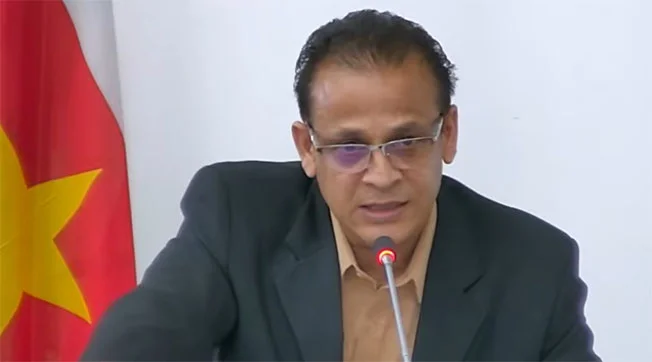
On November 14, Surinamese National Assembly representative Wedprekash Joeloemsingh of the ruling NDP party laid out a comprehensive case for and against the country’s planned accession to the Latin American and Caribbean Space Agency (ALCE) during parliamentary deliberations on the membership treaty. Joeloemsingh, a member of the rapporteur committee overseeing the review, opened his remarks by pointing to a recent high-profile law enforcement breakthrough: the discovery of an unregistered aircraft on a suspected illegal airstrip in the remote Tibiti interior, a operation that relied heavily on satellite imagery to locate the unmarked site. He emphasized that the successful operation was a tangible demonstration of how satellite surveillance capabilities could drastically boost national security efforts to crack down on illicit activities ranging from unauthorized airstrips to cross-border smuggling. Beyond domestic security, the lawmaker outlined a wide array of additional public benefits that ALCE membership could unlock for the small developing nation. He noted that enhanced access to regional satellite data would vastly improve extreme weather forecasting, pointing to severe thunderstorms that struck just days before the debate, damaging dozens of residential properties and destroying personal belongings. More precise early warning systems for high winds, extreme rainfall and flood events, he argued, would allow communities to prepare in advance and avoid catastrophic, unplanned losses. He also called for parallel policy discussions to expand natural disaster insurance coverage and formalize government support frameworks for post-disaster home reconstruction. Additional use cases Joeloemsingh outlined included satellite mapping of low-lying natural stormwater retention zones, to prevent unregulated residential partitioning of these critical areas that have been driving increased urban and rural flood frequency in recent years. The technology could also support large-scale national forest conservation efforts, track unauthorized deforestation, map under-documented natural resource reserves, and strengthen surveillance of Suriname’s expansive maritime territorial waters. He added that local institutions including the national meteorological service, the Ministry of Agriculture, Animal Husbandry and Fisheries, the National Institute for Professional and Technological Training (NATIN) and Anton de Kom University would all stand to gain access to shared space sector resources and technical support. Despite enumerating these far-reaching benefits, Joeloemsingh raised a series of targeted, unresolved concerns that he urged the national government to clarify before parliament moves to ratify the treaty. First, he flagged ambiguities in Article 10 of the text, which outlines special privileges and immunities granted to ALCE as an institution, its full-time staff and accredited regional representatives. He requested a full public breakdown of exactly what categories of immunity would apply on Surinamese territory, and a formal assessment of whether existing Surinamese domestic legal frameworks would require amendments to meet these obligations. He also called for explicit clarification on Article 11, which governs intellectual property protections and data confidentiality rules, noting that the treaty mandates some sensitive shared data remain classified for a minimum of 10 years even after the agreement is terminated, and asked the government to outline what new legislative safeguards would be required to enforce this data protection requirement. Finally, Joeloemsingh turned to the critical question of financial feasibility, referencing Article 8 of the treaty that requires all member states to pay regular assessed contributions under a yet-to-be-finalized cost-sharing formula. He noted that Suriname has a documented history of falling into arrears on membership fees for other international organizations, and pressed the government to disclose the exact projected annual cost of ALCE membership, to confirm that the expense is fiscally sustainable amid the country’s current economic conditions. He also requested full details on any included provisions for student training, technical skills transfer and joint research partnerships for Surinamese technicians, academics and youth, to ensure the membership delivers tangible long-term value to local communities rather than becoming an unproductive recurring fiscal burden.
Joeloemsingh: Satelliettechnologie kan helpen bij opsporing illegale activiteiten