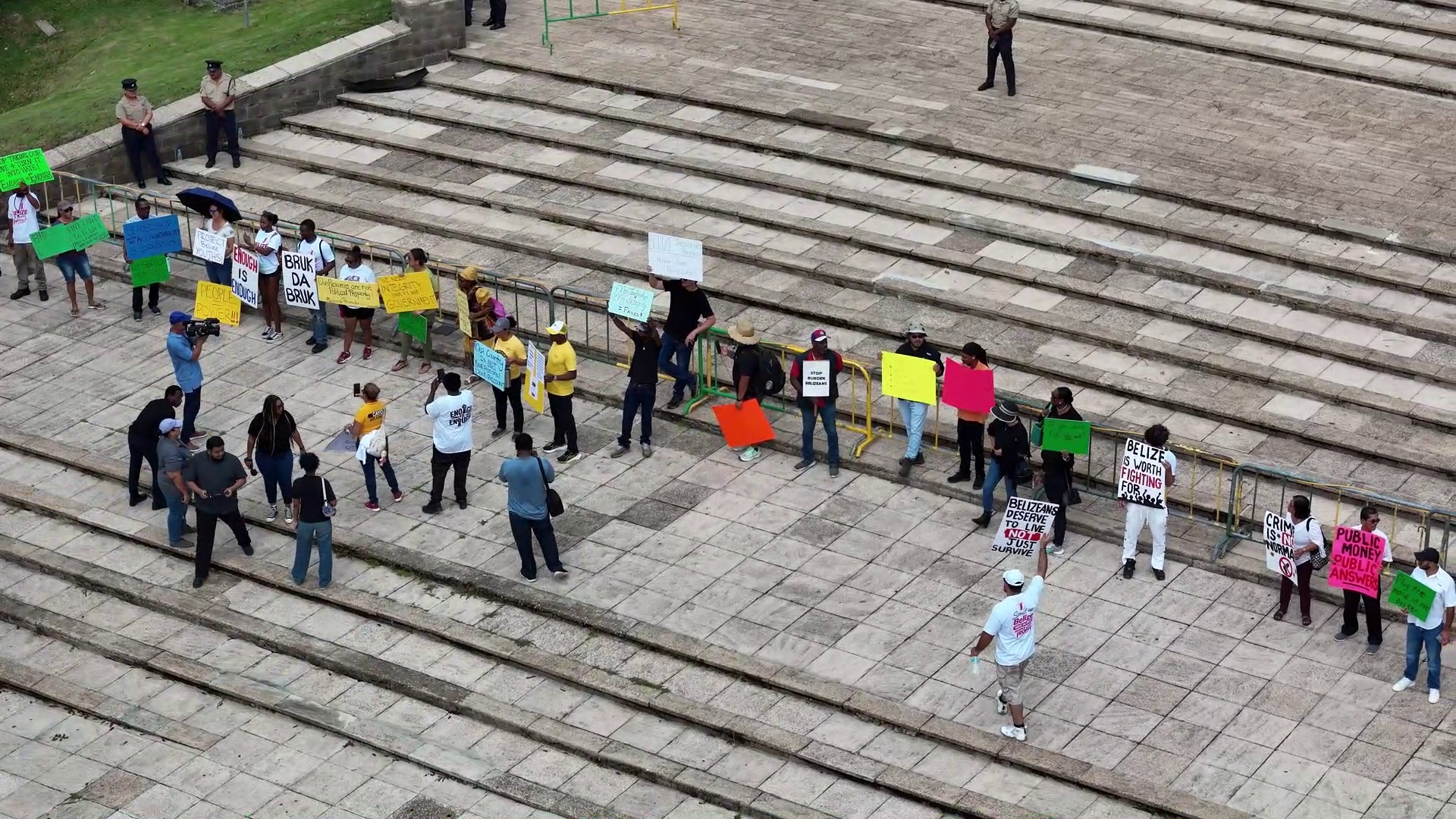
On November 13, 2026, hundreds of fed-up Belizean residents, including union members, public school teachers, and concerned ordinary citizens, assembled outside the National Assembly in Belmopan for the grassroots “Enough is Enough” protest, a demonstration sparked by the nation’s deepening cost-of-living crisis that has left many working people unable to stretch their monthly paychecks to cover basic expenses before their next payday.
The rally proceeded even though the House of Representatives had concluded its official session one day prior, a scheduling hiccup that organizers emphasized did nothing to erode participants’ determination. Attendees carried two core sets of demands: immediate tangible financial relief for cash-strapped working families, and concrete action on 11 long-stalled good-governance reforms that organized labor groups have advocated for over multiple years, after years of unfulfilled government pledges.
Marianne Ramclam, lead organizer of the demonstration, framed the action as a non-negotiable stand for national accountability and transparency. “We are showing up and standing firm for accountability, for transparency, and we are pushing forward against every barrier, because Belize matters. The people of this nation matter. Our children matter, and the future of our country matters,” she told assembled press.
The National Trade Union Congress of Belize (NTUCB) formally endorsed and joined the demonstration, as the national labor body continues sustained negotiations with the sitting administration over its 11 outstanding reform demands. NTUCB President Ella Waight noted that among the government’s latest set of proposals, the tentative plan to cut the current 25% personal income tax rate stands out as a promising step that could deliver direct financial support to struggling workers. Waight explained that the NTUCB had previously submitted an official recommendation to lower the 25% rate, though the union did not propose a 15% figure, and a finalized reduced rate would go a long way to helping workers cover mounting daily costs and household bills.
Ramclam emphasized that union representatives are not distant officials, but ordinary Belizeans themselves who face the exact same soaring household expenses as the general public, making their collective participation a powerful, unifying force for the campaign.
For public school educators, the financial strain spills far beyond their personal household budgets and directly impacts their work in classrooms, according to Nadya Martinez, a representative from the Belize National Teachers’ Union’s (BNTU) Belmopan branch. Martinez noted that teachers currently cannot access their pensions until age 60, a milestone many current educators fear they will not live to reach amid soaring living costs. She added that many teachers regularly spend hundreds, even thousands of dollars of their own money on classroom supplies each semester, and while the government has proposed a one-off $300 school supply allowance, the sum is far too meager to offset the nearly $1,000 she spent out of pocket on classroom materials in September alone.
The demonstration has also evolved beyond a cost-of-living advocacy event to become a wider reckoning over public trust in government. Leonora Flowers, President of the Christian Workers Union, pointed out that years of closed-door meetings with the prime minister and his cabinet have resulted in almost no progress on promised anti-corruption measures tied to the United Nations Convention against Corruption (UNCAC), a framework Belize signed on to years prior. Flowers, who has personally attended at least three high-level meetings with the prime minister on UNCAC implementation, stated that the cycle of empty promises must end immediately.
Organizers confirmed that while the peaceful protest outside the National Assembly has formally concluded, the broader advocacy campaign will continue indefinitely. Attendees made clear to government officials that vague, unfulfilled pledges will no longer be accepted, and that sustained, tangible action on both cost-of-living relief and long-delayed governance reforms will be required to meet their demands.
Paychecks Shrink as Cost-of-Living Pressure Grows