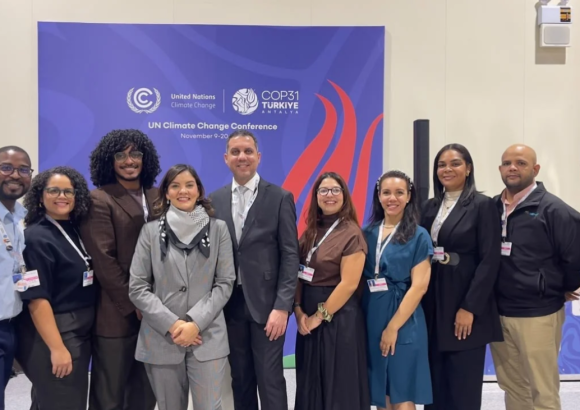
Antalya, Türkiye – As global climate leaders gather for the 31st UN Conference of the Parties (COP31) to advance collective climate action, the Dominican Republic has laid out a focused, action-driven agenda centered on translating longstanding international climate pledges into tangible financing, technical assistance, and on-the-ground results for the world’s most climate-vulnerable nations, with a particular emphasis on small island developing states (SIDS).
Heading the national delegation is a two-tiered leadership team comprised of Paíno Henríquez, Minister of Environment and Natural Resources, and Ana Emilia Pimentel, Vice Minister of Climate Change and Sustainability. Over the course of the two-week summit, the team will engage in high-stakes formal negotiations, cross-border ministerial roundtables, regional alignment sessions, and targeted bilateral dialogues with multilateral agencies, donor nations, and international climate partners.
A longstanding active member of the Alliance of Small Island States (AOSIS), the Dominican Republic is positioned to amplify unified regional priorities that represent the shared interests of nations facing disproportionate, life-threatening exposure to extreme weather events, sea-level rise, and climate-driven economic disruption. The delegation’s top policy priority at COP31 is securing formal agreement on a structured, actionable roadmap to deliver on the global commitment to triple global climate adaptation financing by 2035. This framework will include a standardized, agreed baseline for current adaptation funding flows, a clear phased implementation trajectory to hit the 2035 target, and independent, transparent monitoring mechanisms to track progress and hold high-emitting nations accountable for their commitments.
Beyond the adaptation finance roadmap, the Dominican negotiating team will push for sweeping regulatory reforms to remove systemic barriers that currently block SIDS from accessing critical financial resources, technical expertise, and green technology required to design, fund, and execute robust national adaptation plans. A core additional priority is the establishment of a dedicated international technical task force, mandated to develop harmonized, context-appropriate methodologies to measure tangible progress in national climate adaptation efforts, with a full set of draft frameworks scheduled for release ahead of COP32.
The delegation will also advance formal positions across a full spectrum of interconnected climate priority areas: scaled and accessible climate finance for loss and damage, ambitious near-term greenhouse gas mitigation targets, gender-inclusive climate policy design, targeted capacity building for under-resourced national climate agencies, climate-resilient agricultural systems to protect regional food security, transparent and equitable global carbon market rules, and streamlined cross-border green technology transfer protocols. To advance nature-positive climate solutions, the Dominican Republic will also lead targeted advocacy for expanded international cooperation on ecosystem-based adaptation models, sustainable tropical forest management frameworks, community-led resilience programming, and inclusive, equitable implementation opportunities under Article 6 of the Paris Agreement, which governs international carbon market collaboration.
Overall, the Dominican Republic’s COP31 participation is structured to accelerate full, equitable implementation of the Paris Agreement, while centering the unmet needs of vulnerable nations to ensure global climate action does not leave high-risk, low-emitting communities behind. For ongoing in-depth local coverage of the Dominican Republic’s COP31 negotiations, readers can visit DominicanScope.