A recent series of unfolding events in Suriname’s political landscape has cast a harsh spotlight on alleged systemic misuse of state power to shield partisan allies, centered on the ongoing controversy surrounding Harish Monorath, the country’s Minister of Justice and Security. The imbroglio traces its roots to operations at the Telecommunicatie Autoriteit Suriname (TAS), the national telecommunications regulatory body, laying bare a stark conflict between partisan political loyalty and the fundamental principles of transparent, legally compliant public governance.
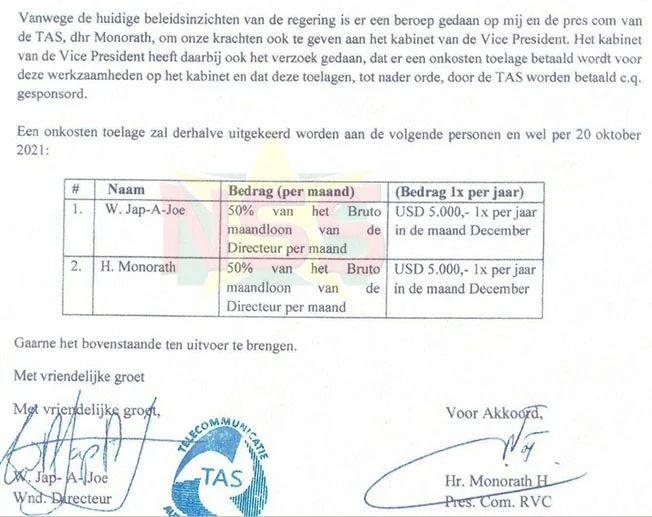
At the heart of the controversy are three senior figures affiliated with the ABOP political party: former vice president and current ABOP party leader Ronnie Brunswijk, ex-TAS director Wendy Jap-A-Joe, and Monorath himself, who previously served as TAS’s chief supervisory commissioner. Verified documents, including records voluntarily submitted by the ABOP party itself, outline a highly unusual operational arrangement that bypassed standard administrative protocols. When Brunswijk held the vice presidency, he formally wrote to then-TAS director Jap-A-Joe, requesting that Monorath, in his capacity as TAS supervisory commissioner, be seconded to serve on the vice president’s personal staff. Following this request, Jap-A-Joe, Monorath, and other TAS staff carried out duties for the vice president’s office, with substantial salaries, stipends, and supplementary benefits pre-arranged for this off-book work.
Investigative records confirm a circular, unregulated salary-setting scheme among the three ABOP affiliates: Monorath unilaterally determined Jap-A-Joe’s compensation not only for her official TAS role, but also for the part-time work she performed for Brunswijk’s vice presidential office. In turn, Jap-A-Joe set Monorath’s pay for the duties he carried out for the same vice presidential team at Brunswijk’s behest. Nearly all available documentation, including materials recently released by Brunswijk and Monorath, indicates that established public governance procedures were deliberately sidelined, with unaccountable political authority effectively replacing formal legal mandates for administrative oversight.
Critics emphasize that Monorath, a trained lawyer, former head of Suriname’s Bar Association, is uniquely positioned to distinguish between partisan political directives and legally defined official powers. The role of TAS’s chief supervisory commissioner, they note, carries independent statutory oversight responsibilities for the telecom regulator, and does not equate to being a personal staff member of the vice president – a status that cannot be nullified by a simple letter from a senior political figure or a presidential administrative resolution. The current sitting board of commissioners at TAS has already submitted a formal request to Suriname’s top public prosecutor to launch a full criminal investigation into the conduct of Monorath and Jap-A-Joe, a step that does not presume guilt on their part but underscores the gravity of the alleged procedural breaches, which cannot be dismissed as trivial administrative errors.
The official defense mounted by ABOP representatives has drawn widespread public criticism for its apparent disregard for constitutional governance norms. National assembly member Geneviévre Jordan has publicly justified Monorath’s continued tenure as justice minister and Jap-A-Joe’s prior leadership at TAS by citing informal political agreements struck between Brunswijk and current Surinamese president Jennifer Simons. This line of reasoning, analysts argue, demonstrates a shocking lack of understanding of the separation between partisan political pacts and formal legal jurisdiction, as no elected public official should operate under the assumption that coalition governance agreements act as a blanket exemption from adhering to national laws.
Brunswijk’s own public defense has done little to defuse the controversy: he has claimed all the contested actions by Monorath were carried out in compliance with a formal resolution issued by former Surinamese president Chandrikapersad Santokhi, framing the presidential signature as automatic legal validation for every subsequent administrative step taken. This casual framing of raw political authority as a legitimate legal justification, observers note, is deeply troubling, as all presidential resolutions are legally required to operate within the bounds of existing national legislation, no political directive can arbitrarily override the statutory powers of independent public institutions, and no party leader is authorized to negotiate away the legal accountability of public officeholders.
While President Simons, following a consultation meeting with Monorath that Brunswijk also attended, has publicly stated that Monorath’s position as justice minister is no longer tenable and that he must submit his voluntary resignation, critics have questioned why the president has not taken decisive formal administrative action to remove him from post, with many pointing to the high political sensitivity surrounding ABOP’s role in the ruling coalition as a likely factor behind the hesitation.
For his part, Monorath maintains that he acted in good faith and in full compliance with rules throughout his tenure both at TAS and as justice minister, pointing to documented policy successes under his leadership and framing the ongoing public scrutiny as a politically motivated smear campaign. Even if his policy achievements are acknowledged, however, they do not negate the fundamental requirement that a sitting justice minister – of all public officials – must operate completely beyond any reasonable doubt of his commitment to upholding legal boundaries and respecting formal statutory authority. The ABOP party retains every right to defend its members, but partisan loyalty carries no weight as a legal defense, and backroom political agreements can never serve as proof of compliant public administration.
The past week of developments has laid bare just how deeply personal interests, partisan party politics, and formal public governance have become intertwined in Suriname’s administrative system. The moment has arrived for all involved stakeholders to clearly recognize the non-negotiable line between political patronage and the rule of law: a political agreement may elevate an individual to a cabinet post, but no such arrangement can place any public official above the requirements of national legislation.