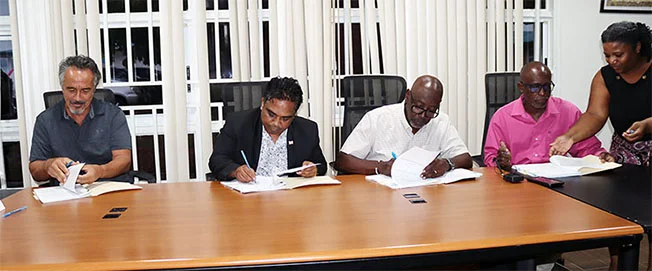
On the afternoon of Wednesday, November 12, Suriname’s Minister of Agriculture, Livestock and Fisheries Mike Noersalim formally signed a landmark construction agreement for a new national plant health laboratory, a project valued at approximately SRD 82 million (equivalent to USD 2.1 million).
Funded entirely by the Inter-American Development Bank (IDB), the agreement was co-signed by Michael Dalton, the country representative for the Inter-American Institute for Cooperation on Agriculture (IICA, acting on behalf of IDB), and Patrick Dundas, director of the awarded contractor Dundas Bouwbedrijf N.V., which will oversee full design and construction of the core laboratory facility and all supporting auxiliary infrastructure.
The new specialized facility is purpose-built to drastically upgrade Suriname’s national capacity to rapidly identify, diagnose, and monitor invasive crop diseases and pest infestations, addressing longstanding gaps in the country’s agricultural biosecurity framework. It will deliver far higher standards of accuracy, reliability, and quality for all plant health diagnostic services administered by the Ministry of Agriculture, Livestock and Fisheries (LVV).
Minister Noersalim framed the initiative as a major milestone for Suriname’s agricultural sector, noting it runs parallel to the nearly completed pesticide residue testing laboratory that is scheduled to launch operations in the near future. The two facilities serve distinct, complementary functions: the upcoming residue lab will focus on detecting traces of pesticides and chemical contaminants in harvested crops, while the new plant health lab will specialize in early detection and in-depth analysis of pathogens and pest species that damage growing crops.
“Healthy crops directly drive higher yields. If we can quickly identify exactly what disease or pest is threatening our fields, we can roll out targeted, responsible mitigation strategies that protect harvests,” Noersalim explained. “This not only ensures we have a steady supply of affordable, nutritious food for our entire domestic population, but also creates new economic opportunities for local agricultural producers looking to enter international export markets.”
The new lab directly addresses a longstanding barrier for Suriname’s agricultural exports: in previous years, multiple shipments of Surinamese crops were rejected at foreign border checkpoints after inspectors detected non-native insect species, triggering phytosanitary bans. Trading partners enforce these strict rules to prevent foreign pests and pathogens from invading and destroying their own domestic agricultural ecosystems. Noersalim emphasized that the new diagnostic capacity will eliminate these avoidable rejections, by giving Suriname full ability to verify that all exported crops meet global phytosanitary standards before they leave the country. “A certified, pest-free product gives us guaranteed, long-term access to overseas markets, which brings critical extra revenue to our farming communities and national economy,” he added.
LVV investeert ruim SRD 82 miljoen in laboratorium voor plantgezondheid