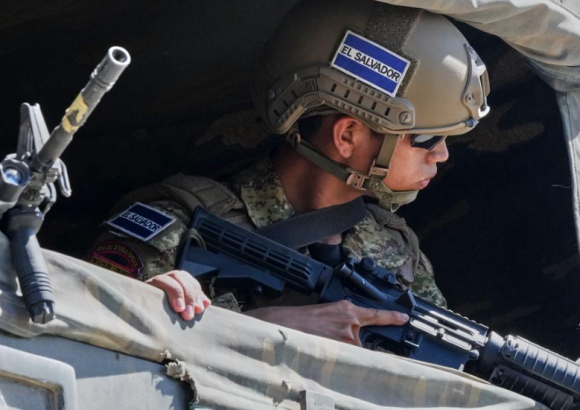
A sweeping military intervention launched by El Salvador in Haiti has come under intensifying global international oversight, as President Nayib Bukele attempts to frame his administration as a uniquely capable actor equipped to dismantle the Caribbean nation’s spiraling gang control. The cross-border security campaign was first initiated in mid-October, triggered by the disappearance of four Salvadoran aviation technicians assigned to a UN-backed support mission in the aftermath of a violent gang assault. Since that incident, El Salvador has dispatched roughly 2,500 military personnel, including elite units with proven track records in domestic anti-gang operations targeting high-risk criminal strongholds.
Bukele and his loyalist supporters have circulated curated video footage across social media platforms showing Salvadoran ground troops and armored military convoys patrolling Haitian territories, framing the entire deployment as a selfless humanitarian mission designed to help the beleaguered Haitian state restore full sovereign control over its territory. Independent political and security analysts, however, argue that the high-profile operation serves a dual purpose, functioning as a carefully calibrated public relations push to burnish Bukele’s domestic political profile in the lead-up to El Salvador’s upcoming February general elections.
Prominent Salvadoran political strategist Roberto Dubón has openly characterized the government’s surrounding communication blitz as a deliberate attempt to cast Bukele as a larger-than-life “superhero” figure, adding that Haiti effectively functions as a real-world testing ground to trial the controversial hardline security policies that Bukele first rolled out at home for potential future export to other regional partners.
The unannounced deployment has sparked widespread alarm from human rights organizations and global governance watchdogs, with critics flagging severe gaps in operational transparency, unaddressed risks of human rights abuses, and the very real prospect of a protracted, open-ended military quagmire in Haiti’s ungoverned territories. Amnesty International has issued a formal public demand for both the Salvadoran and Haitian governments to fully release the text of any official bilateral agreement that authorizes the foreign troop deployment, and to put enforceable safeguards in place to guarantee all military activities strictly adhere to international humanitarian and human rights law.
Global and regional powers have taken sharply divergent stances on the unprecedented intervention. U.S. Secretary of State Marco Rubio has explicitly distanced the Biden administration from the operation, issuing a public statement clarifying that Washington is not participating in or actively backing the Salvadoran military mission. By contrast, Dominican Republic President Luis Abinader has voiced full public support for Bukele’s initiative, confirming that his administration is supplying critical logistical back-up and real-time intelligence sharing to support the Salvadoran troops on the ground.
Leading regional security experts have issued stark warnings that Haiti’s uniquely volatile security landscape — defined by heavily armed, well-organized criminal gangs and near-total collapse of formal state institutional capacity — makes it virtually impossible to directly replicate the mass gang crackdown model that Bukele implemented across El Salvador. Analysts further caution that large-scale foreign military raids could galvanize far more coordinated, violent pushback from Haiti’s criminal networks, and risk dragging the region into a costly, years-long prolonged conflict with no clear exit strategy.