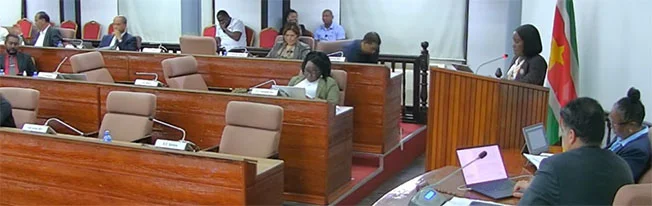
On November 12, lawmakers in Suriname’s National Assembly advanced targeted amendments to the draft Financial Inclusion Act during parliamentary deliberations, addressing longstanding gaps that leave large swathes of the country’s inland population locked out of formal financial systems. Committee chair Silvana Afonsoewa, representing the National Democratic Party (NDP), emphasized that the core intent of the pending legislation is to extend formal financial access to every citizen, but the current draft fails to account for the harsh realities of inland communities: vast swathes of the interior lack physical bank branches, and internet connectivity is spotty, unreliable, or entirely non-existent, rendering popular modern mobile banking apps and online payment tools completely unusable for thousands of residents.
Afonsoewa tabled formal proposals to embed provisions in the law that explicitly authorize SMS and USSD-based payment infrastructure, a low-tech framework that enables full basic financial transactions via even the most basic non-smart mobile phones, with no internet connection required. She also called for formal legal recognition of local, trusted community intermediaries who can act as physical cash-in/cash-out points for residents to deposit and withdraw funds without traveling hundreds of kilometers to the nearest bank branch. To ensure accountability, Afonsoewa mandated that all future official evaluations of the Financial Inclusion Act include a standalone, public report tracking access metrics exclusively for inland regional populations, to prevent remote communities from being sidelined in implementation rollouts.
Fellow committee member Asis Gajadien of the Progressive Reform Party (VHP) pushed for parallel, large-scale investment in national digital identification infrastructure, noting that past Surinamese government plans to link digital national ID cards to formal banking services were never fully executed, leaving marginalized groups disproportionately disadvantaged. Gajadien cited India’s widely successful Aadhaar biometric ID and unified mobile payment ecosystem as a proven global model that has drastically cut barriers to financial access for hundreds of millions of low-income and remote residents. He urged the administration to launch a coordinated cross-stakeholder modernization initiative that brings commercial banks, telecommunications providers, and state regulatory agencies into a single aligned framework to upgrade national payment systems, rather than pursuing fragmented, uncoordinated policy changes.
Third committee member Ingrid Bouterse-Waldring echoed the cross-party concern for vulnerable groups, stressing that the shift to digital financial services must never create new exclusionary barriers for citizens who do not own smartphones, lack consistent internet access, or have no formal steady income stream. All three parliamentarians demanded that the federal government publish a clear, actionable public roadmap outlining how equitable financial access will be delivered across every Surinamese district, alongside a formal guarantee that non-digital and offline alternative services will remain permanently available for populations that cannot use online banking platforms. Parliamentary deliberations on the full draft Financial Inclusion Act are scheduled to resume the day following the initial debate session.
Afonsoewa en Gajadien willen bankieren zonder internet mogelijk maken