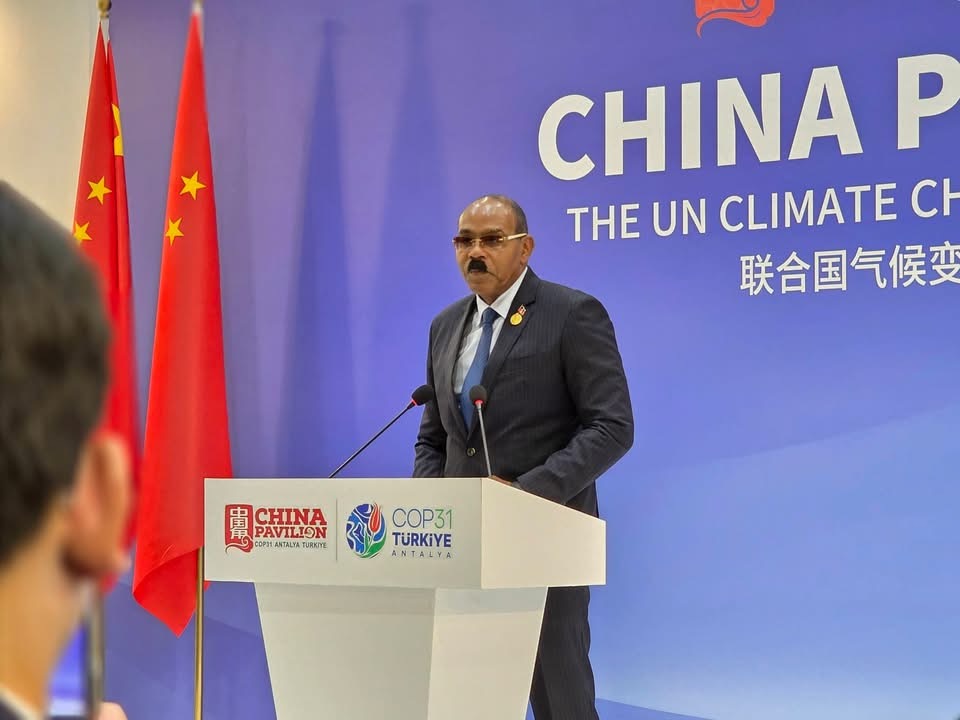
During a high-profile side event at the 31st UN Climate Change Conference (COP31) hosted in Türkiye, Antigua and Barbuda’s Prime Minister the Honourable Gaston Browne publicly restated his nation’s unwavering, decades-long diplomatic and development alliance with the People’s Republic of China, marking a key milestone in advancing collective climate action for vulnerable Global South nations. The High-Level Forum on South-South Cooperation on Climate Change, themed “Taking Action Together: Building a Low-Carbon and Climate-Resilient Global South,” served as the platform for Browne’s official remarks, where he also held a bilateral meeting with Chinese Vice President Han Zheng to align on future collaborative priorities between the two sovereign states. Browne traced the roots of the bilateral partnership back more than 40 years, noting that the diplomatic ties are anchored in non-interference, mutual respect, unshakable solidarity, and a shared vision of inclusive, people-centered sustainable development. He framed the Antigua and Barbuda-China alliance as a gold standard model of effective South-South collaboration, pointing to tangible cross-sector contributions that have lifted local livelihoods across the twin-island nation, spanning large-scale infrastructure upgrades, renewable energy rollouts, digital technology access, expanded educational programming, and enhanced public healthcare capacity. The prime minister called out specific high-impact Chinese-supported initiatives that have directly boosted national resilience: nationwide street lighting installations paired with solar photovoltaic backup power systems, climate-adaptive agricultural programs designed to shore up long-term food security, and targeted technical training schemes that upskill local workforces to manage and maintain critical green infrastructure. As a vivid, recently completed proof of concept of this collaborative impact, Browne highlighted the newly inaugurated Pelican Court Housing Development in Booby Alley, a 150-unit residential complex built to strict climate-resilient building codes entirely with Chinese development support. “Pelican Court is not just a housing project – it is adaptation in action, a living example of how South-South cooperation turns national development priorities into tangible investments that shield families from extreme weather events and make our communities stronger for generations,” Browne told assembled global delegates. Shifting focus to the systemic crises facing Small Island Developing States (SIDS), which bear a disproportionate brunt of climate change despite contributing less than 1% of global historical greenhouse gas emissions, Browne called for scaled-up cross-Global South collaboration on renewable energy deployment, flood and storm-proof public infrastructure, regenerative sustainable farming, and barrier-free green technology transfer to low-income nations. He emphasized that South-South knowledge sharing, targeted green investment, and practical localized solutions are critical to accelerating global climate progress, but stressed that such south-south efforts can never replace or excuse developed nations from fulfilling their long-overdue climate finance obligations outlined under the Paris Agreement. As worsening extreme weather events increasingly erode critical public infrastructure, disrupt local livelihoods, and threaten the long-term economic stability of small island states across the Caribbean and Pacific, Browne issued a call to the global community to move beyond symbolic climate pledges and turn international commitments into measurable, on-the-ground action. He closed his address by reaffirming Antigua and Barbuda’s deep gratitude for its decades-long partnership with China, and restated his administration’s full commitment to advancing shared goals for universal sustainable development and cross-border climate resilience. “At the end of the day, the true measure of success for any international cooperation agreement is the tangible, positive difference it makes in the daily lives of ordinary people,” Browne declared. The high-level engagement underscores Antigua and Barbuda’s ongoing diplomatic priority of building inclusive, equitable global climate governance frameworks that center the needs of developing nations that have been disproportionately harmed by the climate crisis.
PM Browne Praises China’s Support for Housing and Development in Antigua and Barbuda at Climate Summit