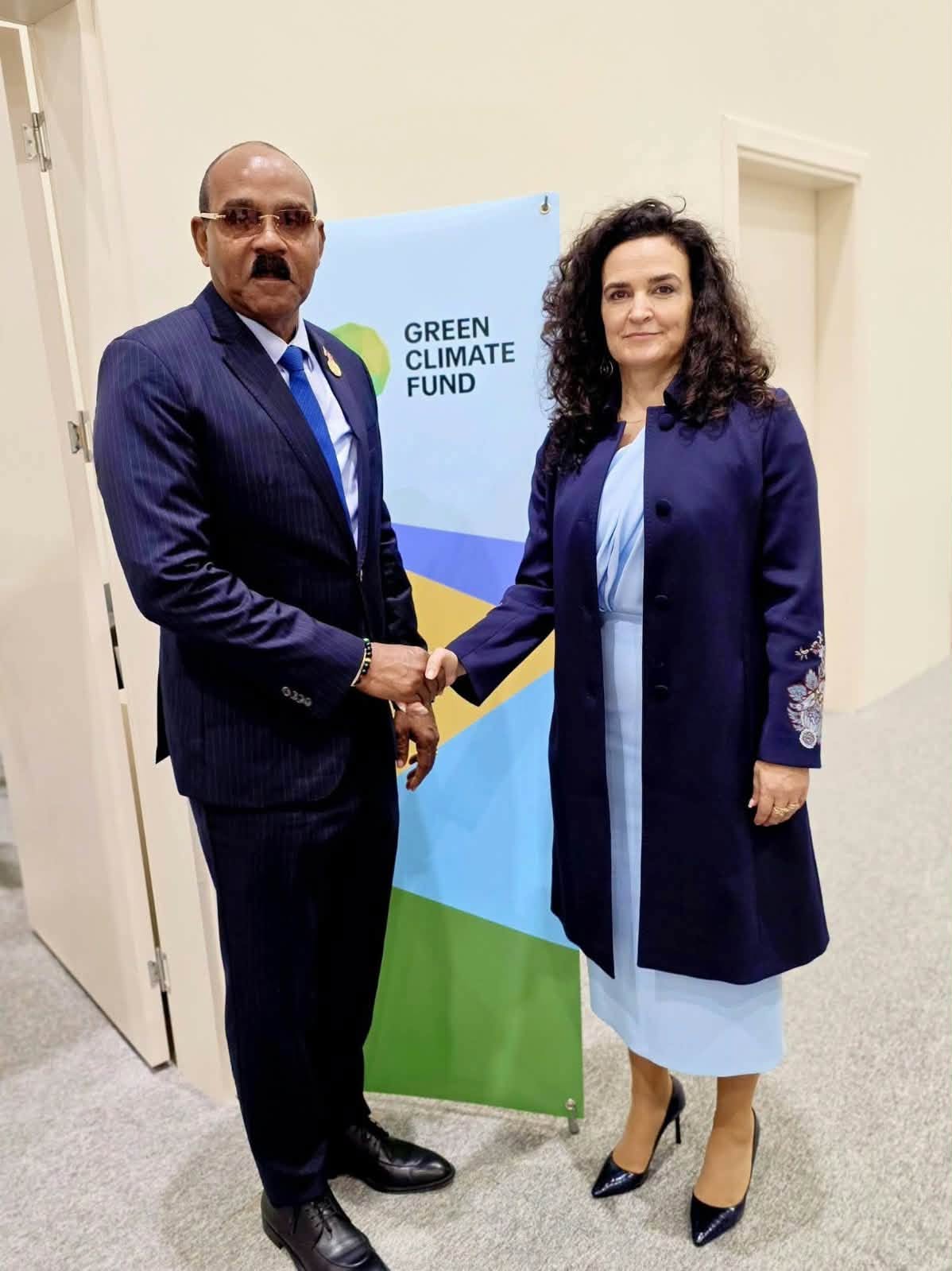
On the sidelines of the 31st United Nations Climate Change Conference (COP31) hosted in Antalya, Türkiye, Prime Minister the Right Honourable Gaston A. Browne of Antigua and Barbuda led a pivotal high-level bilateral dialogue with Green Climate Fund (GCF) Executive Director Ms. Mafalda Duarte and her core leadership team, as part of a sustained diplomatic push to mobilize tailored international financial and technical support for Small Island Developing States (SIDS) grappling with escalating climate threats.
During the substantive discussions, Prime Minister Browne laid out a tiered set of national priority areas where expanded GCF investment could deliver transformative, long-lasting public good for the twin-island nation, which faces disproportionate risk from extreme weather despite contributing a negligible share of global greenhouse gas emissions. Top of the agenda was the rollout of widespread climate-resilient housing upgrades for vulnerable coastal and inland communities: the Prime Minister stressed that targeted funding for storm-proof, elevated residential infrastructure would prevent avoidable loss of life, cut sky-high post-hurricane disaster recovery costs, and protect the livelihoods of low-income households most exposed to intensifying tropical cyclones and flash flooding.
The two sides also delved into the urgent national crisis of accelerating coastal erosion and shoreline degradation, with Prime Minister Browne requesting dedicated GCF resources for nature-based shoreline restoration, engineered coastal defense barriers, and targeted adaptation projects that would safeguard at-risk coastal settlements, preserve the country’s multi-billion-dollar tourism asset base, and reinforce natural ecosystem defenses against steadily rising sea levels and more powerful storm surges. A third core priority was the climate hardening of Antigua and Barbuda’s critical national infrastructure, including its main international airport and primary commercial seaport – facilities that the Prime Minister noted form the backbone of the country’s tourism-reliant economy, underpin international trade and regional connectivity, and whose uninterrupted operation is non-negotiable for long-term national economic security.
Delegates from both nations explored the framework for a coordinated, nationally led pipeline of climate-positive investments designed to streamline Antigua and Barbuda’s access to GCF capital, and align all incoming funding with the country’s overarching integrated strategy for climate adaptation, emissions mitigation, and inclusive sustainable development. Prime Minister Browne used the dialogue to reaffirm that the rapidly closing window to keep global temperature rise below the 1.5°C threshold represents an existential threat to SIDS across the Caribbean and Pacific, making the timely disbursement of accessible, affordable climate financing more urgent than ever. He emphasized that nations that have contributed almost nothing to historic global emissions should not be forced to carry the disproportionate financial burden of addressing a climate crisis they did little to create, and called on global climate finance institutions to adopt simplified application procedures, low-interest financing terms, and flexible support structures that are tailored to the unique constraints of small island economies.
The high-level COP31 engagement marks a major new milestone in Antigua and Barbuda’s ongoing campaign to deepen formal partnerships with leading global climate finance bodies, and unlock a steady stream of investment for high-impact resilience and sustainable development projects. The outcome of the talks reinforces the Browne administration’s core policy commitment to translate years of global climate advocacy into tangible, on-the-ground investments that protect vulnerable communities, harden critical public infrastructure, accelerate the transition to 100% renewable energy, and build a far more climate-secure future for all residents of Antigua and Barbuda.