On 10 November, senior Surinamese political correspondent Nita Ramcharan broke details of an impending high-stakes accountability showdown orchestrated by Suriname’s head of state Jennifer Simons, as the nation grapples with a sprawling web of alleged legal violations and public fund mismanagement tied to the country’s Telecommunications Authority (TAS).
President Simons has publicly confirmed she will convene a no-holds-barred, critical meeting with her sitting Minister of Justice and Security Harish Monorath, following a formally filed, document-backed criminal complaint submitted to the Prosecutor General’s office. The allegations stretch far beyond procedural missteps, touching on unauthorized employment contracts, potential double compensation, lavish unvetted public spending, and fundamental breaches of Suriname’s statutory governance rules for independent regulatory bodies.
At the core of the controversy is Monorath’s prior tenure as the supervisory board chair of TAS, during which he personally signed a contested employment contract for then TAS director Wendy Jap-A-Joe — a move that directly violates Article 4 of the TAS Act. The legislation explicitly mandates that all terms of employment for the TAS director and deputy directors must be set by the relevant sector minister, approved by the Council of Ministers, and finalized only after formal consultation with the TAS supervisory board, rather than unilaterally executed by the board chair. Legal experts note that Monorath, a trained lawyer, former practicing attorney, and past president of the Surinamese Bar Association, cannot claim ignorance of this clear legal provision, nor can he evade personal liability by claiming he acted on verbal or written directives from the former president or vice president, as no executive order under Surinamese law overrides formal statutory requirements.
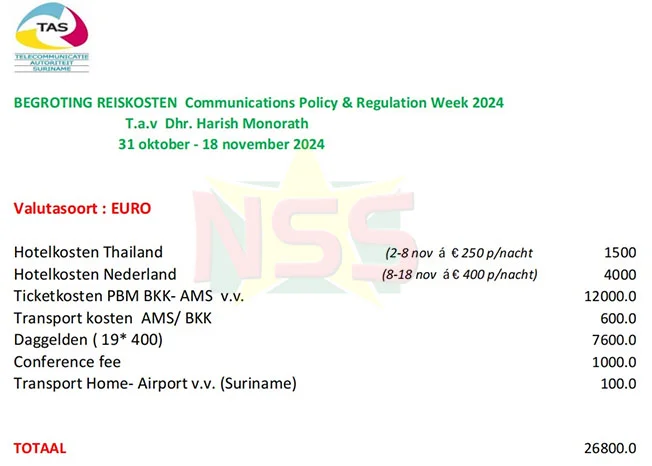
The scope of alleged impropriety extends to tens of millions of Surinamese dollars in unvetted public expenditure, including high-value international travel for four TAS representatives including the agency’s director, exorbitant daily allowances that ran parallel to fully covered $400-per-night hotel stays, premium accommodation bills, unsubstantiated equipment purchases, and unapproved supplementary stipends that lack verified legal or operational justification. Additional red flags have emerged over a parallel, unvetted arrangement: Monorath, Jap-A-Joe and other TAS affiliated staff were paid for advisory and operational work at the Office of the Vice President, despite already holding full-time public sector roles. Many of the positions they were hired to fill — including chief of protocol, secretaries, drivers, security officers and front desk reception staff — have no logical connection to TAS’s core mandate of specialized telecommunications and ICT oversight, even as Suriname has a well-established local pool of domestic ICT firms and national e-governance technical teams that could have delivered relevant services at far lower cost.
To unpack every layer of the scandal, President Simons has prepared a list of 10 pointed, unflinching questions for Monorath to answer under oath during their closed-door accountability session. These queries range from confirming his awareness of the TAS Act’s Article 4 provisions, identifying who drafted the contested non-compliant employment contract, and proving the legal basis for the double salary payments, to demanding he justify how a senior legal professional of his standing could overlook clear statutory limits on his authority, and prompting him to consider voluntarily stepping down to ensure the ongoing criminal investigation can proceed without the cloud of conflict of interest posed by his current role as the nation’s top justice official.
The probe follows a public, uncompromising anti-corruption pledge President Simons delivered during last year’s national budget debates, where she famously stated that no public official, even those in her immediate inner circle, would receive protection from accountability, adding “I may cry for you, but you will still be sent to the Prosecutor General’s office.”
Political analysts emphasize that while a filed criminal complaint does not equal a formal conviction, a sitting Minister of Justice must maintain a standard of conduct entirely free of any reasonable doubt regarding his commitment to upholding the rule of law. President Simons has clarified she will not wait for a final criminal court verdict to assess and enforce appropriate political accountability, noting that personal sympathy or concern for potential damage to the ruling coalition’s public standing cannot override the state’s obligation to safeguard Suriname’s legal system. The head of state has signaled she will take decisive formal regulatory action if Monorath declines to voluntarily take responsibility for the alleged breaches.
Column: De president huilt mee, maar Harish moet verantwoorden