Paramaribo, Suriname – November 10: Leading Indigenous advocacy bodies in Suriname have issued a formal ultimatum to the national government, warning they will stage a public demonstration in the capital no later than November 25, the country’s independence anniversary, if authorities fail to deliver tangible, actionable progress on three core demands: formal legal recognition of Indigenous communities’ collective traditional land rights, a full independent investigation into the parties who facilitated and authorized Mennonite agricultural settlements on contested inland territories, and urgent intervention to curb widespread environmental harm threatening Indigenous and Maroon livelihoods.
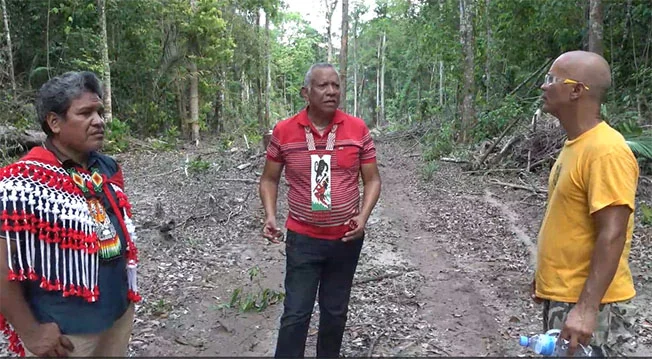
The announcement was delivered jointly by Stanley Liauw Angie, chair of the Organisatie Inheemsen in Suriname (OIS, or Indigenous Organization of Suriname), Lloyd Read, representative of the Inheems Kolectief Suriname (IkSur, or Suriname Indigenous Collective), and prominent Indigenous activist Erlan Sleur, during a recent on-site inspection of the remote inland areas where Mennonite farming communities have established large-scale operations in recent years. The three leaders emphasized that the dispute extends far beyond the presence of the Mennonite settler community itself, framing the conflict as a long-simmering crisis of state neglect that puts Indigenous cultural survival, ecological integrity, and intergenerational land access at imminent risk.
Liauw Angie explained that Indigenous representative bodies have spent years submitting formal policy proposals, petitioning for the enforcement of longstanding judicial rulings that affirm collective land ownership, and engaging in repeated rounds of dialogue with successive administrations, only to be met with empty promises, token consultation processes, and no binding regulatory framework to protect traditional territories. He rejected the government’s previous proposals to designate narrow, 5 to 10 kilometer protected zones around individual Indigenous villages as wholly insufficient, noting that traditional Indigenous lands span vast interconnected ecosystems that support hunting, fishing, foraging, and cultural practices far beyond the immediate perimeter of residential settlements. He highlighted a comprehensive 2017 co-drafted policy framework developed jointly by traditional Indigenous governance leaders and community organizations that lays out clear, community-endorsed standards for land protection, which the government has never formally adopted or implemented.
The OIS chair also noted that state neglect of Indigenous communities extends far beyond land tenure, pointing to chronic underfunding of rural education and public health services in inland villages. He stressed that the government has a fundamental legal and moral obligation to fulfill its pre-existing duties to Suriname’s original inhabitants before allocating large swathes of untouched forest land for commercial agricultural projects.
For his part, IkSur’s Lloyd Read emphasized that the planned investigation into the Mennonite settlement process must center on the state and private intermediaries who arranged the land transfers, rather than placing full blame on the Mennonite farming families themselves. He alleged that politically connected brokers with direct financial stakes in large-scale agribusiness and speculative land transactions may have coordinated the settlements in violation of existing national land laws, and called for full public disclosure of all contracts, official approvals, and communications between government officials and the parties that facilitated the Mennonites’ arrival. No formal documentary evidence of alleged official misconduct was presented during the leaders’ recent site visit, but Read insisted that a transparent, independent probe is necessary to root out any potential corruption or regulatory circumvention.
Read also warned that the rapid expansion of large-scale commercial agriculture in the inland forest zones poses cascading, long-term ecological risks that will extend far beyond the boundaries of individual Mennonite farm plots. Even projects formally zoned outside of designated village areas, he explained, disrupt interconnected forest, river, and wildlife systems that Indigenous and Maroon communities have depended on for their livelihoods for centuries, driving widespread deforestation that will rob future generations of their access to critical natural resources. He called for unified cross-community solidarity between Indigenous groups and Maroon tribal communities, as well as increased scrutiny from civil society groups, faith institutions, and independent media to hold the government accountable for its inland land use decisions.
The leaders also tied the ongoing land rights dispute to broader, unaddressed public health and environmental harms in Suriname’s interior, including widespread mercury and chemical pollution from unregulated mining operations. Read cited ongoing community concerns in the Pikin Saron area, where local residents have reported unsafe levels of contaminants in river water and wild fish populations, but the government has refused to release full public findings from its official environmental testing, or provide clear guidance on safe drinking water alternatives for affected communities. The representatives demanded that the administration publish all unredacted results of inland environmental and public health studies immediately, and roll out targeted remediation and support programs for communities impacted by mining pollution.
In a direct open appeal to Suriname President Jennifer Simons, Read stated that the Indigenous advocacy groups stand ready to fully support the administration if it takes decisive, public action to enforce collective land rights, root out corruption in inland land allocation, and protect inland ecosystems. The groups confirmed that they remain open to constructive dialogue with the government for the remaining two weeks before their November 25 deadline, but are already in advanced stages of planning the Paramaribo protest action to make their demands visible to the public on the country’s independence anniversary, if no concrete progress is made. For all three leaders, the core of the movement is not opposition to any specific settler group, but a fundamental demand that Suriname’s Indigenous and tribal communities receive full, enforceable decision-making power over the lands and natural resources they have stewarded for millennia.