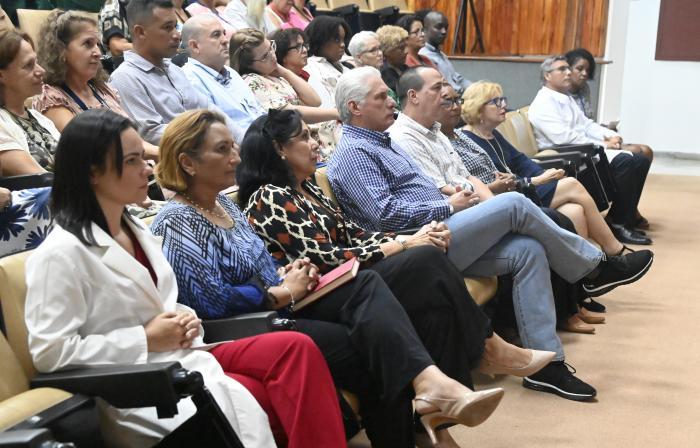
On the afternoon of Friday, November 6, 2026, Miguel Díaz-Canel Bermúdez, First Secretary of the Central Committee of the Communist Party of Cuba and President of the Republic of Cuba, conducted an official on-site visit to the Pedro Kourí Institute of Tropical Medicine (IPK), a world-renowned center of excellence based in Havana, accompanied by Minister of Public Health José Ángel Portal Miranda and a delegation of senior health sector officials. During the visit, the head of state met directly with the IPK’s leadership, leading microbiologists, researchers, frontline clinical staff and trainees, expressing profound admiration for the institution’s decades-long track record of advancing public health outcomes for both Cuban citizens and global communities. Following a detailed, data-backed briefing delivered by IPK Director Dr. Vivian Kourí Cardellá – a leading physician, microbiologist and Doctor of Sciences – Díaz-Canel highlighted the institute’s irreplaceable role during the 2020-2022 COVID-19 public health emergency, noting that IPK and its peer institutions under the national BioCubaFarma network formed the backbone of Cuba’s highly effective national pandemic response. He specifically referenced the institute’s early, pre-local-outbreak COVID-19 research, pioneering clinical trial work and development of life-saving domestic treatment protocols, which he credited for placing Cuba among the nations with the most successful pandemic management outcomes worldwide. The president also addressed the disproportionate strain that tightened U.S. economic and energy blockades have imposed on Cuba’s entire healthcare system, noting that IPK staff have persisted through extreme operational hardships including transport shortages, frequent residential power outages and long, unscheduled work shifts to continue delivering specialized care, running critical diagnostics and advancing research. He emphasized that the consistent, heroic dedication of IPK’s workforce has prevented far more severe public health harms that would have otherwise been amplified by decades of systematic external economic pressure. Díaz-Canel also outlined the national government’s ongoing 2026 priorities to roll out widespread digital transformation and expand responsible artificial intelligence integration across all public sectors, noting that pilot programs are already underway in the health portfolio to leverage these technologies to elevate the institute’s research, diagnostic and training capacities. Later, the presidential delegation toured IPK’s state-of-the-art research laboratories that focus on infectious disease surveillance and treatment development. During the visit, Dr. Kourí Cardellá walked attendees through the institution’s nearly 90-year history, tracing its origins back to 1937, its formal reorientation post-1959 revolutionary victory to block the reintroduction of eradicated exotic diseases, the official adoption of the IPK name in 1979, and the 1993 inauguration of its current purpose-built campus by Cuban revolutionary leader Fidel Castro, who famously charged the institute to serve not just Cuba but all of humanity. Today, the IPK functions as Cuba’s national reference hub for infectious diseases, operating a specialized hospital, running high-complexity diagnostic laboratories that exceed standard hospital capabilities, and delivering accredited master’s, doctoral and undergraduate training programs for students from across Cuba and dozens of other countries. Its research contributions have shaped global public health guidelines for dengue, chikungunya, Oropouche virus and COVID-19, cementing its status as a globally respected public health resource. Dr. Kourí Cardellá confirmed that the institute has fully honored Fidel’s founding mandate to serve all humanity, noting that its team prioritizes recruiting and mentoring young scientific talent even amid national economic challenges to sustain its legacy of impact-driven research and cross-border public health collaboration.
They have fulfilled their commitment to Fidel: The IPK is—and will remain—an Institution for all humanity