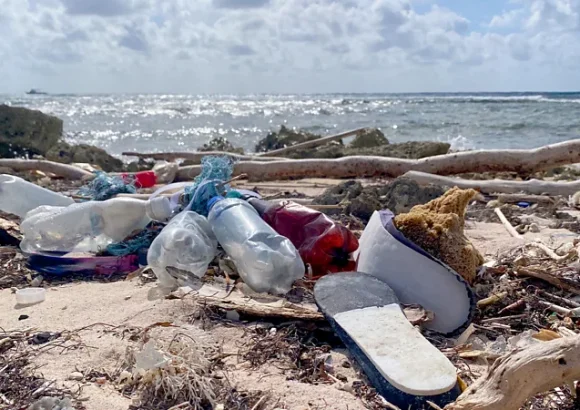
Patriotism and national pride should not be confined to annual national holiday celebrations, argue long-term Dominican Republic residents Clayton Gush and Renn Loren, in a provocative reflection on the gap between public displays of patriotic fervor and widespread casual littering that erodes the island’s most valuable natural assets. Every February 27, Dominican Independence Day, streets across the nation fill with uniformed schoolchildren marching, beating drums and radiating unmistakeable national pride, a tradition deeply woven into the fabric of Dominican cultural identity that the authors say they have long admired. But over years of living and raising families on the island, the pair have observed a troubling disconnect: that same fierce national pride rarely translates to consistent, daily care for the country’s landscapes outside of festive occasions. For first-time visitors, the first aerial view of the Dominican Republic as planes descend toward Puerto Plata reveals a postcard-perfect paradise: lush forested mountains, palm-fringed white sand beaches, and coastal waters shimmering in vivid shades of sapphire and turquoise. That idyllic first impression often shatters the moment visitors leave the airport, however, as highways are lined with discarded plastic bottles, food wrappers and household waste tangled in roadside vegetation. The authors note that they have watched local motorcyclists and drivers casually toss rubbish out of vehicle windows without a moment’s hesitation, under the apparent mistaken assumption that overgrown foliage will hide discarded items from view. In reality, most plastic waste persists in the environment for decades, breaking down into microplastics that leach into soil, clog drainage systems, flow into rivers and eventually empty into the Caribbean Ocean that draws millions of international tourists to the island each year. Many local waterways are so choked with accumulated waste that the surface of the water is barely visible, while steep ravines have become informal unregulated dumping grounds that heavy seasonal rains sweep downstream toward coastal communities and tourist zones. This widespread littering creates a stark economic contradiction for the Dominican Republic: its unrivaled natural beauty is the backbone of its multi-billion-dollar tourism sector, the industry that supports household incomes, pays for children’s school fees and sustains entire coastal communities, yet many residents continue to trash the very roads leading to the island’s most famous beach destinations. The authors emphasize that the Dominican Republic is far from unique in facing this challenge, pointing to the United States’ own litter crisis in the 1960s and 1970s, when the rise of disposable consumer packaging led to widespread roadside waste across the country. In 1971, the non-profit Keep America Beautiful organization partnered with the Ad Council to launch one of the most iconic public service announcements in U.S. television history: the ad featured actor Iron Eyes Cody, who portrayed a Native American man paddling a canoe through heavily polluted waterways before reaching a highway, where a passing motorist tosses a bag of rubbish directly at his feet. A close-up shot captures a single tear rolling down Cody’s cheek, paired with the tagline “People Start Pollution. People Can Stop It.” While the ad faced later controversy over the revelation that Cody was of Italian, not Indigenous, ancestry and drew criticism for diverting attention from corporate responsibility for packaging waste, it was undeniably culturally impactful, shifting public social norms to the point that littering became widely viewed as an embarrassing, socially unacceptable act. The authors note that the campaign was so effective that as children growing up in that era, they even found themselves admonishing their own parents for tossing soda cans out of car windows. The pair argue that the Dominican Republic could benefit from a similarly sweeping cultural shift to reframe littering as a betrayal of the national pride displayed so vividly on Independence Day. They point out that hundreds of local volunteers, Dominican citizens and expats alike, already dedicate their weekends to organized beach and roadside cleanups, hauling away tons of waste discarded by other community members, and these grassroots efforts deserve far more public recognition and institutional support. The authors also acknowledge structural barriers that contribute to the litter crisis, noting that public waste bins are extremely scarce along most rural and suburban roads, in residential neighborhoods and even in busy commercial public spaces, while formal household waste collection services are inadequate or entirely non-existent in many underserved communities. While the Dominican Republic already has formal laws banning improper waste disposal, inconsistent enforcement undermines their effectiveness. A major positive development came on September 18, 2026, when President Luis Abinader inaugurated a state-of-the-art RD$1.6 billion modern waste management facility in Puerto Plata, a landmark investment designed to resolve decades of systemic waste disposal challenges across the northern region. But the authors stress that even the most technologically advanced waste processing infrastructure in the Caribbean cannot stop a person from tossing a plastic bottle out of a car window on their commute home: that change can only come from a shift in individual mindsets. They note that as long-term expats who have built businesses, raised children and made the Dominican Republic their permanent home, they feel a deep sense of ownership and affection for the country, and argue that anyone who chooses to make the island their home has every right to feel that same national pride, regardless of their place of birth. This sense of stewardship does not require large, costly national environmental initiatives: small, daily acts make all the difference, from holding onto a used bottle until a suitable waste bin is found, to picking up stray litter that is not even yours, to teaching children not to throw waste out of car windows, to local business owners taking responsibility for cleaning the stretch of roadside outside their storefronts. The authors share their longstanding personal tradition of having every member of their group pick up 10 pieces of litter before leaving any public beach, campsite or park, a simple ritual that requires no funding or government approval. They acknowledge that the Dominican Republic faces far more urgent systemic social and economic challenges than scattered plastic bottles, but unlike those large-scale issues that require years of legislative debate, massive public investment and complex political negotiation, ending casual littering is a problem every single resident, citizen and expat alike, can start solving that very same day. They conclude by calling on the public to channel the same fiery national pride seen in the Independence Day parades into daily acts of environmental stewardship, so that the spectacular view of the Dominican Republic from the plane window matches the view from every roadside, riverbank and neighborhood across the island, turning the concept of orgullo patrio, or national pride, from a once-a-year celebration into a way of life 365 days a year.