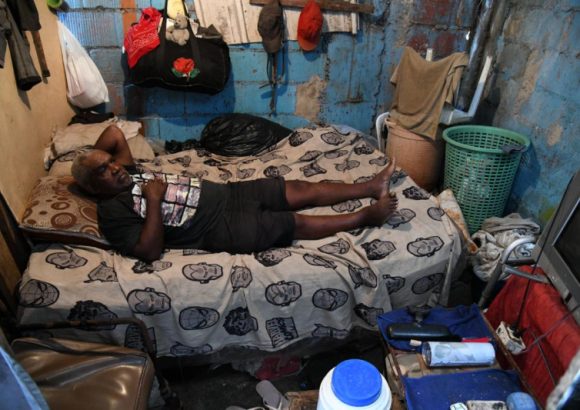
The life of 40-something former mechanic Vicente De la Rosa was irrevocably upended on November 23, 2023, as he exited a local gas plant, when an unidentified motorcyclist struck him before fleeing the crash site without stopping to offer aid. De la Rosa lost consciousness immediately after the collision, and woke up days later at the Darío Contreras Traumatology Hospital, where he had already undergone emergency life-saving surgery. But the procedure was only the first step in his required medical care: clinical staff informed him he needed a series of follow-up operations and specialized medical supplies to fully recover his mobility, with a total estimated cost of RD$30,000 — a sum the working-class tradesman had no way to cover, as he had no savings buffer and no access to formal social safety net support to cover the bills. In the months following his discharge from hospital, De la Rosa never regained the ability to walk, and remains permanently confined to either a wheelchair or his bed. His former career as a mechanic, the skilled trade that had been his sole source of stable livelihood for decades, is now completely out of reach, leaving him with no regular income to cover even basic daily needs. With no immediate family members nearby to provide round-the-clock care, he cannot complete the most fundamental tasks of independent living on his own: he requires assistance to bathe, get in and out of bed, use the restroom, and even step outside his home to get fresh air and sunlight. Trapped between crippling physical disability and crushing financial precarity, his quality of life has plummeted to near-unlivable levels, as he struggles to access consistent food, critical medications, and even basic home repairs for his dilapidated residence. “I am trapped in a situation I never could have imagined, and I am begging anyone with a kind heart to reach out and help me,” a tearful De la Rosa shared in a recent interview. In the absence of formal state or family support, a small network of local neighbors has stepped forward to serve as his only lifeline. Leading that group is Ángel Martín, a nearby resident who has dedicated consistent time and limited personal resources to tending to De la Rosa’s needs. “We are the only people who show up for him right now,” Martín explained, noting that his own family regularly cooks extra portions of meals to bring over to De la Rosa to ensure he does not go hungry. The informal group of local caregivers can only do so much with their limited means, however. Martín has made a public appeal for local civil society groups, government social welfare agencies, and individual members of the public to step in and offer additional support, including donated food, prescription medications, household goods, construction supplies to repair De la Rosa’s damaged home, direct financial aid, and access to the long-delayed follow-up medical care that could ease his chronic pain and improve his mobility. Anyone interested in coordinating aid for Vicente De la Rosa can reach out directly to Ángel Martín, who serves as the official community liaison for his care, at phone number 829-386-9672. Martín emphasized that no donation is too small: even a single bag of groceries, a gently used bed, or a small cash contribution can drastically improve De la Rosa’s current dire living circumstances.
Vicente De la Rosa has been living on the kindness of his neighbors for three years.