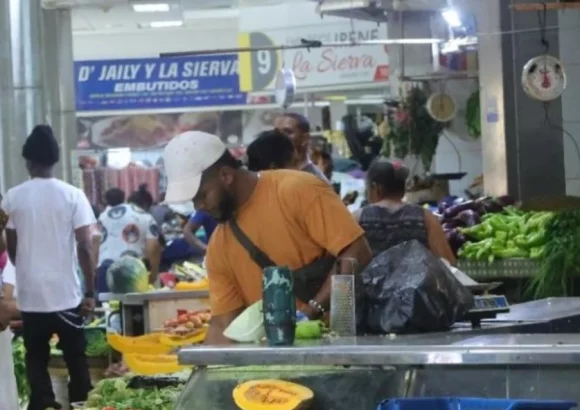
A stark disconnect has emerged between Dominican government narratives on food price stability and the harsh on-the-ground reality experienced by millions of residents across the Caribbean nation, as surging costs for staple groceries push working and middle-class families to make increasingly drastic trade-offs to put meals on their tables. Across neighborhoods and bustling public markets in the capital Santo Domingo, shoppers, small-scale vendors, and local merchants uniformly echo the same frustration: every trip to purchase basic food supplies grows more unaffordable by the day, with household budgets stretched far thinner than official communications suggest. While most Dominican residents acknowledge that global spikes in crude oil prices have driven up cost of living pressures worldwide, widespread public sentiment holds that the current administration has failed to deliver meaningful, targeted support that prevents ordinary families from falling into financial precarity, even amid existing state subsidy programs. These grievances are not limited to end consumers: small business owners from corner shop operators to street food vendors confirm their own operating costs have skyrocketed, a burden they cannot fully pass on to cash-strapped customers without losing sales entirely. For Ramón Peralta, a Santo Domingo resident supporting a family of five, the monthly budget he and his working wife allocate for groceries has surged more than 50% in just a few short months, forcing the pair to slash the volume and variety of goods they purchase during their biweekly shopping trips. “Dominicans are only eating because we have no other choice, and we are scraping by with every last bit of effort we have,” Peralta shared with reporters from local outlet HOY. “We stretch every single peso as far as it will possibly go. Things are exceptionally tough right now.” Price checks at Santo Domingo’s largest public markets lay bare the scale of the affordability crisis: chicken retails for between RD$65 and RD$68 per pound, rice ranges from RD$38 to RD$40 per pound depending on grain quality, red beans cost a flat RD$70 per pound, a standard carton of eggs is priced at RD$210, and individual plantains sell for RD$25 to RD$30 each. Longtime market shopper Isabel Triburcio pushed back directly against official government claims that food remains accessible for most households, noting that salaries must also cover rent, utility bills, transportation and other non-negotiable costs, leaving far less room for grocery spending than policymakers appear to assume. While President Luis Abinader recently acknowledged in an exclusive interview with HOY that the country faces a tangible cost-of-living challenge, and that fixed-income earners are bearing the brunt of the financial strain, many citizens argue that ordinary people have been grappling with these soaring costs for far longer than official statements suggest, and that government officials have not demonstrated any shared sacrifice to address the crisis. Many residents have also questioned the value of the Dominican Republic’s widely cited macroeconomic wins, including status as one of the fastest growing economies in the region, a record 12 million annual tourist arrivals, and steady export growth, when these gains do not translate to improved household purchasing power. “What is the point of all that economic progress if we cannot even afford to eat decent, nutritious meals? We still lack access to quality public services, and many of us are no better off, or even worse off, than we were under previous administrations,” local resident Eladio Contreras told reporters. Multiple citizens also pushed back against official claims that the administration scrapped its controversial proposed tax reform, arguing that successive new targeted tax measures have already been rolled out, with the heaviest burden falling squarely on low and middle-income households. President Abinader did confirm in his interview that fixed-income earners are the demographic most adversely impacted by the ongoing cost-of-living crunch, acknowledging openly, “We really have a problem with the high cost of living. The impact is being felt.” For additional local Dominican news coverage, visit DominicanScope.
Dissatisfaction “The government is experiencing a very different reality when it comes to food prices.”