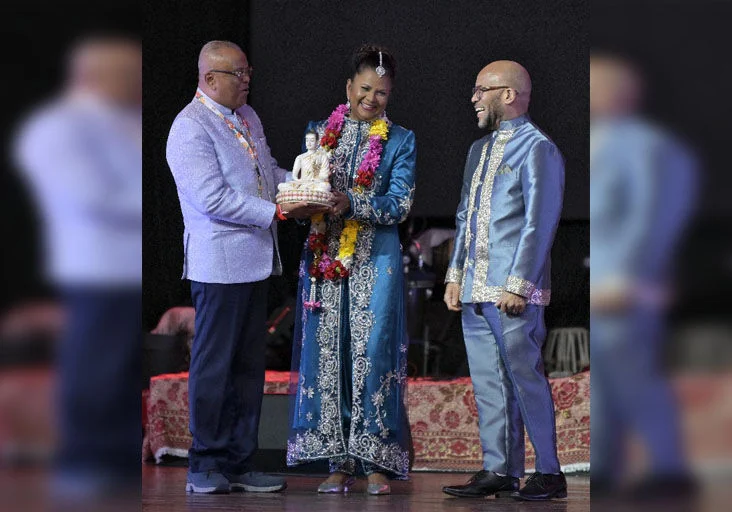
Trinidad and Tobago President Christine Kangaloo delivered a landmark keynote address at the 40th anniversary celebration of Divali Nagar in Chaguanas on Wednesday night, centering her speech on the event’s 2024 theme “Viveka—Discerning Truth in the Age of AI” to address the growing societal risks and transformative opportunities posed by rapidly advancing artificial intelligence systems. Opening with a provocative rhetorical question to the assembled crowd, Kangaloo asked: “How are we to remain faithful to truth when artificial intelligence can create false words, false images and false voices that appear real?” She pushed back against the common narrative that AI introduced the global struggle to distinguish fact from fiction, emphasizing that humanity’s battle against misinformation stretches back millennia, long before the invention of computing systems or machine learning algorithms. Pre-existing human flaws including implicit prejudice, deliberate dishonesty, and systemic abuse of power have threatened information integrity for centuries, she noted, framing AI as an amplifier of these longstanding vulnerabilities rather than their root cause. Rejecting both unmitigated fear and uncritical acceptance of the technology, Kangaloo highlighted AI’s vast positive potential: it can accelerate life-saving medical research, expand equitable access to quality education, deliver tailored support for persons with disabilities, and help solve complex cross-sector challenges that have stymied human experts for generations. “AI is therefore not the enemy,” she stressed. “We should neither fear it blindly nor embrace it uncritically, but govern and use it wisely.” At the same time, she warned that AI grants age-old human failings unprecedented speed, global reach, and superficial credibility, enabling bad actors to generate hyper-realistic deepfakes that fabricate false statements or actions attributed to completely innocent people. To illustrate this tangible risk, Kangaloo shared a firsthand anecdote from last year, when a member of the public arrived at her office prepared to invest a large sum of money in a fraudulent financial scheme, because he had seen a convincing deepfake video that falsely appeared to show the president endorsing the scam. “The video was false, but it was convincing enough to prompt a real financial decision,” she explained, emphasizing that this incident proved no member of the public can afford to remain passive about verifying information they encounter online in the AI era. Beyond the risks, Kangaloo outlined AI’s constructive cultural applications, noting the technology can be harnessed to preserve and widely share Trinidad and Tobago’s precious national archives, oral history collections, indigenous music, visual art, and intangible cultural traditions. She emphasized that the living, community-centered experience of events like Divali Nagar cannot be replicated by AI, as the annual gathering offers culture as a lived practice—rooted in worship, artistic performance, traditional cuisine, handcrafted art, volunteer service, and cross-generational connection—rather than a static, algorithmically summarized digital artifact. While the concept of “Viveka” originates in Hindu philosophical thought, Kangaloo noted its core emphasis on truth, moral wisdom, and collective responsibility transcends all religious, cultural, and demographic divides. She framed Viveka as the deliberate practice of combining critical thinking, personal conscience, and accumulated communal wisdom to reliably separate fact from falsehood, drawing a direct parallel to the core symbolism of Divali: the glowing deya (clay lamp) that represents knowledge dispelling ignorance, and the return of Lord Rama to Ayodhya that marks the triumph of dharma (righteousness) and truth over deception and ego. She closed her address with a call to collective action, asking attendees: “Will we use these extraordinary tools to enlarge knowledge and opportunity, or to manufacture deception and deepen exclusion?”