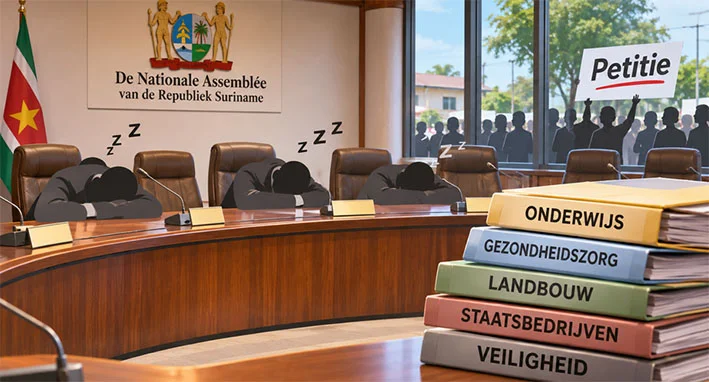
A recent analysis by veteran Surinamese public affairs commentator Wilfred Leeuwin, published November 6, lays bare a deeply entrenched pattern of unaddressed systemic failures across the country’s public sector, where longstanding critical issues resurface year after year without resolution, only attracting fleeting official attention when a crisis erupts.
These recurring, seemingly permanent administrative headaches span every segment of public life, from public safety and infrastructure to regulatory governance, education, healthcare and food security. One stark example is the mercury leak at the Nieuwe Haven police station, which forced the closure of an entire operational room. Despite law enforcement regularly seizing mercury as contraband for years, the government has still failed to establish a designated secure long-term storage facility for the hazardous material, leaving seized stockpiles stored in ad-hoc, high-risk locations.
Public safety gaps extend to local emergency response systems: parliamentarians have repeatedly flagged that Albina’s fire department lacks a single operational fire truck, a failure that came into sharp relief after a school in nearby Moengo burned to the ground, displacing hundreds of students who now require temporary alternate learning space. While no fire response system can prevent every blaze, Leeuwin notes that waiting until flames engulf a building to discover critical shortages of emergency equipment represents a reckless failure of basic proactive planning.
Similar gaps plague the agriculture sector, where exporters have issued repeated warnings about insufficient oversight of pesticide residues on locally grown produce. Draft reforms to strengthen food safety inspection protocols were first circulated years ago, but no meaningful implementation has occurred, forcing public officials to revisit the exact same food safety debates in 2024 without any tangible improvements for consumers.
Even formal regulatory bodies are not immune to these procedural lapses. The ongoing governance dispute at the Telecommunications Authority Suriname (TAS) centers on the validity of a former director’s employment contract. A previous presidential resolution granted the then-chairperson of TAS’s board authority to sign off on the contract, but national TAS legislation explicitly outlines a separate, legally required procedure for setting director-level employment terms. A court ruling on the contract’s legal status is still pending, but parliamentary disclosures from the relevant minister confirm no written authorization from the responsible sitting minister at the time of signing can be located. Leeuwin points out that no presidential resolution carries legal weight above formal national statute, raising critical questions about why this procedural breach was only uncovered years later, when an internal administrative conflict erupted, rather than being flagged during routine compliance checks.
Leeuwin urges the current administration to launch a system-wide audit of all state-owned enterprises and parastatal bodies, reviewing every senior leadership employment contract to confirm all legal procedures were followed, rather than limiting scrutiny to TAS alone. He emphasizes that this review must not devolve into a partisan political witch hunt: audits should cover decisions made by both the previous and current administrations, as national law does not cease to apply simply when a new political party takes power.
This pattern of delayed action and unaddressed backlogs extends to core government ministries as well. For decades, the education sector has grappled with dilapidated school buildings, chronic teacher shortages and massive backlogs in routine facility maintenance. The public healthcare system faces recurring, well-documented gaps in medicine stock, frontline staffing and critical medical supplies. Every budget cycle, the government rolls out new reform plans for these sectors, but almost no formal reviews are conducted to audit the outcomes of previously announced plans, track allocated public spending, or document why uncompleted projects were abandoned. While national budget debates focus heavily on new spending promises for the coming fiscal year, almost no time is dedicated to reviewing unmet targets and unfulfilled commitments from prior years.
The long-running partisan tactic of blaming all current failures on inherited problems from the previous administration is also called out by Leeuwin. While many of these systemic issues do date back to prior governments, repeatedly highlighting who created a problem does nothing to resolve it: the administration currently in power bears full responsibility for addressing gaps on its watch.
Leeuwin acknowledges that Suriname cannot resolve all of its deep-rooted structural public sector challenges overnight, given the scale of the issues and limited national resources. But the public is fully entitled to expect transparency from elected officials: clear public documentation of every unaddressed critical issue, concrete action plans with defined timelines for delivery, and regular self-audits to identify gaps before a crisis, court case or public outcry forces the government to act.