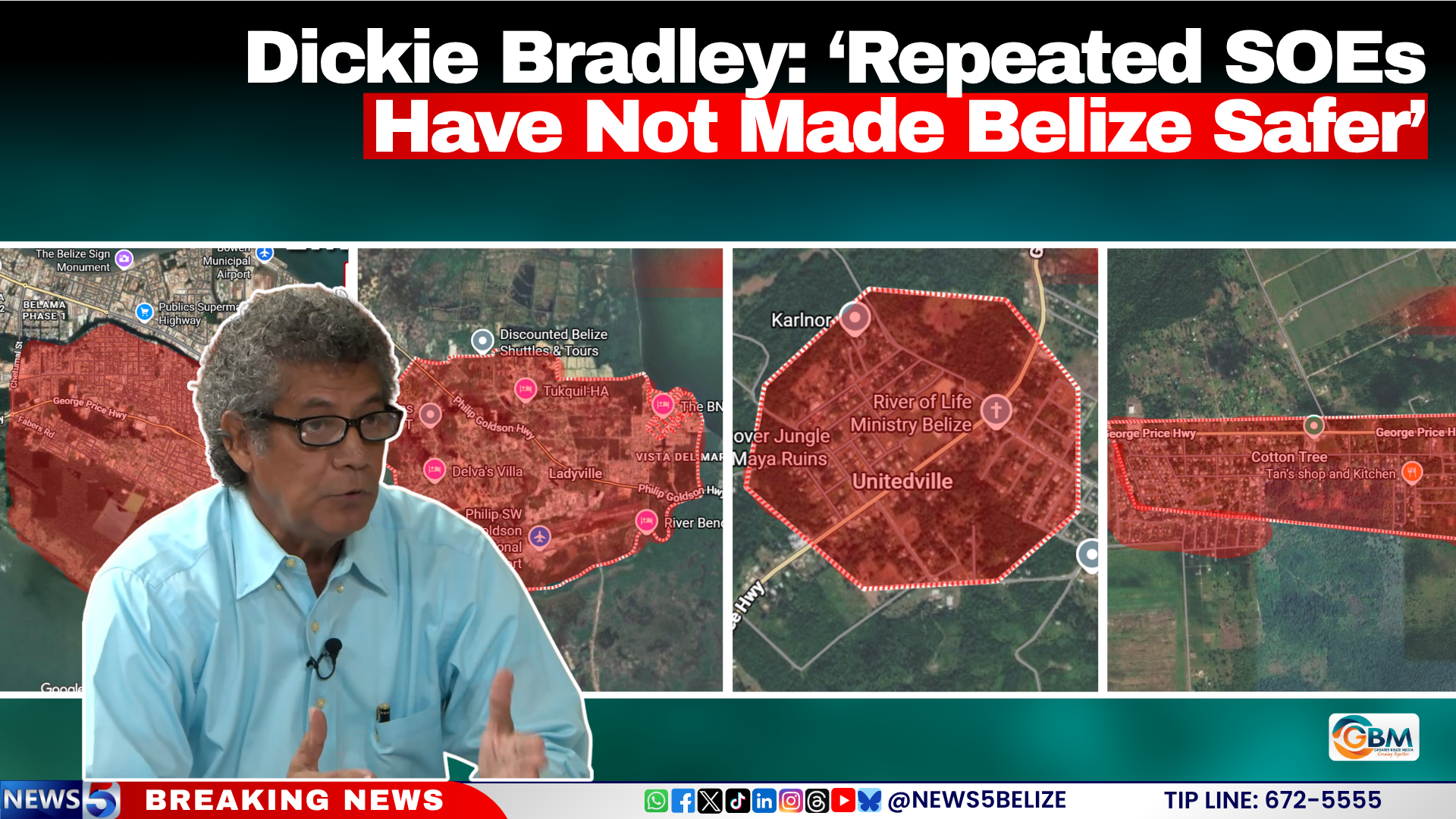
On November 3, 2026, prominent legal figure and former attorney Richard “Dickie” Bradley delivered a scathing assessment of Belize’s decades-long approach to public safety, asserting that successive rounds of declared States of Emergency (SOEs) have delivered no meaningful, lasting reduction in violent crime and have left the nation more vulnerable to gang-related harm than before the measures were first rolled out. “We have made zero progress. We are exactly back to square one, and in reality, public safety conditions are far worse than when we first implemented these emergency orders. This points to a deep, unaddressed structural failure across our entire society,” Bradley stated during a public address focused on recent public safety developments, which were spurred by a wave of seven consecutive homicides that prompted the government to roll out yet another sweeping SOE earlier that week. Bradley traced the origins of Belize’s unrelenting gang crisis directly to decades of short-sighted policy choices by successive administrations that prioritized temporary, enforcement-focused crackdowns over long-term, preventative investment. He cited official public safety data showing that the country had only six documented active gangs operating nationwide in 2008, a figure that ballooned to 26 known, structured gang networks by 2020, the year a new administration took office, with gang presence now extending far beyond urban hubs to remote rural villages, offshore cayes, and the southern township of Punta Gorda. The veteran legal practitioner also criticized the government’s overreliance on arrests and mass detention as the sole core of its crime strategy, arguing that critical, underfunded initiatives like community policing and youth development programs have been sidelined for years. “Effective community policing builds mutual trust between law enforcement and residents: officers are embedded in the neighborhoods they serve, know local community members by name, and residents feel comfortable sharing actionable intelligence that stops violence before it occurs, rather than only showing up to make an arrest after a murder has already happened,” Bradley explained. He further pushed back against the current administration’s public interest in adopting the controversial heavy-handed anti-gang model implemented by El Salvadoran President Nayib Bukele, noting that Belize’s distinct colonial governance history, democratic institutional framework, and smaller national context make a direct copy of that policy entirely unworkable. “We operate under a completely separate legal and social system, with a unique set of community relationships and civil liberties protections that cannot be overridden to replicate a model built for a vastly different national context,” he emphasized.