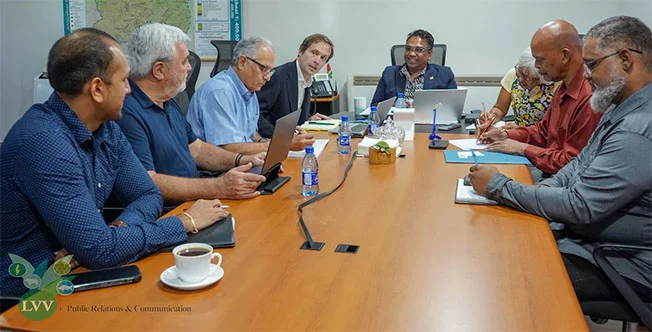
On November 3, 2024, representatives from a joint technical mission led by the Food and Agriculture Organization (FAO) of the United Nations and the Caribbean Development Bank (CDB) held initial high-level consultations with Suriname’s Minister of Agriculture, Livestock and Fisheries Mike Noersalim and his senior departmental staff, kicking off a seven-day working visit running from November 1 to 7. The core objective of the mission is to identify five high-potential agricultural production value chains that will receive prioritized support for targeted future investment, as part of a broader regional initiative to data-driven decision making for agricultural sector growth across the Caribbean.
During the opening bilateral talks, Minister Noersalim laid out the administration’s assessment of the domestic agricultural sub-sectors with the greatest untapped growth potential, while also openly outlining longstanding bottlenecks, systemic gaps and unmitigated risks that have historically hindered the expansion of Suriname’s farming, livestock and fisheries operations. The mission builds directly on a comprehensive sector analysis and national agricultural investment framework that the FAO finalized for Suriname earlier in 2024, and is being rolled out concurrently across two other Caribbean nations: Saint Lucia and Dominica.
The mission’s expert panel, led by FAO economist Julien Vallet, also includes agribusiness specialist Carlos Puig Esteve, investment advisor Cesar Falconi, agricultural value chain expert Prithvi Jairam, and CDB representative Malcolm Wallace. Over the course of the week, the team will conduct structured consultations with a wide cross-section of stakeholders: units within the Ministry of Agriculture, Livestock and Fisheries including its dedicated statistics department, smallholder producer associations, private agribusiness owners, local financial institutions, cross-sector government agencies, and international development partners.
All collected stakeholder input will be assessed through a multi-criteria weighted evaluation framework, designed to rank potential value chains based on their projected return on investment, local employment generation capacity, climate resilience, export market access and alignment with national food security targets. Once the five priority chains are formally selected following the conclusion of field work and subsequent desktop analysis, the team will develop detailed, investor-ready business profiles and customized targeted investment plans for each identified sub-sector. The coordinated effort is intended to streamline capital inflows to Suriname’s agricultural space, reduce barriers for domestic and international investors, and unlock inclusive, sustainable growth for the country’s rural economy.
FAO en CDB onderzoeken investeringskansen in Surinaamse landbouw