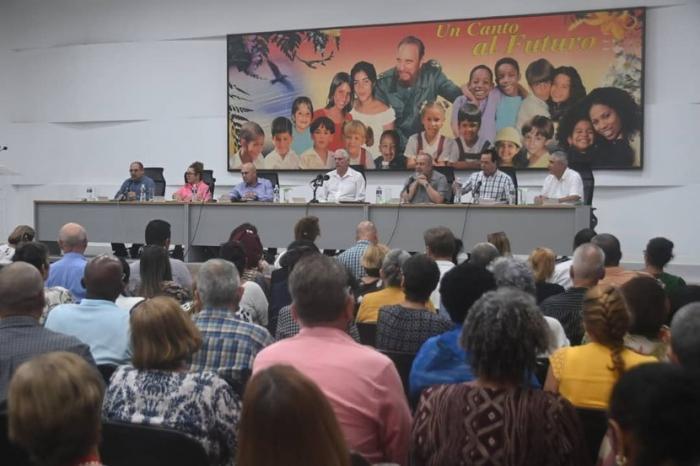
On November 2, 2026, Cuban head of state Miguel Díaz-Canel Bermúdez, who holds dual roles as First Secretary of the Communist Party of Cuba’s Central Committee and President of the Republic, presided over the closing plenary of an extensive multi-day fact-finding working tour led by Central Committee members and supporting administrative teams across the island’s entire public health ecosystem. The tour spanned the national Ministry of Public Health (MINSAP) headquarters, frontline primary care clinics, regional secondary care facilities, specialized tertiary hospitals, and all affiliated enterprises under the health sector’s operational network.
The multi-site visits included direct, unfiltered conversations with hundreds of Cuban stakeholders: facility administrators, medical specialists, frontline clinical and administrative staff, patients, and family members accessing public health services, as part of the Communist Party’s established framework for on-the-ground oversight of the country’s sweeping economic and social transformation agenda. The core purpose of these structured field reviews is to track policy implementation, deliver targeted operational guidance to grassroots organizations, and identify actionable adjustments to strengthen service delivery across all public sectors.
During his opening remarks at the closing session, Díaz-Canel noted that the gathering was taking place mere hours after Cuba secured its 34th consecutive diplomatic victory at the United Nations, where an overwhelming global majority of nations voted to condemn the 60-plus year U.S.-imposed economic, commercial, and financial blockade on the island. He framed the landslide UN vote not only as a rejection of Washington’s decades-long aggressive policy and global campaign of diplomatic blackmail to coerce allied nations into opposing Cuba, but also as a global recognition of the Cuban people’s widespread resilience, creative resistance, and collective courage – with the nation’s 99,000-strong healthcare workforce singled out as central contributors to that international standing. He emphasized that Cuban healthcare is explicitly structured as a universal, non-commodified human right, a landmark achievement of the 1959 Revolution, rather than a privilege reserved for those who can pay, and praised the altruism and professionalism of health staff who routinely turn widespread systemic shortages into opportunities for grassroots, community-led problem-solving.
The closing session, co-chaired by senior party and government leaders including Political Bureau Organization Secretary Roberto Morales Ojeda, Prime Minister Manuel Marrero Cruz, and Deputy Prime Minister Eduardo Martínez Díaz, included a detailed operational briefing from MINSAP Minister Dr. José Ángel Portal Miranda. The minister laid out the cascading pressures facing the national health system under the intensifying U.S. blockade and concurrent energy siege: plummeting revenue from Cuba’s global medical solidarity programs due to targeted U.S. sanctions and smear campaigns, widespread shortages of critical medications, diagnostic reagents, high-tech medical equipment, and essential consumables, plus widespread underinvestment in facility infrastructure ranging from power generators and cold storage units to medical transport fleets. He acknowledged that these constraints have generated legitimate public dissatisfaction with service levels, and that more than 90,000 patients are currently on surgical waiting lists, with tens of thousands more facing disrupted cancer treatment and dialysis schedules, alongside 34,000 pregnant women unable to access their full required scope of prenatal care. Even with these challenges, Portal Miranda confirmed that no public health facility across the country has been forced to close, that Cuba’s world-renowned national vaccination program remains 95% operational, and that the sector’s 2,098 active research projects and 62 affiliated medical training institutions are continuing to expand the country’s domestic capacity to produce local medical solutions.
Díaz-Canel outlined that the ongoing rollout of the 176 approved national economic and social transformations is specifically designed to revitalize the national economy without rolling back core social achievements, with 24% of the total 2026 state budget – over 76 billion Cuban pesos – allocated directly to public health to address existing gaps. He also pushed back against ongoing U.S.-funded disinformation campaigns that falsely frame Cuban international medical brigades as human trafficking operations, noting that the vast majority of countries that host Cuban health teams continue to express unwavering support for their work, despite U.S. diplomatic pressure. He closed by reaffirming the nation’s deep gratitude for frontline health workers who consistently show up for their communities even amid prolonged power outages and transportation shortages, ensuring that essential primary care services never cease operation.