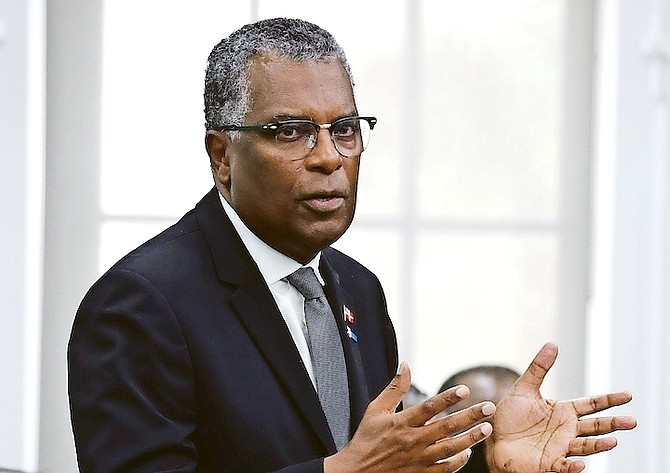
Bahamas Minister of Foreign Affairs Fred Mitchell has forcefully pushed back against scathing critiques of the Davis administration’s planned governance reforms for Grand Bahama, dismissing widespread warnings that adjusting the decades-old Hawksbill Creek Agreement could trigger irreversible economic harm as factually baseless and inflammatory. The sharp rebuke follows public remarks from former Grand Bahama Chamber of Commerce president Dillon Knowles, who told The Nassau Guardian last week that unraveling provisions of the landmark 71-year-old pact would act as a destabilizing “pull of the thread” that could collapse Freeport’s long-standing economic framework.
Mitchell framed the criticism as deliberate fear-mongering orchestrated by political opponents aligned with the opposition Free National Movement, rather than a genuine assessment of policy risks. “The government is taking a bold, forward-looking step to reshape the future of Grand Bahama for all residents, and yet we are facing unfounded attacks from every direction,” Mitchell stated. “In reviewing all public commentary following the prime minister’s policy announcement last week, I was stunned to see one leading critic label these proposed changes catastrophic. That is a foolish, ill-conceived statement with zero grounding in verifiable fact. It is obvious the people using that word have no grasp of what a true catastrophic outcome actually entails.” He went further to denounce the “catastrophic” framing as a “contemptible, damnable lie” designed to mislead the public, and singled out The Nassau Guardian and its executive editor for stoking unnecessary public anxiety around the policy overhaul.
Prime Minister Philip “Brave” Davis first announced the planned end to the existing Hawksbill Creek governance framework last month, describing the 1950s-era agreement as a lingering colonial relic that no longer serves the equitable development interests of all Grand Bahama residents. The administration later released a formal Green Paper laying out its reform roadmap, which includes a full review of all Hawksbill Creek Agreement terms and the drafting of a new Grand Bahama Development Act intended to modernize local governance structures and spread economic opportunity beyond Freeport’s existing special economic zone boundaries.
Mitchell emphasized that Davis delivered his landmark policy address on the campus of one of Grand Bahama’s largest private, foreign-owned employers, a deliberate choice he said signaled the administration has no intention of threatening foreign investment rights or pursuing expropriation of private assets. “None of the international investors in that room voiced any overblown, hyperbolic pushback after hearing the prime minister’s remarks, because they recognized there is no foreign policy risk or threat to their property interests in this reform package,” he noted.
In a direct appeal to Bahamian citizens, Mitchell invoked the famous 20th century German anti-apathy poem often referred to as “First They Came” to urge the public to reject unsubstantiated opposition talking points and defend the administration’s reform agenda. He warned that remaining silent in the face of what he described as deliberate misinformation would leave ordinary Bahamians with no one to advocate for their interests once the opposition’s disinformation campaign escalates.
The Davis administration has formalized a six-month public consultation period running from November 1, 2026, through April 30, 2027, to collect community, business, and stakeholder feedback on all elements of the proposed Grand Bahama overhaul. Officials have outlined a clear subsequent timeline: a finalized White Paper incorporating public input will be released on July 1, 2027, with draft legislation tabled for parliamentary approval in the first quarter of 2028.
Mitchell dismisses criticism that government’s proposed GB reforms could be ‘catastrophic’