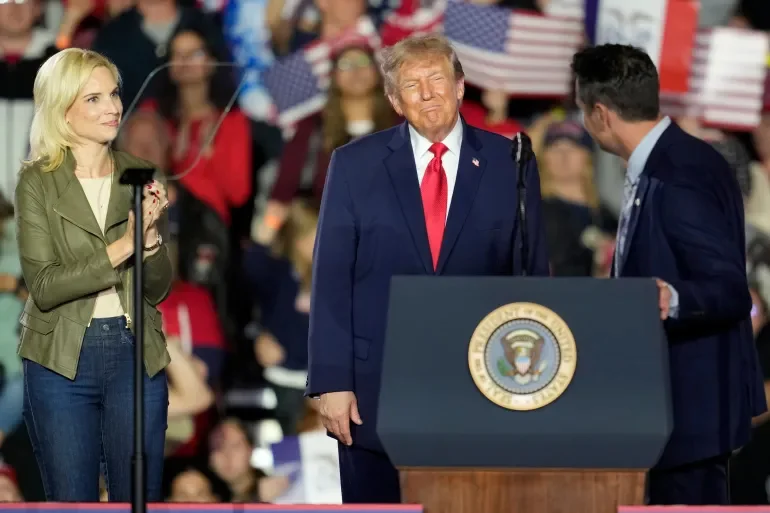
On November 1, 2026, at Dubuque’s Five Flags Event Center in Iowa, Republican Iowa gubernatorial hopeful Zach Lahn and incumbent GOP U.S. Representative Ashley Hinson stood side-by-side, observing former and sitting President Donald Trump address a packed campaign rally, as captured in an Associated Press photograph. Just two days later, on November 3, American voters headed to the polls for the highly anticipated midterm elections, a nationwide contest that will define the trajectory of Trump’s second presidential term for the remaining two years.
Currently, Republicans hold slim majorities in both the 435-seat U.S. House of Representatives and the 100-seat Senate, with 35 Senate seats up for grabs alongside all House spots, including two special Senate elections. The outcome of these races will determine which party controls the legislative branch, which holds core authority over drafting federal legislation, approving government budgets, and conducting oversight of the executive branch. A Democratic takeover of either chamber would severely constrain Trump’s ability to advance his policy agenda, open new avenues for congressional investigations into his administration’s actions, and force grueling bipartisan negotiations over every major bill moving forward.
Recent national polling data underscores widespread voter frustration, particularly over household financial stability: an October 26 Reuters/Ipsos survey found 73% of respondents believe the cost of living is moving in the wrong direction, with soaring grocery prices, fuel costs, housing unaffordability, and expensive healthcare topping voter concerns. Among registered voters, Democrats held a 11-point lead over Republicans in congressional preference, 47% to 36%, and that gap widened to 9 points among likely voters at 53% to 44%. Analysts caution that these national figures do not guarantee a Democratic majority, as results will hinge on localized district dynamics, voter turnout rates, and the popularity of individual down-ballot candidates rather than a uniform national wave.
No state encapsulates the partisan tensions and high stakes of the 2026 midterms more than California, the nation’s most populous state with 52 House seats at stake. The state’s Democratic-led government implemented a controversial redistricting process after voters approved Proposition 50 in 2025, temporarily sidelining the state’s independent redistricting commission to redraw congressional boundaries through 2030. The move was framed as a direct counterweight to Republican-led gerrymandering efforts in other GOP-controlled states, with the new map designed to net Democrats up to five additional House seats, a potentially decisive gain given the narrow Republican majority in the chamber. The redrawn lines have already forced two incumbent California Republicans, Ken Calvert and Young Kim, to run against each other for the same House seat, while turning previously safe or competitive districts into battlegrounds. Key contested races include the Central Valley’s 22nd District, where Republican incumbent David Valadao faces Democratic challenger Randy Villegas in a race centered on cost of living, healthcare, and Trump’s hardline immigration policies that carry outsized weight in the agriculture-heavy region dependent on immigrant labor. In the 48th District along the San Diego-Mexico border, an open seat left by retiring Republican Darrell Issa pits Republican Jim Desmond against Democrat Marni von Wilpert, with the race seen as a critical toss-up that could tip the balance of House control.
A bitter legal battle between the Trump administration and California state officials has further escalated pre-election tensions, after the U.S. Department of Justice launched an investigation into unsubstantiated claims that non-citizens are improperly registered on California voter rolls. The federal government demanded special handling of roughly 20,000 ballots linked to individuals it suspects are ineligible to vote, a request that California officials rejected as based on unreliable, flawed data that risked disenfranchising valid legal voters. Two separate federal judges have since issued rulings blocking the Trump administration’s efforts: one denied the request to segregate the contested ballots, warning it would lead to widespread invalidation of legally cast votes, while a second issued a temporary restraining order in place through November 16 barring federal officials from pressuring local election administrators or threatening them with criminal prosecution for processing ballots in compliance with state law. The legal fight highlights longstanding constitutional tensions over U.S. election governance, where primary authority for administering elections rests with state and local officials under the bounds of federal law, and no evidence of widespread systemic non-citizen voting fraud has been substantiated to date.
California’s concurrent gubernatorial race, termed out incumbent Gavin Newsom, also serves as a critical barometer of state voter sentiment, with former Biden administration Health and Human Services Secretary Xavier Becerra holding a commanding lead over Republican conservative commentator Steve Hilton. A late-October Emerson College poll showed Becerra leading 64% to 36% after accounting for undecided voters, with his campaign tying Hilton closely to the unpopular Trump administration in the deep-blue state, while Hilton has sought to capitalize on voter frustration over high crime, energy costs, and housing shortages.
Beyond U.S. borders, the midterm results carry tangible global implications. As the world’s largest economy and leading geopolitical power, shifts in congressional control will shape U.S. foreign aid budgets, trade policy, climate financing, regional security cooperation, and drug enforcement partnerships that directly impact nations across the Caribbean including Suriname. While the president retains significant unilateral foreign policy powers, Congress holds the power to block funding for administration priorities, impose new regulatory constraints, and launch oversight hearings that can derail diplomatic initiatives. Though the midterms do not feature a presidential race, they function as a de facto nationwide referendum on Trump’s leadership, his domestic policy record, and the direction the U.S. will take for the final two years of his second term.
Amerikaanse midterms: strijd om het Congres zet Trump onder druk