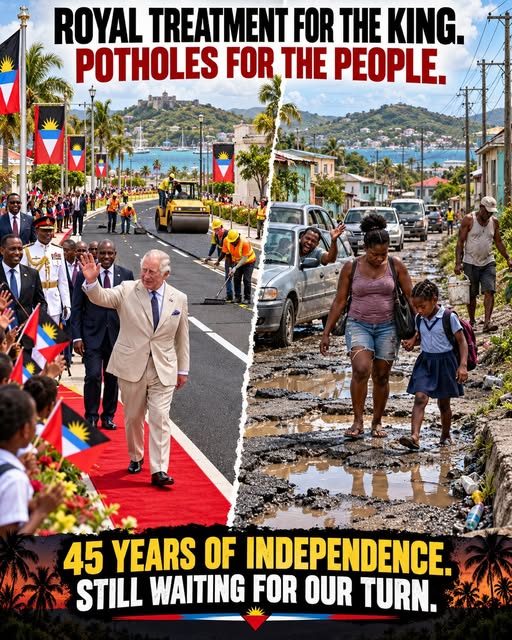
As a 17-year-old teen standing shoulder to shoulder with thousands of fellow Antiguans and Barbudans at the Antigua Recreation Grounds on November 1, 1981, I was swept up in a wave of unbridled hope. The air hummed with pageantry and the long-awaited promise of breaking free from the colonial chains that had for generations stifled national progress. I watched the Union Jack slowly lowered to the strains of *God Save the Queen*, followed by the triumphant raising of Antigua and Barbuda’s sun emblazoned national flag, paired with a soaring, melodic rendition of our newly minted national anthem performed by a British military band. A reverent hush fell over the packed stadium, a tangible, almost hypnotic pause that signaled the birth of a new national era. The entire nation seemed to squeeze into that single venue to witness the historic transfer of power, as Princess Margaret formally handed governing authority to the nation’s first premier VC Bird Sr., triggering a thunderous, spontaneous roar of cheers from overcrowded stands. The night wrapped up in a cascade of fireworks, with a grand final display honoring VC Bird as the official father of the nation. Every attendee left the grounds glowing with optimism, fully convinced that a future of unshared prosperity and self-determination lay just ahead. Fast forward 45 years to October 30, 2026: a Royal Air Force aircraft taxis to a stop at VC Bird International Airport. The pilot leans out the cockpit window to mount two small flags, one bearing Antigua and Barbuda’s national colors, the other emblazoned with the British royal insignia. King Charles descends the aircraft steps with a regal bearing that frames him as no visiting foreign dignitary, but as the reigning monarch of Antigua and Barbuda itself. He is greeted by a line of local officials, escorted down a red carpet to a raised dais, where he accepts a full royal salute and inspects a guard of honor. In that moment, a stark, disillusioning realization washed over me: all the lavish pageantry, the curtsies, the unreserved deference bordering on reverence, even the wide, eager smiles from public figures who had previously spoken publicly in support of colonial reparations, laid bare a harsh truth. That idealistic 17-year-old from 1981 had been duped, just as the public was betrayed by the notorious Antigua Airways corruption scandal. We were told independence would wrest full power from colonial overlords and place it directly in the hands of the people, but 45 years of lived experience reveals almost no meaningful structural shift. It was all a carefully crafted illusion, smoke and mirrors designed to disguise ongoing foreign control. It is almost unfathomable that only in 2026 did elected local officials finally stop taking formal oaths of allegiance to the British monarch and his heirs. It is no trivial coincidence that vast swathes of national territory are still legally designated as Crown Lands, the very legal framework the sitting administration exploited to seize the long-held communal lands of Barbudan residents in what many describe as a treasonous power grab. For four and a half decades, no successive government made it a priority to dismantle colonial-era laws and regulations explicitly engineered to foster blind obedience and robotic servitude, systems designed to prioritize the economic and political interests of Britain at the direct expense of local communities. The British Empire, which once ruled a quarter of the global landmass, built these governing frameworks with ruthless precision to advance its *Rule, Britannia* agenda, embedding total social, political and economic dominance over its former colonies. These systems served British national interests perfectly, but they have never been reoriented to prioritize Antigua and Barbuda’s own development goals. The stark contrast with Singapore is impossible to ignore: in just 25 years of independence, with far fewer natural resources than our twin-island nation, Singapore evolved into a global economic powerhouse, while 45 years on Antigua and Barbuda still relies on begging for financial handouts from our former colonial rulers. The core difference is simple: Singapore immediately implemented sweeping constitutional reform tailored to its own national development priorities, while we retained nearly every vestige of the old colonial governance system. A personal review of Antigua and Barbuda’s constitution reveals that every nominal freedom it appears to guarantee is paired with a deliberate loophole that allows the state to restrict or revoke that right. Unlike the U.S. constitution, which enshrines all individual freedoms as default rights that no government can curtail, our local constitution grants the state near-absolute power. Over my 60-plus years of residence, I have repeatedly witnessed local officials violate individual freedoms with total impunity, most notably through a long string of unchallenged forced private property seizures that have become normalized state practice. The hard truth of this so-called independence is that British colonial rulers installed a local proxy elite that shares our skin color, but serves the interests of the former metropole rather than the local population. This small ruling class inherited all the lavish ceremonial trappings the colonial administration left behind, and has no interest in stripping away these archaic displays of power. They crave public adulation, and use their unaccountable authority to enrich themselves and their close allies at public expense. This is why after 45 years of nominal independence, the vast majority of Antiguans and Barbudans feel no real sense of empowerment over the issues that impact their daily lives, and the government still routinely prioritizes handing over national resources to foreign investors, particularly those hailing from former colonial powers. The absurd lengths the administration went to prepare for the King’s visit lays bare exactly how little regard it holds for its own citizens. Potholes that residents had begged for years to have repaired were patched overnight, all along the route of the royal motorcade, even though many of those exact same road hazards had been left unattended for months, causing costly vehicle damage and daily travel disruptions for ordinary people. In 45 years, I have never seen the local government operate with such speed and single-minded focus. It makes one wonder: if officials treated every local citizen like royalty, could chronic issues like unreliable running water access be fully resolved within a single year? The absurdity of the situation has led many to half-joke that the government should schedule monthly royal visits to different communities across the islands, from Fort James to Dickenson Bay Street, to force the administration to finally repair roads, install sidewalks, and boost public sector productivity to unprecedented levels. Joking aside, the core structural failures run far deeper. Vague public order laws criminalizing “excessive noise” were explicitly drafted in the colonial era to crush grassroots protest against ruling power, and local officials have not hesitated to deploy these archaic statutes to silence prominent activists like Washington Bramble. The old adage that the stick that beats the wild goat beats the tame holds true here. The so-called independence we celebrated in 1981 was never a transfer of power to the local population, but a carefully orchestrated ruse that removed all British financial responsibility for governing the islands, while retaining total structural control. This system mirrors the 1834 emancipation of enslaved people in the British Caribbean, where formerly enslaved people were forced into four years of unpaid apprenticeship, continuing to work on plantations for no pay, while their enslavers no longer bore the cost of housing and feeding them. Antigua and Barbuda skipped the formal apprenticeship phase only because the large population of already freed Black residents meant the exploitative system operated seamlessly without official designation. The local ruling elite function exactly as the Black slave drivers of the plantation era did: as puppet enforcers for distant colonial interests. This is why our so-called independent government meekly acquiesces to unfair, one-sided OECD global financial rules that target small island developing states with arbitrary money laundering and tax evasion sanctions, even as major OECD nations are rife with their own systemic corruption. We are technically independent, but we are far from sovereign. After 45 years, if our government cannot fix basic water access, maintain passable roads, protect private property rights, and defend our national interests from unfair double-standard global rules, what legitimate purpose does it serve? Standing on the cusp of our 45th independence anniversary, the disillusionment is unavoidable: the 17-year-old who cheered the lowering of the Union Jack in 1981 was promised a sovereign, prosperous future, but on November 1, 2026, we are still no closer to that reality.