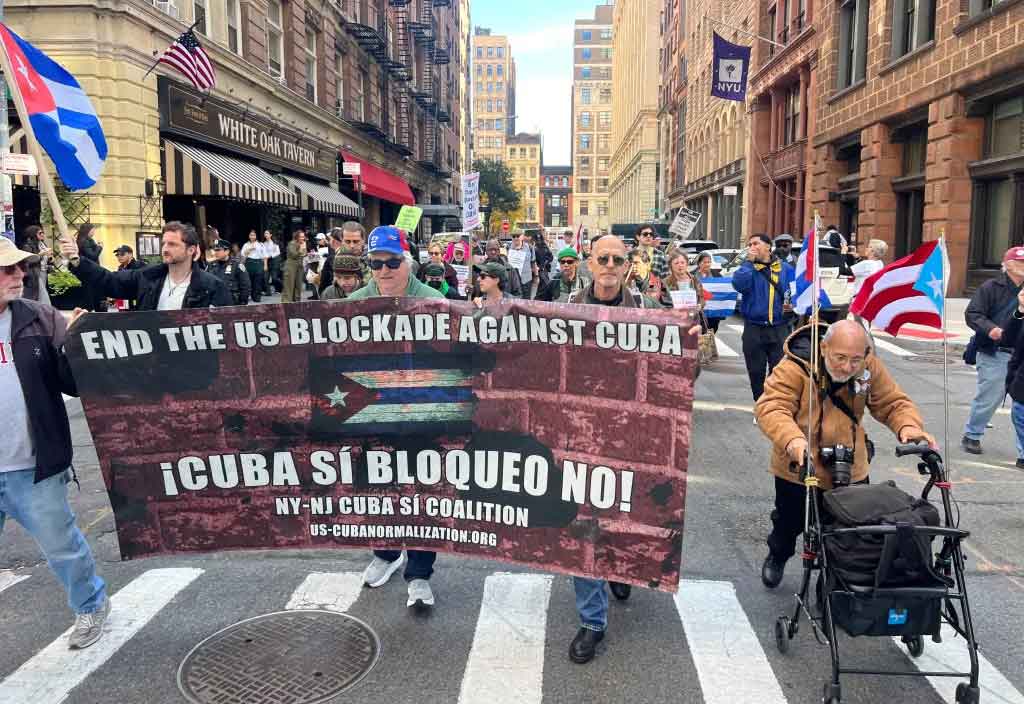
Between October 24 and 31, the National Network on Cuba coordinated a coordinated international advocacy campaign dubbed the “Global Week of Action against the U.S.-Imposed Genocide in Cuba,” uniting hundreds of grassroots activists, labor representatives, community organizers and anti-war advocates across major U.S. cities to demand an immediate end to Washington’s decades-long unilateral economic siege on the Caribbean island.
The cross-country series of events kicked off with an interactive educational forum at the Chicago Cultural Center on October 24, followed by a community gathering at the First Baptist Church in Jamaica Plain, Massachusetts, two days later, and a panel discussion hosted on the Massachusetts Institute of Technology (MIT) campus in Boston on October 27. A large, peaceful march also took place in the streets of New York City, drawing crowds of local residents and solidarity groups calling for normalized U.S.-Cuba relations.
On October 28, the exact same day the United Nations General Assembly held its annual non-binding vote on a Cuban-led resolution demanding the full removal of the U.S. trade and travel blockade, roughly 50 local activists assembled at downtown Miami’s iconic Torch of Friendship monument to stage a public protest against the punitive measures. Longtime local organizer Pete Seidman noted that the demonstration pushed back against prevailing narratives that frame Miami’s Cuban-American community as uniformly supportive of Washington’s hardline policies, highlighting that a significant segment of the city’s population aligns with the overwhelming global majority that backs Cuba’s longstanding call to end the embargo.
Local broadcaster Radio Miami also covered a parallel demonstration held at Chicago’s Federal Plaza, where attendees delivered fiery speeches condemning successive U.S. administrations for policies that intentionally restrict access to essential goods, medicine and fuel for ordinary Cuban citizens, describing the measures as a deliberate attempt to economically suffocate the island nation’s population.
On the U.S. West Coast, labor union members and progressive political organizers in the Los Angeles area, mobilized by Workers United – an affiliate of the national Service Employees International Union (SEIU) – hosted a dedicated gathering to denounce the unilateral blockade that has remained in place for more than 65 years. Local activist Mark Friedman emphasized that the steady turnout for the event reflected growing cross-movement solidarity between U.S. labor groups and Cuban civil society.
Savannah Boyd, a representative from anti-war group CodePink and independent community bookstore All Power Books, stressed during one of the public forums that the ongoing U.S. fuel embargo against Cuba carries immediate, life-altering consequences for ordinary families, rejecting framing of the policy as a distant, abstract partisan debate. Her remarks echoed repeated statements from the Cuban government that characterize the cumulative humanitarian toll of the six-decade blockade as a form of silent, slow-motion genocide.
US support of Cuba and protests against the blockade stand out