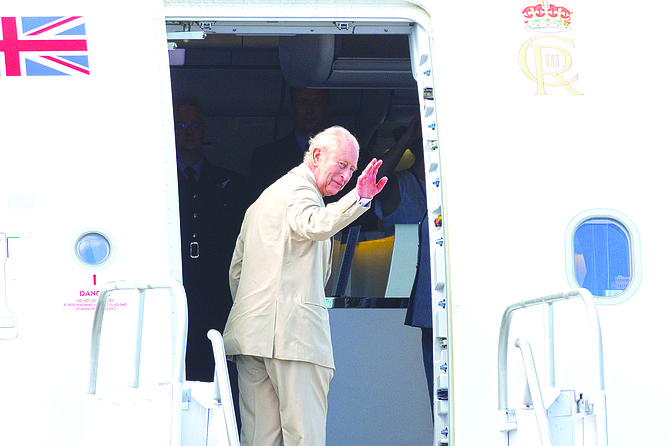
After a packed three-day official tour of The Bahamas, King Charles III departed the Caribbean nation yesterday, pausing on the steps of his waiting aircraft to deliver a final wave to assembled local dignitaries, as Buckingham Palace framed the trip as a landmark diplomatic win for UK-Bahamas bilateral ties. The 77-year-old monarch, clad in a tailored tan suit, traveled to the international airport in a formal royal motorcade led by a Mercedes flying the UK’s Royal Standard, where he was formally escorted down a red carpet flanked by the Royal Bahamas Police Force Commissioner Shanta Knowles and Royal Bahamas Defence Force Commodore Floyd Moxey, as the Bahamian national anthem played for the final time during his stay. Waiting at the foot of the royal aircraft’s staircase to bid him farewell were Bahamian Prime Minister Philip “Brave” Davis (accompanied by one of his young grandsons), Governor General Cynthia “Mother” Pratt, and Health and Wellness Minister Dr Michael Darville. The two leaders paused for several minutes in animated, unscripted conversation before King Charles ascended the aircraft, marking the end of the Bahamian leg of his wider Caribbean Commonwealth tour. The Royal Standard that had flown prominently from a tarmac flagpole for the duration of his visit was formally lowered immediately after the plane’s doors closed. A Buckingham Palace spokesperson noted the King had long held deep personal affection for the archipelago, having first visited in 1973 to witness the nation’s historic independence, and that the warm crowds that lined many public routes during his trip would remain a vivid, encouraging memory as he proceeded to subsequent stops in Guyana and Antigua and Barbuda. The official Royal Family social media channels also published a public message of gratitude to Bahamians who turned out to welcome the monarch. Despite widespread displays of public enthusiasm from royal supporters, the visit faced significant domestic pushback across multiple segments of Bahamian society. Many local residents questioned the lack of clear, tangible economic or developmental benefits tied to the high-profile trip, while others expressed frustration over widespread school closures and dozens of road shutdowns across New Providence that disrupted daily commutes and community routines. Killarney MP Michela Barnett-Ellis publicly questioned why long-delayed road resurfacing projects, including works on Shirley Street, were only completed in time for the royal visit, a claim Works Minister Clay Sweeting refuted, confirming the paving plans had been scheduled months in advance. Critics also accused Prime Minister Davis’s administration of political hypocrisy, noting the government has publicly backed a national transition to a republican system that would remove the British monarch as head of state, yet allocated unreported sums of public taxpayer money to fund the royal visit and hosted lavish formal welcome ceremonies. No official cost breakdown for the trip has been released to the Bahamian public to date. The tour was also overshadowed by sustained, visible protests led by the Rastafarian community and members of the Bahamas National Reparations Committee, who held signs at public royal events demanding formal financial compensation from the UK government for centuries of transatlantic chattel slavery and colonial exploitation. In his opening public speech at a youth rally at Clifford Park on the first day of his visit, King Charles explicitly acknowledged the “great suffering and injustices of the past in these islands and beyond” but stopped short of issuing a formal, explicit apology for British colonial harms, a demand the reparations committee had publicly set as a pre-condition for their support of the trip. Defending the King’s carefully calibrated public remarks, a Buckingham Palace spokesperson told ITV News that the visit was designed as a “sensitive balancing act” that prioritized celebrating the modern, equal partnership between the UK and The Bahamas, addressing shared 21st century challenges including climate change and food security, while acknowledging historical injustices in a respectful, constructive framework. Beyond the political controversies, the tour included a series of warm, unscripted moments that highlighted the King’s longstanding personal ties to the country: he greeted local well-wishers using familiar Bahamian dialect, joked with the 300 young attendees at the Clifford Park rally about his familiarity with the iconic local Junkanoo cultural parade’s three biggest rival groups, the Valley Boys, Saxons Superstars, and One Family, drawing laughter as he teased Prime Minister Davis that he would be pressured to declare a favorite team. At the Royal Bahamas Defence Force’s Coral Harbour base, he laid a commemorative wreath for the four marines killed when the HMBS Flamingo was attacked and sunk by Cuban military jets in 1980, and bonded with retired Captain Whitfield Neely, a surviving crew member, after discovering both had trained at the Britannia Royal Naval College in Dartmouth, England, with the King telling the veteran they were part of the same extended naval family. During a stop at Bonefish Pond National Park, his deep curiosity about local mangrove conservation ecosystems led Bahamas National Trust executive director Lakeshia Anderson-Rolle to joke that the monarch had effectively taken over leading the guided tour. He later broke out in unreserved laughter when staff at the Bahamas Boxing Academy presented him with a custom T-shirt printed with a cartoon of him as a heavyweight champion, complete with a crown, boxing gloves, and a world title belt. The most viral moment of the trip came when the normally reserved 77-year-old monarch joined a spontaneous Junkanoo rush-out on Bay Street, picking up a cowbell painted in Bahamian national colours and disappearing into the throng of performers in elaborate feathered costumes as spectators waved national flags to the sound of the classic local folk track Naughty Johnny. His official schedule wrapped up with a formal garden reception at Government House, where Governor General Pratt welcomed him as a guest “home to The Bahamas” and wished him a long, peaceful reign, with attendees including three former Bahamian prime ministers: Hubert Ingraham, Perry Christie, and Dr Hubert Minnis. Immediately after departing Nassau, King Charles landed at Cheddi Jagan International Airport in Georgetown, Guyana yesterday afternoon to begin a two-day state visit, before he will travel to Antigua and Barbuda to join Queen Camilla for the Commonwealth Heads of Government Meeting running from November 1 to 4.