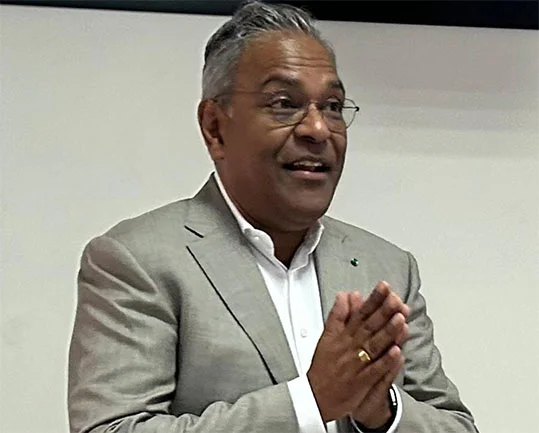
On October 29, distinguished Netherlands-based Surinamese notary Aniel Autar delivered a keynote inaugural lecture for first-year Bachelor of Law students at the Anton de Kom University of Suriname (AdeKUS), framing his address around the theme “The Surinamese Jurist 3.0: New Eras, New Challenges”. Autar emphasized that three concurrent transformative shifts — the rapid expansion of Suriname’s burgeoning oil and gas sector, the 2025 implementation of the revised Civil Code, and the widespread integration of artificial intelligence in legal workflows — are raising unprecedented professional standards for the country’s legal practitioners, far exceeding the traditional requirement of mere mastery of domestic statutory law.
Autar noted that the upcoming GranMorgu offshore oil and gas project, which is on track to deliver its first commercial production in 2028, will bring far more than engineering and commercial opportunities to Suriname. The flood of cross-border energy investments will generate sprawling international contracts, layered financing arrangements, complex liability frameworks, and high-stakes cross-jurisdictional disputes, while even local small and medium-sized enterprises supplying goods and services to the sector will increasingly face foreign legal systems and international arbitration proceedings. He argued that national local content policies must expand beyond creating entry-level jobs and awarding local corporate contracts to prioritize nurturing homegrown legal expertise, ensuring Surinamese jurists can sit as equal, authoritative representatives at international negotiation tables rather than relying exclusively on external foreign legal counsel.
Turning to the newly enacted 2025 Civil Code, Autar cautioned against unthinkingly importing Dutch legal frameworks to Suriname, stressing that the nation’s unique legal heritage, communal land tenure systems, indigenous community legal norms, and distinct local family and social dynamics demand context-specific legal expertise. Practitioners must develop a nuanced command of not only the new civil code provisions but also legacy pre-reform laws and transitional legal rules governing overlapping cases between the old and new regulatory regimes.
On the integration of AI into legal practice, Autar acknowledged the technology’s utility for accelerating legal research and drafting routine legal documents, but warned of well-documented risks including fabricated non-existent judicial precedents, misstated statutory provisions, and erroneous analytical outputs. He stressed that jurists must retain robust independent subject-matter expertise to identify AI-generated errors, safeguard confidential client data at all times, and bear full, unshared professional liability for all formal legal advice issued, regardless of any AI tools used to support workflow.
Beyond technical specialization in energy law, corporate law, and emerging tech regulation, Autar underscored the non-negotiable importance of lifelong continuous professional development, a broad foundational grounding in core legal principles, and unwavering professional independence. He reminded students that they must be prepared to render impartial judgments even when facing pressure from clients, employers, or powerful public and private stakeholders, rejecting commercial interests or longstanding informal customary practices as justifications for unethical professional conduct. He concluded by noting that Suriname’s projected future economic growth will only deliver durable, inclusive, sustainable benefits if paired with strong legal certainty, robust institutional integrity, and equitable legal protection for both ordinary citizens and local enterprises, urging the cohort of future legal professionals to prioritize accessible, ethical representation for marginalized communities facing powerful opposing parties. “Suriname has placed its highest hopes on its future, and that future rests on your shoulders,” Autar told the incoming law students.