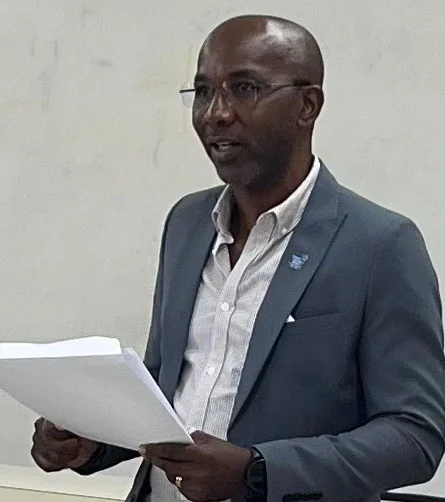
During the inaugural lecture for the Faculty of Mathematics and Natural Sciences at Anton de Kom University of Suriname, industry veteran Steven Alfaisi laid out a forward-thinking, actionable framework to steer Suriname away from overreliance on finite oil and gold reserves toward inclusive, enduring shared prosperity. Drawing on decades of on-ground experience leading community development and stakeholder engagement initiatives at state-owned oil firm Staatsolie, and in his current role at gold sector enterprise Miata Metals, Alfaisi argued that Suriname’s windfall revenues from extractive industries represent a one-time, time-bound opportunity to build permanent knowledge ecosystems, safe public living conditions, and a resilient multi-sector economy that does not depend on depleting natural assets.
Alfaisi emphasized that core STEM disciplines — biology, mathematics, physics, and chemistry — are the foundational bridge to this transition, but their impact can only be unlocked when paired with intentional community inclusion, local entrepreneurship, and transparent, accountable governance. He noted that large-scale extractive investments often overlook the most pressing, practical concerns of the communities that host operations: will their children access stable local employment after projects conclude? Will their drinking water and food supplies remain uncontaminated long after extraction sites are closed? Will local residents have a formal seat at decision-making tables that reshape their living environments, and clear avenues for redress if harm or disputes arise? Citing Nobel Prize-winning American economist Joseph Stiglitz’s core thesis that meaningful development is a holistic social transformation rooted in accessible knowledge, broad public participation, and local agency, Alfaisi challenged attending STEM students to continuously evaluate how their academic work can deliver tangible, equitable public value, rather than remaining confined to laboratory or lecture hall settings.
To turn this philosophy into actionable practice, Alfaisi introduced the user-centric BRUG methodology, a structured four-step framework that unites academic research, administrative decision-making, and on-the-ground implementation: the acronym stands for Begrijpen (Understand), Richting kiezen (Set Direction), Uitvoeren (Execute), and Gezamenlijk toetsen (Collectively Evaluate). The framework’s success is measured not by formal policy documents or technical reports, but by whether the resulting public systems deliver real, measurable benefits for the communities they are designed to serve, creating a direct, sustainable bridge between temporary oil and gold revenues and long-term national development capacity. This approach aligns fully with the World Bank’s established guidance for exhaustible resource management, which requires nations to prioritize building permanent, transferable national wealth rather than spending extractive windfalls on short-term, unsustainable consumption.
Alfaisi laid out three mutually reinforcing development tracks to deliver on this vision. The first track focuses on protection and long-term savings: a national savings and economic stabilization mechanism to buffer the country against volatile global oil prices and unpredictable fluctuations in extractive sector revenue, ensuring public funds are distributed evenly across generations rather than spent during short-term boom cycles. The second track centers on investing in human capital and universal public services, including high-quality accessible education, robust public healthcare, reliable universal energy access, widespread digital connectivity, and well-maintained cross-country public infrastructure. The third track prioritizes targeted growth in non-extractive productive sectors, with dedicated investment in applied research, small business skill-building, standardized quality control systems, and expanded access to regional and global export markets. Alfaisi stressed that balanced, coordinated progress across all three tracks is non-negotiable, with all planning anchored in realistic revenue projections, transparent debt management, verifiable implementation capacity, and publicly agreed social priorities.
To prevent uncoordinated, ecologically damaging development, he also called for the formal adoption of a binding National Spatial Planning Act, which would set aside dedicated protected zones for critical ecosystems, freshwater sources, and culturally significant heritage sites, while allocating clearly demarcated, appropriately zoned land for sustainable agriculture, residential development, public infrastructure, low-impact tourism, and regulated mining, with full, legally mandated community participation and respect for indigenous and local land rights embedded as core requirements for all planning decisions.
For economic diversification, Alfaisi identified four high-potential, low-footprint priority sectors that align with Suriname’s unique national strengths: sustainable agriculture and local food processing, biodiversity-focused ecotourism, integrated cross-sector water and energy management, and knowledge-based professional services paired with a scalable circular economy. He noted that priority setting for these sectors must be guided by clear, evidence-based criteria: proven existing market demand, capacity to meet consistent international quality standards, clear pathways to create formal, well-paying jobs for Surinamese citizens, minimal negative impacts on public health and fragile ecosystems, and long-term operational viability without ongoing permanent subsidies from remaining oil revenues. To ensure development benefits are distributed evenly across the country rather than concentrated in the capital, Alfaisi proposed rolling out a network of decentralized regional development centers nationwide to stimulate inclusive local growth and foster productive public-private partnerships. He also called on the university’s Faculty of Mathematics and Natural Sciences to launch an annual interdisciplinary program, where cross-departmental student teams collaborate with local industry partners and adjacent community groups to solve on-the-ground local challenges, ranging from drinking water quality monitoring and post-harvest food loss reduction to waste stream optimization, ecotourism planning, and residential energy efficiency upgrades. This model, he argued, will help cultivate a new generation of locally rooted STEM professionals who are deeply connected to community needs, and prepared to deploy their technical expertise to advance equitable national development long after Suriname’s oil and gold reserves are depleted.
Wat blijft over als de olie op is?