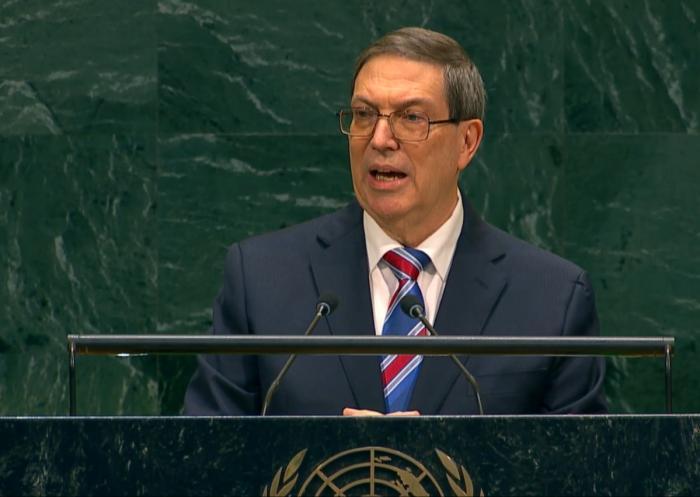
On October 29, 2026, Cuban Minister of Foreign Affairs Bruno Rodríguez Parrilla delivered a landmark address during the United Nations General Assembly’s debate on Agenda Item 37, the long-running call to terminate the U.S.-imposed economic, commercial and financial blockade against Cuba, opening with official condolences for the fatalities of the recent Toledo railway accident in Spain, and commending the General Assembly President for upholding the body’s formal rules of procedure the prior day.
The foreign minister first raised two urgent procedural grievances against the U.S. delegation: he condemned uninvited, non-consensual surveillance and filming of Cuban diplomatic staff by a U.S. official, an incident that required UN security intervention, describing the act as a violation of diplomatic decorum, personal dignity and privacy that ran counter to the UN’s core norms, and framing it as a deliberate tactic to undermine Cuba’s pending candidacy for a UN intergovernmental body. He further exposed that a designated internationally wanted Cuban terrorist, listed at position 52 on Cuba’s official most-wanted registry via formal legal resolution published in the island’s Official Gazette, had been granted gallery access to the Assembly by the U.S. permanent mission. The individual, linked to two U.S.-based terrorist organizations with a documented history of violent attacks against Cuba, had also embezzled large sums of U.S. government earmarked funding for personal enrichment. Rodríguez formally requested the General Assembly President to direct the UN Secretariat to verify the individual’s presence and immediately remove him, noting his presence constituted an insult to all global victims of terrorism, including 9/11 casualties and hundreds of Cubans killed by U.S.-based violent extremists, and served as irrefutable proof that Cuba had no place on the U.S.’s arbitrary, discredited state sponsors of terrorism list.
Rodríguez then noted the prior day’s address by the U.S. representative had inadvertently strengthened Cuba’s case, citing the American diplomat’s defiant declaration “This is America” as a revealing window into Washington’s hegemonic worldview that treats the entire planet as de facto U.S. territory, framing sovereign nations like Cuba as de facto subordinate entities equivalent to one of the 50 U.S. states. This imperial mindset, he argued, underpinned the U.S. doctrine of “peace through strength” that justifies coercive intervention against smaller, independent states. He dismissed Washington’s long-running designation of Cuba as an “unusual and extraordinary threat” to U.S. national security as the height of cynicism, noting the small Caribbean nation posed no conceivable risk to the world’s largest nuclear power, while the 60+ year blockade was the real, ongoing existential threat to Cuban livelihoods. He highlighted the U.S. delegate’s absurd, factually baseless claim that “the blockade against Cuba does not exist”, then displayed a live public counter tracking real-time damages from the sanctions, noting that in the mere hours since the prior day’s debate opened, the blockade had inflicted more than $22.9 million in verified economic harm on Cuban communities.
The foreign minister characterized the U.S. campaign against Cuba as a deliberate, undeclared economic war targeting a peaceful, solidarity-focused small sovereign state, designed explicitly to force regime change and full U.S. domination. The ongoing fuel blockade, he stressed, functioned as a de facto naval siege that qualified as an act of war, collective punishment and a potential violation of the Genocide Convention, all explicitly banned under international law. The measures’ cascading harms permeate every facet of Cuban daily life: shortages of food for children, life-saving medicines for the sick, consistent electricity, clean potable water, and accessible supplies for routine medical operations, turning basic human needs into tools of political coercion. He contextualized that while the General Assembly has held annual votes on ending the blockade since 1992, the 2026 debate unfolded in an unprecedented new landscape, where the U.S. government had launched a coordinated campaign of pressure, intimidation and blackmail against dozens of UN member states, demanding they abandon their decades-long consistent, sovereignty-aligned votes against the blockade. Rodríguez presented official documentary evidence of this U.S. coercion, noting the moment represented a defining test for the entire multilateral system: if the UN allowed Washington to dictate how nations vote, who they trade with, which shipping routes they can use, and what financial partnerships they can enter, today that arbitrary pressure would target Cuba, but tomorrow it could be deployed against any other sovereign UN member state. The Assembly, he emphasized, was being called on to decide whether to normalize collective punishment tactics designed to break a nation’s political will through economic strangulation, mass hunger, and widespread civilian suffering.
Rodríguez detailed that U.S. aggression against Cuba had been drastically escalated since the start of 2026, with the Trump-era maximum pressure policies first imposed in 2019 transformed into a medieval-style full siege as of January 2026, with dozens of new unilateral coercive measures added to the already draconian six-decade sanctions architecture. The U.S. State Department had openly admitted its goal of preventing Cuba from developing any escape routes from the sanctions stranglehold, with Secretary of State publicly stating on August 7, 2026, that every time Cuba develops a new policy to evade the blockade’s noose, the U.S. will tighten restrictions further to eliminate all available pathways. He dismissed U.S. pretexts for the blockade as entirely baseless, noting no UN member state accepts the absurd claim that Cuba poses a threat to U.S. national security, and that in reality Cuba has for decades voluntarily shared sensitive intelligence on transnational drug trafficking, terrorist plots and other cross-border crimes that directly benefited U.S. and regional security, even amid the current administration’s open hostility. He called out Washington’s rank hypocrisy for leveling unsubstantiated accusations of elite corruption and inequality against Cuba, coming from the world’s largest plutocracy where corporate money dominates political representation and a sprawling, unaccountable military-industrial complex is widely recognized as a threat to U.S. democratic governance. He further condemned U.S. slander targeting Cuba’s global medical internationalism programs operating in more than 50 countries, which the U.S. had repeatedly tried to sabotage through blackmail and disinformation campaigns falsely framing Cuban medical personnel as victims of human trafficking or state enslavement.
Rodríguez laid out the catastrophic, human-scale harms of the escalated blockade in unflinching detail: since the maximum pressure policy was fully implemented, Cuba’s infant mortality rate has doubled, with 70% of all essential medicines now out of stock even though Cuba has the domestic capacity to produce nearly all of them, leaving 100,000 people including 12,000 children on long waiting lists for postponed life-saving surgeries. He held up two tangible examples of the blockade’s absurd cruelty: the U.S.-produced lung cancer medication Pemetrexed, which Cuba can afford to purchase but is barred from accessing under sanctions, driving a sharp rise in Cuban cancer fatalities, and the Cuban-developed Alzheimer’s treatment Neuralcim, a breakthrough therapy proven to slow neurodegenerative decline, which the U.S. blockade blocks 7 million American patients from accessing entirely. He noted 85% of Cuba’s potable water pumping systems run on electricity, and the ongoing fuel and power shortages linked to the blockade have left 2.6 million Cubans without reliable access to clean drinking water, while U.S. secondary sanctions have blocked 7,000 contracted shipping containers carrying food, medicine, hemodialysis supplies and medical equipment from reaching Cuban ports. Public opinion polling, he noted, showed 72% of U.S. taxpayers oppose the ongoing blockade, 60% support full normalization of relations, and only 25% of Americans back the harsh fuel siege measures.
Rodríguez rejected Washington’s token, restricted humanitarian aid carveouts as proof the blockade does not exist, noting the full $100 million in advertised U.S. humanitarian aid to Cuba would only offset five days of the blockade’s total economic damage, and could power national electricity grids for just two weeks, and could never replace Cuba’s inherent right to unobstructed international trade. He outlined the wide range of targeted, community-led Cuban policies that had prevented the U.S. from triggering a full catastrophic humanitarian crisis, including massive investments in photovoltaic energy, expanded domestic crude oil production and refining capacity, targeted social safety nets for vulnerable populations, expanded agroecological farming to boost domestic food production, and optimized reorganization of health and education services. He concluded by formally introducing draft resolution A/81/L.5, calling on all UN member states to vote in favor of ending the blockade as a demonstration of commitment to international law and multilateral justice, on the 100th anniversary of Cuban revolutionary leader Fidel Castro Ruz’s birth. Reiterating the longstanding Cuban national slogan “Homeland or Death! We shall overcome!”, Rodríguez reaffirmed Cuba’s unwavering commitment to defending its sovereignty under the leadership of Raúl Castro Ruz and President Miguel Díaz-Canel Bermúdez, noting Cuba’s only request was to be left in peace to resolve its own domestic challenges without external aggression.
«The blockade silently kills and punishes our population like never before»