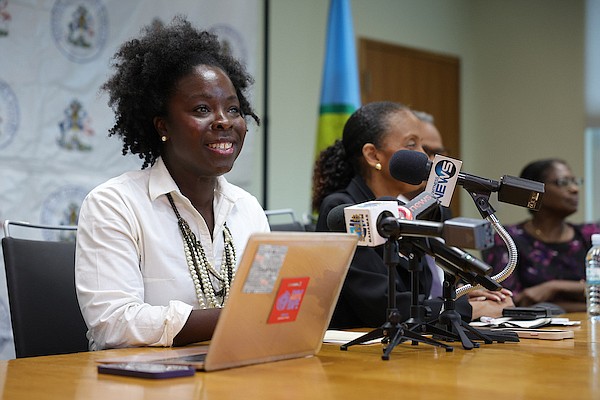
Leading Bahamas National Reparations Committee figure Dr. Niambi Hall Campbell-Dean has shared her firsthand account of being instructed by local law enforcement to stow her pro-reparations placard if she wished to remain in Parliament Square to observe King Charles III’s hosted Junkanoo cultural celebration, according to a recent report from The Tribune’s staff reporter Keile Campbell. Attending the public event as a private Bahamian citizen, Dr. Hall Campbell-Dean explained she had planned to both engage with the beloved local Junkanoo tradition and peacefully demonstrate her disappointment that the British monarch has not issued a formal public apology for the United Kingdom’s centuries-long role in the transatlantic chattel slavery system. She confirmed that she and fellow nearby activists complied with officers’ direct requests to put their placards away, with accompanying UK press traveling with the royal party also documenting police rapidly approaching other demonstrators in the Parliament Square crowd holding signs reading “Pay us what you owe us.” The royal engagement saw King Charles observe the vibrant Junkanoo rush-out performance for several minutes before joining the parade himself, picking up a pair of maracas to participate in the festivities. This reported interaction marks the second public complaint in as many days regarding police actions to keep pro-reparations demonstrators out of the monarch’s direct line of sight: just one day prior, on Tuesday, a group of Rastafarian activists gathered at the King’s youth rally at Clifford Park, who were demanding a formal apology, reparations, and support for repatriation to Africa, accused law enforcement of repeatedly ordering them to relocate throughout the event. Despite these recent restrictions, Dr. Hall Campbell-Dean emphasized that the national reparations movement is not contingent on King Charles issuing an apology during his current Bahamas visit. “Our work and our movement is bigger than just this king apologising,” she stated. “If he doesn’t, then we’re just going to continue to do the work.” The committee’s ongoing efforts prioritize widespread public education across the Bahamas, with plans to publish historical resources, host public seminars and workshops, and lead educational talks in local schools to unpack the full, untaught history of the Bahamas’ colonial ties to the British monarchy, and explain why the monarch’s failure to apologize for the harms of slavery during his visit represents a profound injustice. During his Tuesday address at Clifford Park, King Charles acknowledged the profound suffering and historical injustices tied to the colonial era, noting that many of the most cherished elements of modern Bahamian culture emerged out of that dark period of history. He stopped short of issuing a formal, explicit apology for Britain’s role in chattel slavery, instead referencing upcoming deliberations between Commonwealth heads of state at the Commonwealth Heads of Government Meeting scheduled to take place in Antigua and Barbuda from November 1 to 4. Dr. Hall Campbell-Dean clarified that local grassroots protests and the upcoming intergovernmental summit serve distinct, complementary purposes: public demonstrations act as a critical tool to raise awareness and educate everyday Bahamians on reparations demands, while the regional summit creates a formal policy space for national leaders to advance tangible action on the issue. She added that she hopes Commonwealth leaders will move beyond vague references to slavery as a “dark chapter” in British history, and formally acknowledge the full legal and moral responsibility for the atrocities committed against enslaved African people. “It was a crime then, and it is a crime now,” she asserted. While she expressed disappointment that a segment of the Bahamian public does not currently support the reparations movement, she noted this pushback is not entirely unexpected, and stems from longstanding gaps in formal public education about the full scale of chattel slavery’s atrocities. “We still have a long way in learning the truth about what happens in this system,” she explained. “We don’t know a lot of the details that would allow us to fully understand all of the atrocities that were committed.” She went on to outline that the entire system of chattel slavery was built on the deliberate dehumanization of enslaved African people, a strategic framework designed to frame the treatment of human beings as disposable property as a legally legitimate practice. “But if you’re no longer a person, then what I’m doing is not a crime, right? So they remove the humanity to try and add some sense of legality to a completely immoral act,” she noted. “And when we understand and learn these details, then I think the movement becomes very simple. A crime was committed. You have to pay.”
Reparations leader says police barred protest placard at King’s Junkanoo celebration