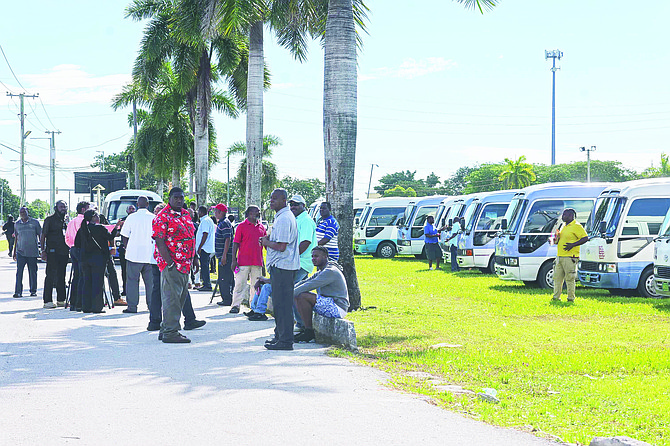
Hundreds of daily commuters across New Providence found themselves stranded at bus stops for hours this week after private public transit operators pulled nearly 100 vehicles off regular routes to stage a coordinated protest, demanding an immediate upward adjustment to standard adult fares amid crippling operating cost inflation. The unannounced work stoppage coincided with widespread road closures and diversions implemented for King Charles III’s official motorcade, which had already snarled cross-island travel since the monarch’s Tuesday arrival, creating cascading delays for residents attempting to reach work, school, medical appointments and other routine commitments. Operators gathered en masse at RM Bailey Park for the demonstration, with many choosing to travel to the site via private vehicle rather than operating their scheduled routes. The transit workers’ core demand is to raise the base adult fare from the current $1.50 to $2.00, a hike they argue is non-negotiable after decades of stagnant pricing that has left small business owners and drivers operating at a net loss amid surging fuel, parts and maintenance costs. Current industry leadership notes the most recent 25-cent fare increase, implemented on May 1, 2024, marked the first adjustment in 16 years, and that the $2 rate had previously been promised to operators by government representatives. Longtime drivers with 30+ years in the sector shared that daily fuel costs to fill a single bus have ballooned from roughly $20 in the 1990s to $150-$160 today, with individual parts including tires, brake components and engine oil rising between 50% and 200% in cost over the past half-decade. Many operators stated they are effectively subsidizing public transit out of pocket, with one driver reporting he earned only $126 in fares on a single recent day, less than the $130 he needed just to refuel his vehicle for the next shift. Union and company leadership emphasized that the stoppage, framed by one organizer as a “sick day” rather than a formal strike, was a last resort after years of unreturned outreach: operators submitted a formal letter outlining their financial crisis to the Ministry of Finance as early as June, and a previously scheduled negotiation session set for earlier that week was abruptly canceled with no rescheduled date. United Public Transportation Company President Harrison Moxey warned that additional, more disruptive industrial action would follow if scheduled 1pm Friday negotiations with Transport Minister Leon Lundy fail to produce tangible results rather than empty promises of further discussion. Following several hours of widespread transit chaos, Lundy confirmed an interim agreement with industry leaders that would restore limited bus services by 3pm the same day, in exchange for operators pausing additional protest actions ahead of the formal talks. While the minister acknowledged that operators’ cost concerns were valid, he criticized the timing of the unannounced stoppage as counterproductive to good-faith negotiation, noting that thousands of low-income Bahamians who rely exclusively on public transit for daily travel should not be forced to bear the brunt of a labor-government dispute. Lundy later outlined that the upcoming Friday meeting will cover far more than fare adjustments: the agenda will also include discussions on road safety enforcement, regulatory compliance, potential bus route reconfigurations, and the long-discussed revival of a centralized, coordinated public bus system pilot program, an initiative successive Bahamian governments have attempted to roll out for decades with Inter-American Development Bank support to replace the current fragmented network of privately operated jitney routes.