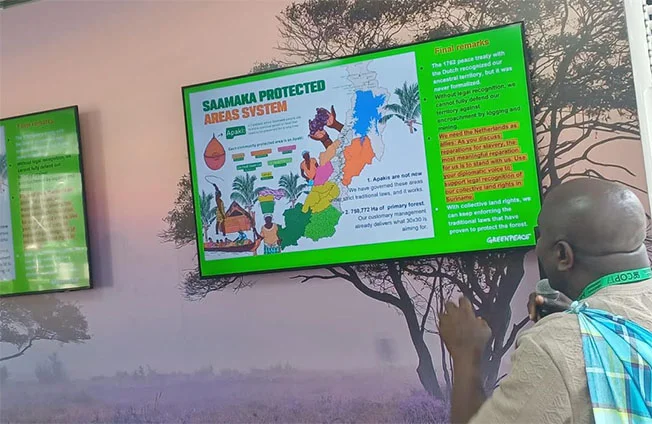
On October 28, the Association of Saamaka Communities (Vereniging Saamaka Gemeenschappen, VSG) used its platform at the 17th Conference of the Parties (COP17) held in Armenia to deliver a firm, long-overdue call to the Surinamese national government and the wider international community: empty promises of forest protection and indigenous rights must be replaced by tangible, enforceable action to formally recognize the Saamaka people’s collective land rights and safeguard their ancestral traditional territories.
For generations, the lush rainforests that the Saamaka have stewarded are far more than a natural habitat: they form the unshakable foundation of the community’s unique cultural identity, intergenerational traditions, and sustainable livelihood systems. VSG emphasized that no biodiversity or forest conservation policy can deliver long-term success if the communities that have protected these ecosystems for centuries are denied formal legal land protections or systematically excluded from all relevant decision-making processes. Currently, these critical ancestral territories face mounting, irreversible pressure from unregulated deforestation, unlicensed illegal gold mining, and other extractive activities that are eroding fragile forest ecosystems at an alarming rate. Without formal legal codification of collective land rights, both the Saamaka communities and the ancient rainforests they rely on will remain perpetually vulnerable to exploitation.
A core pillar of VSG’s advocacy push is the full, unreserved implementation of the landmark 2007 Inter-American Court of Human Rights ruling in the Saamaka case, which ordered Suriname to recognize the community’s collective territorial rights, alongside all other international judicial decisions upholding indigenous and tribal community rights across the country. The association is also calling for immediate acceleration of pending national legislation that would formalize legal protections for collective land holdings and traditional use areas, rejecting the longstanding pattern of making unmonitored international pledges without follow-through. VSG is demanding clear, targeted policy measures with explicitly assigned institutional responsibilities and verifiable, public progress tracking, as well as strengthened regulatory safeguards to block harmful extractive and industrial activities that damage community territories before they can be approved.
The organization also reaffirmed the centrality of the internationally recognized Free, Prior and Informed Consent (FPIC) principle, which requires that indigenous and tribal communities receive full, timely, accessible information about any proposed project that may impact their territories or livelihoods, and are granted full autonomy to make decisions on such projects through their own traditional governance processes, no external pressure applied. VSG stressed that traditional Saamaka leaders and community members must be treated as equal, full partners in all policy drafting related to nature conservation, sustainable land management, and economic development activities taking place on their ancestral lands, and that the generations of accumulated traditional ecological knowledge the Saamaka hold for sustainable forest stewardship must be formally recognized and integrated into national conservation frameworks.
VSG emphasized during its COP17 interventions that biodiversity protection is not merely a narrow environmental issue: it is inextricably tied to fundamental human rights, cultural survival, and the inherent right of marginalized communities to exercise agency over their own collective future. The Saamaka’s millennia of traditional, low-impact stewardship of the Surinamese rainforest has already delivered enormous, proven contributions to preserving regional ecosystem health and carbon sequestration capacity, which justifies granting the community a central, decision-making seat at all discussions governing the protection and sustainable use of these critical forest landscapes. Closing its statement, VSG called on Surinamese authorities to stop treating land rights recognition, international court ruling compliance, and forest protection as separate, disconnected policy priorities, and instead roll out a cohesive, actionable integrated framework that centers Saamaka leadership. The association summed up its core message with the powerful Saamaka creed: “Wi na busi, Busi na Wi!” — We are the forest, and the forest is ours.
VSG eist op COP17 concrete actie voor grondrechten Saamaka