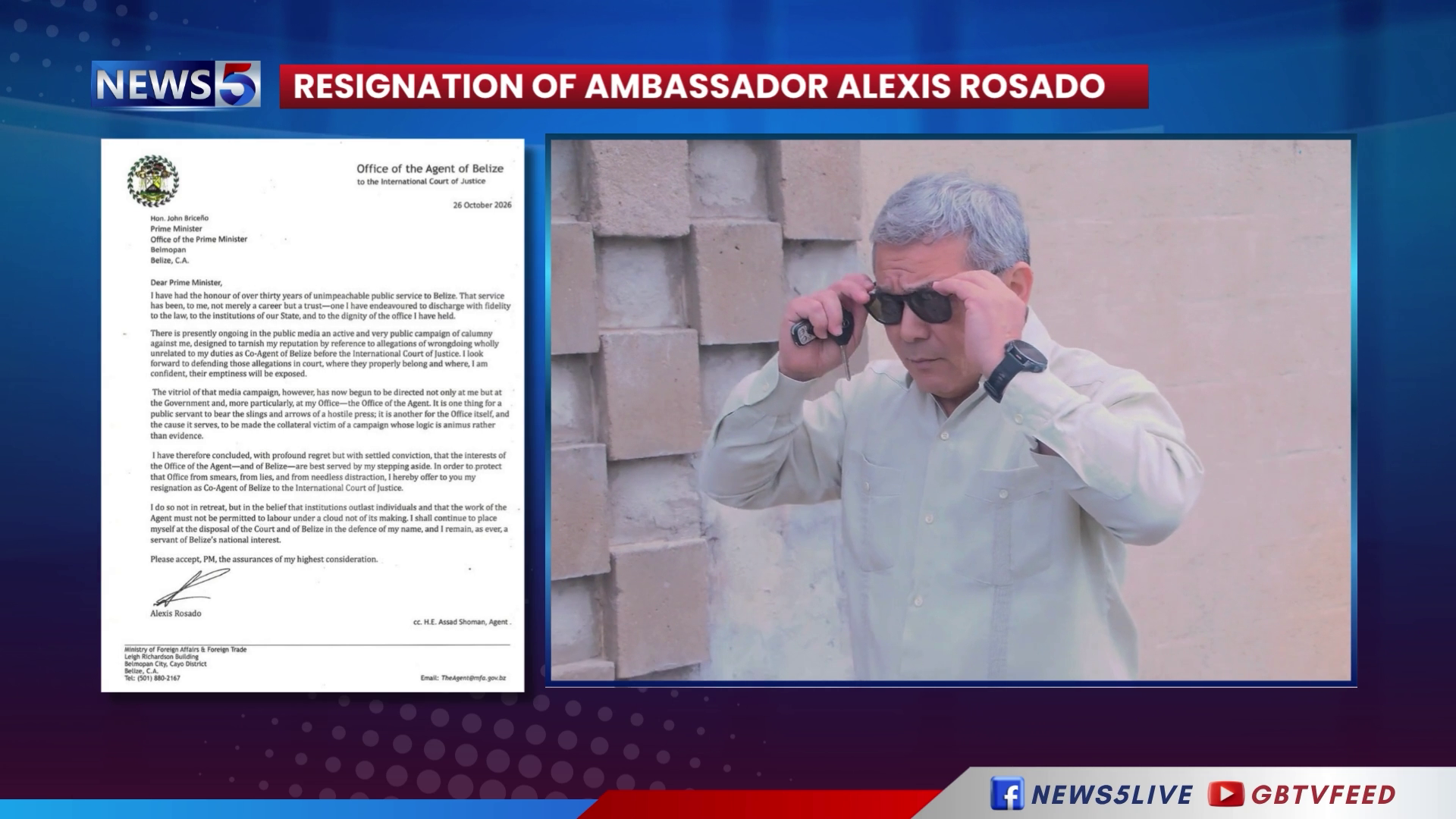
On October 27, 2026, veteran Belizean diplomat Alexis Rosado formally stepped down from his post as Co-Agent representing Belize in the high-stakes ongoing territorial case at the International Court of Justice (ICJ), a move he frames as a deliberate, duty-driven choice to shield national interests rather than a response to mounting public and official pressure over concurrent unresolved criminal proceedings against him. In his public resignation letter, Rosado opens not by addressing the weeks of widespread scrutiny that preceded his departure, but by spotlighting his 30-year tenure in public service, which he unreservedly describes as entirely unimpeachable. He characterizes the sustained criticism that ultimately led to calls for his removal as a coordinated, malicious “campaign of calumny” built on deliberate falsehoods designed to tarnish his personal and professional reputation, repeatedly emphasizing that the pending criminal allegations against him bear no connection to his work on the ICJ file. While Rosado maintains he is fully entitled to the legal presumption of innocence and has committed to vigorously defend himself in national courts to clear his name, the carefully worded statement notably avoids directly addressing the core of public and official concerns that led to cross-sector demands for his resignation: the fundamental question of whether a public servant facing active criminal proceedings could erode public confidence in Belize’s representation at the world’s highest international court, and undermine the integrity of the Office of the Agent for the ICJ case. Even as he frames his last-minute decision to resign after extended “careful reflection” as a selfless act of national service intended to eliminate distracting controversy from the landmark ICJ proceedings, the letter conspicuously fails to explain why he did not step aside voluntarily when the first public concerns about the conflict of his dual roles emerged weeks prior. Notably, formal calls for his removal from senior public figures including House Speaker Valerie Woods never demanded a pre-emptive judgment on the unresolved criminal charges themselves, but instead centered on protecting institutional credibility, public trust, and the unimpeded progress of one of the most consequential international legal cases in Belize’s modern history. Rosado’s resignation does not constitute an admission of wrongdoing, and his departure removes the immediate distraction of the surrounding controversy from the national ICJ legal team. However, his carefully calibrated defensive narrative leaves Belizean public discourse with two competing, unresolved accounts of the months-long standoff: one that casts Rosado as a long-serving public servant who made a principled sacrifice to prioritize his country’s interests, and another that frames him as a senior official who resisted legitimate public accountability pressure for as long as possible before being forced to step down. While the national judiciary will ultimately deliver a verdict on the pending criminal allegations against Rosado, the broader public debate over standards of public office, judgment for senior diplomatic appointees, and the accountability of officials representing national interests on the global stage is set to continue long after his formal departure from the ICJ post.