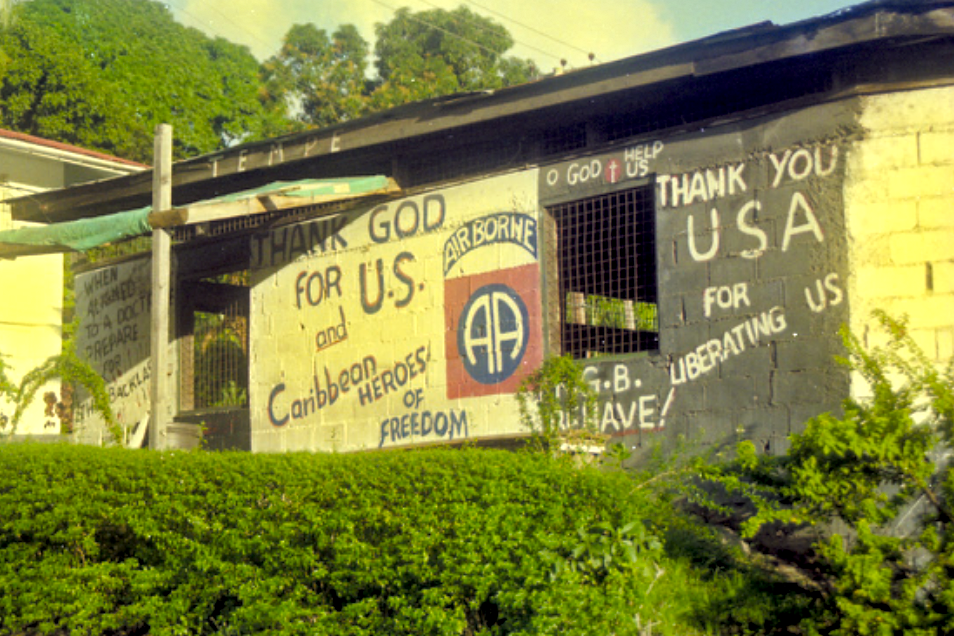
On the morning of October 25, 1983, hundreds of U.S. military personnel launched coordinated combat operations across the Caribbean island nation of Grenada, with three publicly stated core objectives: safeguarding the safety of foreign nationals, most notably the hundreds of American medical students enrolled at St. George’s University (SGU); restoring democratic governance to the territory; and rooting out all Cuban and Soviet military and political presence operating across the island chain. The chain of violent, destabilizing events that unfolded on October 19, 1983, pushed the leadership of the Organisation of Eastern Caribbean States (OECS) to vote in favor of cross-border military intervention. While the 1981 OECS Treaty’s Article 8 explicitly obligated all signatory states, including Grenada’s ruling People’s Revolutionary Government (PRG), to come to one another’s defense in the event of external armed aggression, the charter contained no explicit legal provision authorizing member states to interfere in the domestic internal affairs of a fellow signatory. Despite this clear legal gap, OECS member states cited the collective defense clause as their formal pretext for a military incursion, and lacking the manpower and heavy military equipment to execute such an operation on their own, they joined forces with Barbados and Jamaica to formally request military support from the United States. To add a veneer of constitutional legitimacy to the action, a formal written request was issued by Grenada’s Governor-General Sir Paul Scoon, calling on U.S. and OECS forces to intervene militarily, though persistent rumors circulated for decades that the letter had been backdated, even as officials confirmed a verbal appeal for support had been made in the immediate aftermath of the October 19 unrest. A significant bloc of Caribbean nations, including Trinidad and Tobago, Guyana, and the Bahamas, publicly condemned the planned military action as a violation of Grenada’s national sovereignty. Dubbed Operation Urgent Fury, the mission was cobbled together on an extremely tight, rushed planning timeline, but U.S. military officials publicly framed it as a carefully calibrated, surgical precision operation designed to free Grenada from the grip of what they described as repressive communist hardliners. Regional governments that backed the intervention assembled a 400 to 450-strong Caribbean Peacekeeping Force, composed of paramilitary troops and local police officers, to serve as the regional contingent of a larger Caribbean Multinational Force, though U.S. troops made up the overwhelming majority of deployed personnel and retained full command authority over all operational decisions. The most intense combat operations centered on four key strategic sites: the nearly completed new runway at Point Salines, later renamed Maurice Bishop International Airport (MBIA); the older Pearls Airport on the island’s eastern coast; Government House, where troops were deployed to extract and protect Governor-General Scoon; and Richmond Hill Prison, where forces moved to release dozens of detained political prisoners. By October 31, U.S. forces had secured full control over the main island of Grenada, while the smaller adjacent islands of Carriacou and Petite Martinique were captured without a single shot being fired on November 2. Among the Cuban troops and civilian construction personnel deployed to Grenada, 59 were wounded during the fighting, and 634 were taken as prisoners of war before being fully repatriated to Cuba in the weeks following the operation; a permanent memorial honoring the 24 Cuban nationals killed in the conflict was unveiled at MBIA in 2015. Approximately 40 Grenadian citizens lost their lives during the intervention: 24 of them were civilians, including 16 vulnerable mental health patients who perished when a U.S. airstrike accidentally bombed the Fort Matthew Mental Hospital, alongside at least 14 government soldiers. A memorial honoring these Grenadian fatalities was installed at St. George’s Cemetery in 2013, while an estimated 350 additional Grenadian civilians sustained non-fatal injuries. U.S. military casualty reports documented 19 American service members killed in action and 152 troops wounded, with dedicated memorials to the fallen U.S. personnel located on the SGU campus and at MBIA. The Grenada incursion triggered massive global public protests and fierce cross-continental political debate, sparking widespread public scrutiny of the 1979 Grenadian Revolution, the rationale for the military intervention, and well-documented efforts by U.S. military command to tightly restrict and control independent media access and coverage of the operation while it was underway. The event has accumulated a wide range of competing names in public discourse over the decades, including Operation Urgent Fury, the Rescue Mission, the Intervention, and the “Invasion” — the last term was coined by prominent local journalist Alister Hughes to capture the widespread public ambivalence over whether the action constituted a legitimate rescue operation or a violation of national sovereignty. In the decades following the conflict, October 25 has been formally designated as Grenada’s national Thanksgiving Day, marked by annual public observances across the island. This account is adapted from content published in John Angus Martin’s *A-Z of Grenada Heritage*, with the local publisher NOW Grenada noting it bears no responsibility for the specific opinions, statements, or media content shared by independent contributing authors.