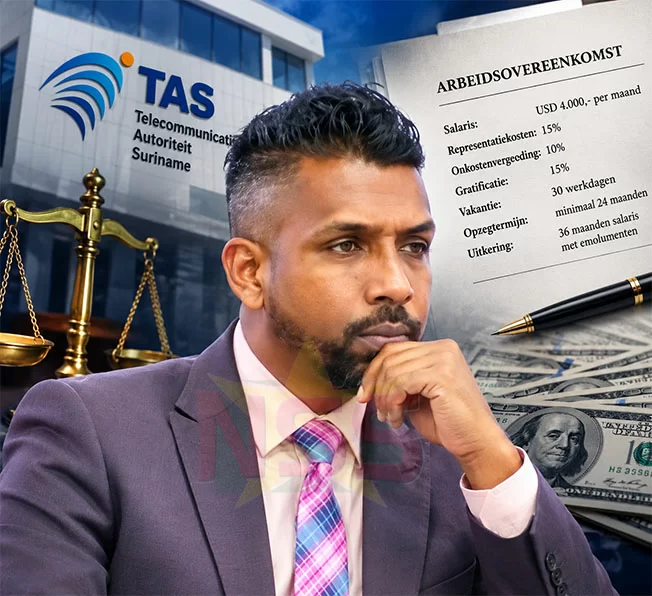
Suriname’s Minister of Justice and Security Harish Monorath, who previously publicly issued a stark warning to criminal elements that he would enforce the law without compromise, stating firmly “No test me,” is now himself at the center of a growing controversy over a disputed employment agreement he signed in his former role as supervisory board president of the Telecommunications Authority Suriname (TAS).
The contested contract, dated November 1, 2021, was signed with Wendy Jap-A-Joe, who had received a five-year presidential appointment as TAS director. The document outlines an open-ended employment relationship that includes a suite of highly generous benefits: a gross monthly salary of $4,000 before contributions and additional allowances, tax-free reimbursements, performance bonuses, vacation pay, full medical coverage, and the right to retain an official service vehicle for free upon departure from the role. It also stipulates a minimum 24-month notice period if TAS terminates Jap-A-Joe’s employment for reasons unrelated to misconduct, with a clause requiring payout of up to 36 full months of salary plus all associated emoluments under specified circumstances. Legal experts note that if these clauses are deemed legally valid, the agreement functions as a crippling financial liability for the public institution.
Local telecommunications legislation explicitly requires that the director’s employment terms be set by the competent transport, communication and tourism minister, following consultation with the supervisory board and formal approval from the Council of Ministers. A supervisory board president has no legal authority to bypass this formal procedure to unilaterally sign off on such a binding agreement. According to available records, neither past nor current ministers of Transport, Communication and Tourism, former TAS commissioners, nor the Surinamese president were aware of the existence of this contract, raising urgent questions about how a deal carrying such massive public financial implications could be finalized entirely outside official oversight channels.
Last Sunday, lawyer Gerold Sewcharan, representing the TAS supervisory board, formally contested the contract’s legal validity, adding that there is preliminary suspicion the document may have been drawn up long after its stated 2021 date — a serious allegation of backdating that has not yet been proven. On Monday, judge Robert Praag ruled against all claims submitted by Jap-A-Joe, issuing an immediate order barring her from acting in any official capacity on behalf of TAS, requiring her to vacate the TAS premises and transfer all work-related files and responsibilities within 24 hours. The disputed employment contract has been temporarily suspended, with a full substantive court case scheduled to determine its final legal status; the judge did not formally rule the document falsified or backdated in his interim decision, but the ruling has amplified calls for full transparency around the contract’s creation process.
A separate parallel concern has emerged that all salaries, allowances and benefits paid to Jap-A-Joe were processed directly through TAS accounts, entirely outside the national public finance oversight body Cebuma, while Jap-A-Joe also held full signing authority over institutional funds. No formal records exist showing who authorized these payments, or on the basis of what legally approved employment terms they were disbursed.
Independent auditors and public oversight bodies are now being urged to launch a full, sweeping financial and administrative audit of TAS, a public entity that processes millions of US dollars in annual revenue. The audit would trace all incoming funds over recent years, track spending on salaries, vendor contracts, international travel and other institutional costs, and verify the total amount of public revenue that has been remitted back to the national treasury. Investigators will be expected to produce verified findings based on official annual financial statements, bank records, board meeting minutes and independent auditor reports, expanding the scope of inquiry beyond Jap-A-Joe’s contract to cover the entirety of TAS’s financial governance and supervisory mechanisms.
Minister Monorath is not being presumed guilty of wrongdoing in advance, but as a senior government official who has repeatedly demanded strict adherence to the law from members of the public and criminal groups, he is now obligated to fully disclose every detail of his role in signing the contested document. TAS is a public state institution, not private property for the benefit of individual officials, and all public funds require full public accountability. The minister’s own earlier warning that no one should test the boundaries of the law now applies directly to himself, as public scrutiny mounts over the unapproved agreement he signed.
Harish, je wordt getest…