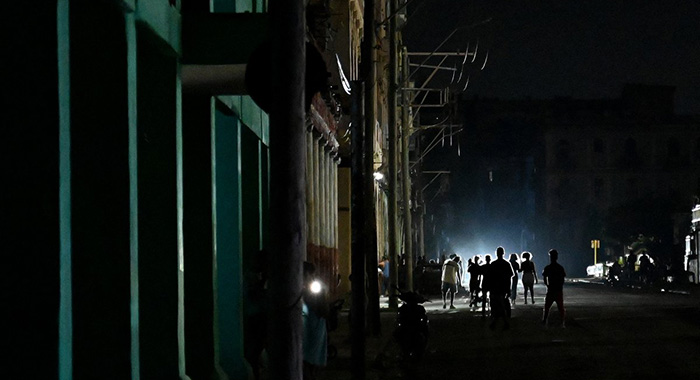
This op-ed is authored by Carlos Ernesto Rodríguez Etcheverry, the Republic of Cuba’s ambassador to St. Vincent and the Grenadines, who lays bare the devastating, human-centered toll of the decades-long U.S. economic, commercial and financial blockade on Cuban communities. The ambassador opens by framing the deliberate policy of restricting Cuba’s energy access as a uniquely cruel form of coercion, one that turns operating rooms into spaces of uncertainty, delays pediatric care, endangers pregnant people, and leaves families fearing for the well-being of their elderly relatives — hardships that stem not from natural disaster, but from calculated political decisions that strip an entire nation of the life-sustaining resources required for daily dignity.
For more than 60 years, successive U.S. administrations have enforced this sweeping blockade, with recent escalations specifically targeting the island’s ability to secure fuel to push this already harsh regime of economic coercion to new, dangerous extremes. Far from a discretionary luxury, energy forms the unshakable backbone of every functional society: it powers hospital operations, enables food production and distribution, runs clean water systems, supports cold-chain medicine delivery, and allows ordinary families to maintain a stable, dignified standard of living. Restricting a nation’s access to energy, the ambassador argues, is a direct, targeted assault on the very foundational structures that hold a society together, with every cold statistic hiding a real, vulnerable human being.
Official data from Cuba’s Ministry of Public Health, published in local Cuban media, lays bare the crushing pressure facing the island’s healthcare system. As of March 2026, 96,387 patients — including 11,193 children — were stuck on surgical waiting lists, over 32,000 pregnant women lacked timely access to diagnostic ultrasound scans, and roughly 30,000 children faced missed scheduled vaccinations because fuel shortages disrupted the refrigerated transport required to keep doses viable. At the same time, 16,000 patients in need of radiotherapy and 2,888 people dependent on life-sustaining haemodialysis services faced growing risks of interrupted care as energy supplies fluctuated. By June 2026, those waiting for surgery had swelled past 100,000, including 5,152 patients in urgent need of cancer operations, with haemodialysis services facing particularly acute strain due to their non-negotiable requirements for consistent electricity, running water, specialized equipment and unbroken supply chains.
The ambassador emphasizes that these figures are not abstract accounting entries: a sick child waiting for surgery cannot be reduced to a number, a pregnant person in need of prenatal care is not a line item, a cancer patient cannot simply pause their illness while political disagreements drag on, and someone reliant on haemodialysis cannot negotiate extra time with their failing kidneys. Behind every delayed procedure is a family living in persistent anxiety, and behind every interrupted service are frontline healthcare workers stretching every available resource to its absolute limit to protect their patients, often overcoming shortages that no amount of medical training or personal sacrifice can fully mitigate. No political dispute, the ambassador stresses, should ever be allowed to overshadow these fundamental, non-negotiable human realities.
The damage to Cuba’s healthcare system extends far beyond rolling blackouts: fuel shortages cripple ambulance fleets, delay the travel of medical staff to remote communities, disrupt medicine distribution networks, and block access to critical imported supplies. In March 2026, Cuba’s Deputy Minister of Public Health Dr. Julio Guerra Izquierdo reported that the healthcare sector had incurred more than $4.183 billion in losses across the 60-plus years of the blockade, with $288 million in damages recorded in 2025 alone. He noted that the financial losses accumulated over just 25 days of blockade-related restrictions would be enough to fund Cuba’s entire national list of essential medicines for a full 12 months, a sum that could cover thousands of missed treatments, repaired diagnostic equipment and life-saving care if it were not wasted on the impacts of coercive policy.
The ambassador acknowledges that Cuba bears inherent responsibility to support its own population, and notes that the country has taken aggressive, creative steps to mitigate the blockade’s harms: reorganized medical services that prioritize emergency cases and vulnerable groups, and a sweeping rollout of solar power infrastructure across public care sites. By March 2026, Cuban authorities had installed solar panels at 282 polyclinics, 78 nursing homes, 97 maternal care facilities, 74 senior day centers and 15 full-service hospitals. These efforts are a testament to Cuban ingenuity and collective determination, the ambassador notes, but they also expose the unreasonable, unsustainable burden the country is forced to shoulder just to preserve basic essential services. He argues that the Cuban people’s well-documented resilience should be celebrated, but never exploited as a justification to prolong unnecessary suffering.
The ripple effects of the energy blockade do not stop at hospital walls, either: they spread across every sector of Cuban society. Scarce fuel makes it far harder for small farmers to transport their harvests to urban markets, forces small businesses to scale back or suspend operations, erodes the reliability of public transit, and disrupts the distribution of food and household essentials. For ordinary Cuban families, this is not mere inconvenience: it translates to hours of extra labor to complete routine daily tasks, persistent uncertainty about the availability of basic goods, and growing strain on household budgets and livelihoods. The harms fall heaviest on the most vulnerable groups: elderly people, people with disabilities, chronically ill residents, and children, while parents carry the additional heavy emotional burden of reassuring their children through extended blackouts and shortages. The right to a dignified, stable life, the ambassador argues, should never be contingent on a country’s willingness to endure an externally imposed economic siege, and the well-being of ordinary civilians should never be used as a bargaining chip in a distant political dispute, even if the stated policy goal of coercive measures is political change.
On October 28, 2026, the United Nations General Assembly is scheduled to hold its annual longstanding vote on the resolution calling for a full end to the U.S. economic, commercial and financial blockade against Cuba. The measure has historically received overwhelming, cross-regional international support, and serves as a global platform to debate the harms of unilateral coercive measures, the core principles of national sovereignty, and foundational norms of international law. The upcoming vote will once again draw global scrutiny to the decades-long rift between the U.S. and Cuba, and to repeated global calls to end the blockade that Cuban officials identify as the single largest barrier to the country’s social and economic development.
The ambassador closes by emphasizing that Cuba is not asking the international community to ignore its domestic challenges, nor is it seeking special unearned privileges. Instead, it is asking for the basic right to allow its people to work, study, access full medical care, raise their children and build a future without the unnecessary, externally imposed burden of a policy designed to strangle its national economic life. Every child deserves timely, unimpeded medical care, every cancer patient deserves access to life-saving treatment, every pregnant person deserves full prenatal care, every older adult deserves dignity in their later years, and every family deserves the basic security of knowing essential services will be there when they need them. These are not partisan political demands, but universal human aspirations. The persistence of the energy blockade against Cuba poses a moral test for the global community: no nation can credibly advocate for universal human rights and dignity while tolerating policies that actively make it harder for millions of ordinary people to access life-sustaining services.
The Cuban people have shown extraordinary perseverance in the face of decades of sustained adversity, the ambassador notes, but that perseverance does not erase their real suffering, and their collective resilience should never be misinterpreted as consent to the harms of the blockade. No population should ever be required to prove their ability to withstand hardship before they are granted the right to live in peace. The lights must stay on in Cuban hospitals, life-saving medicines must reach every patient who needs them, children must receive their scheduled treatments, and families must be free to work, study and live with full dignity. The energy blockade against Cuba is not merely a niche economic dispute: it is a deeply human, moral question that tests the global community’s commitment to the values it claims to uphold. The time has long since arrived to end this policy of collective punishment, abandon unilateral economic coercion, and choose constructive dialogue over confrontation. Cuba has an inherent right to develop without external interference, and its people deserve to live without the constant threat of deprivation imposed from thousands of miles away. The children, patients, parents and elders of Cuba are entitled to the one thing no political dispute should ever take from them: the opportunity to live their lives with full dignity, security and hope. This op-ed reflects the personal views of Ambassador Carlos Ernesto Rodríguez Etcheverry, and does not necessarily align with the editorial stance of iWitness News.