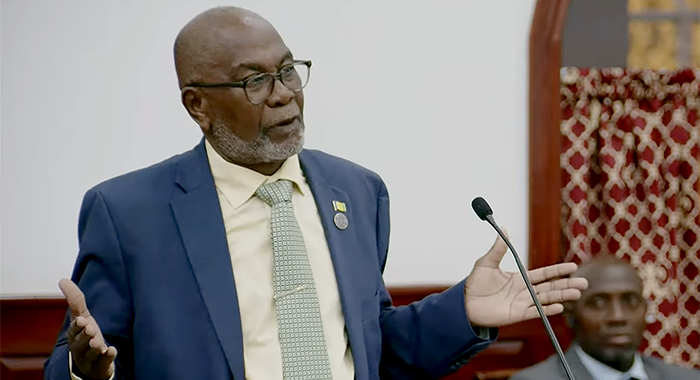
In a parliamentary session on Thursday, St. Vincent and the Grenadines Deputy Prime Minister St. Clair Leacock formally defended the ruling New Democratic Party’s push to join the Development Bank of Latin America and the Caribbean (CAF), addressing concerns raised by opposition Senator Carlos James over potential variable, elevated interest rates tied to the institution’s lending products. Leacock emphasized that CAF membership is not a standalone quick-fix solution to the nation’s fiscal strains, but one integral component of a multi-pronged national economic recovery blueprint designed to stabilize public finances, eliminate systemic waste, and drive sustainable long-term growth. The deputy prime minister explicitly rejected framing the move as a bid to “borrow the country out of its difficulties,” a narrative he repeatedly pushed back against during legislative debates. James, who led the opposition’s deliberations on the CAF membership bill in the absence of Opposition Leader Ralph Gonsalves, extended conditional support for the legislation, backing the formal measure while challenging the government’s framing of the associated financing terms. The opposition senator urged the administration to allocate any funds accessed through CAF exclusively to high-impact, long-return public projects that deliver tangible, widespread benefits for the Vincentian public. “I lend my full support to this bill, but I implore the government to spend these resources wisely, in service to the best interests of all people of St. Vincent and the Grenadines,” James stated during proceedings. Leacock publicly acknowledged the opposition’s qualified support, remarking, “Thanks for your support. Thanks for coming to your senses.” He was careful not to overstate CAF’s transformative potential, noting explicitly, “We cannot borrow ourselves out of the difficulties in which we find ourselves at the moment.” The deputy prime minister outlined that the 11-month-old NDP administration’s broader economic framework pairs rigorous fiscal discipline with targeted efforts to boost national productivity and attract both domestic and foreign direct investment. “We have a clear, actionable plan,” Leacock told assembled parliamentarians, breaking the strategy down as: “Stabilise the economy. Stop the haemorrhaging of public resources. Cut unnecessary losses. Reduce systemic waste. Bring our people to a state where they understand they must cut their cloth according to their means, live within their collective capacity.” He characterized this direct, no-nonsense framing as “necessary for these challenging times,” adding that he shared James’s recognition of powerful external headwinds largely beyond the small island nation’s control. “The external challenges and factors over which we have so little control are like a tsunami coming at us,” Leacock explained. “We have nothing to do with the Ukraine war. We have nothing to do with the Iranian conflict. We have no hand in a whole host of global disruptions that are battering our economy.” He stressed that the government’s agenda goes far beyond short-term fiscal triage: “The fact of the matter is that we are not only just cleaning up and stabilising, but we are putting ourselves on a new course, a new direction for lasting prosperity.” Positioning CAF membership as one tool in a diverse toolkit, Leacock noted that joining the regional development bank as a shareholder would grant SVG access to development-focused financing and specialized technical guidance that is not available through conventional commercial lenders. He highlighted that CAF’s core mandate centered on advancing social and developmental outcomes for member states, setting it distinctly apart from profit-driven private lending institutions. He added that the government’s full strategy extends far beyond international borrowing, incorporating expanded public-private partnerships, targeted mobilization of private capital, and a national push for productivity management that encourages all citizens to deliver more with limited resources. Leacock called for a collective national effort, framing the Vincentian public as the most critical stakeholder in the recovery process. He went on to detail the severe fiscal pressures that shaped the administration’s agenda, noting that official advice from domestic public servants and international financial institutions confirmed the country was “in a very difficult situation” when the new government took office, positioned “at the brink of a precipice” due to unsustainable fiscal choices made by the preceding Unity Labour Party (ULP) administration. To illustrate the need for widespread, creative cost-cutting across all levels of society, Leacock used folksy, relatable analogies: squeezing every last bit of toothpaste from a nearly empty tube, and fusing leftover fragments of bar soap to avoid unnecessary waste. He emphasized that the government’s core fiscal goal is to freeze the national debt burden while simultaneously growing overall economic output, rather than relying on endless new borrowing to paper over gaps. Leacock urged the public to extend trust to the administration’s economic team, noting, “You have to trust and have faith in the Minister of Finance,” and calling for a unified, “all-of-St. Vincent” coordinated response to the national economic challenge. He went on to lay out sharp criticisms of the former ULP administration’s fiscal stewardship, accusing the previous government of taking on large volumes of debt without any concrete, viable plan for repayment. Citing a 2021-era arrangement for US$48 million in Saudi Arabian development funding, Leacock noted that the prior administration borrowed an additional US$3 million just to meet the access requirements for that funding, leaving the nation US$51 million further in the red with no clear repayment structure. He also alleged widespread misuse of public funds and financial instruments under the ULP, including diverting earmarked public funds to cover unrelated debt obligations, issuing bonds to state-owned utility VINLEC instead of repaying outstanding public debts, failing to meet mandatory payment obligations to the National Insurance Services (NIS), and circumventing established fiscal rules by transferring funds directly to NIS outside of the official Consolidated Fund process. He further noted that $123 million in projected revenue failed to materialize as forecast in the 2023 national budget, exacerbating the fiscal crunch inherited by the current government. Leacock acknowledged that the prior ULP administration had initially launched exploratory discussions about CAF membership three years prior, noting that the current NDP government had reviewed those early talks and moved forward only with the components of the proposal that aligned with its responsible, growth-focused fiscal framework.
Leacock rebuts James’ criticism; says ‘We have a plan’ (+video)