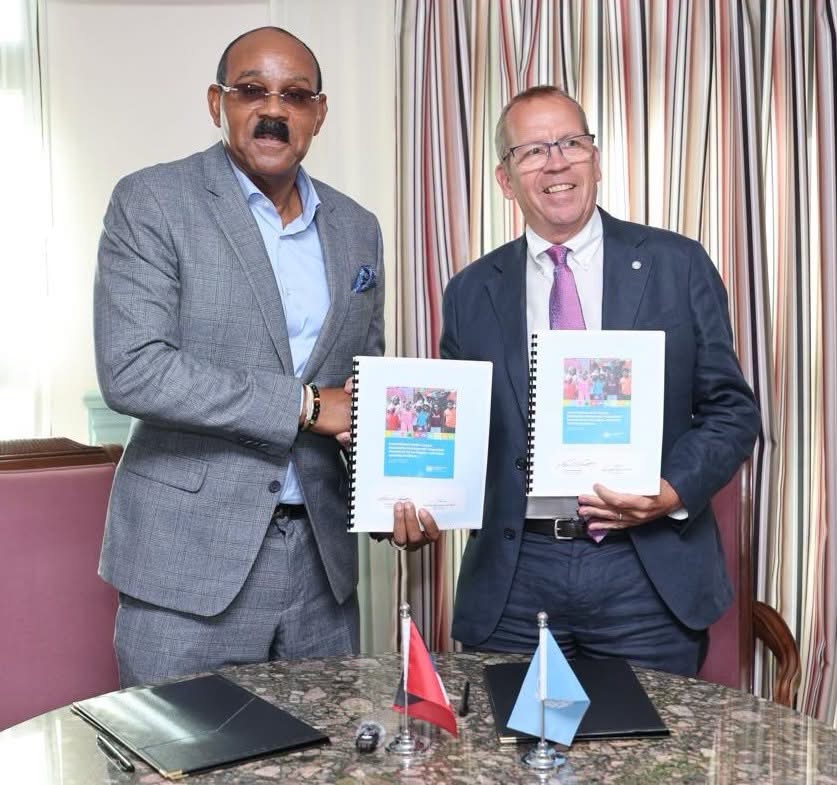
ST. JOHN’S, Antigua and Barbuda – October 23, 2026 – In a landmark move that cements its regional leadership in sustainable development, Antigua and Barbuda has made history as the first Eastern Caribbean state to formally adopt the United Nations Multi-Country Sustainable Development Cooperation Framework (MSDCF) covering the 2027 to 2031 operational period.
The official endorsement took place during a high-profile signing ceremony hosted at the Office of the Prime Minister, where Prime Minister the Right Honourable Gaston Browne affixed his signature on behalf of the national government. The event was attended by Simon Springett, the UN Resident Coordinator for Barbados and the Eastern Caribbean, marking a public reaffirmation of the longstanding collaborative partnership between the twin-island nation and the UN development ecosystem to drive inclusive growth, economic robustness and equitable social advancement.
This early, proactive endorsement positions Antigua and Barbuda at the forefront of global Small Island Developing States (SIDS) efforts to advance sustainable development, build systemic resilience, and push for targeted international cooperation that directly addresses the unique, structural vulnerabilities that disproportionately hamper small island economic progress.
Designed to serve as a shared strategic roadmap, the 2027–2031 MSDCF aligns all UN development system resources and cross-border support across participating Eastern Caribbean nations with local national priorities and broader regional development targets. For Antigua and Barbuda, the framework carries particular weight as it is explicitly structured to back the rollout of the Antigua and Barbuda Agenda for Small Island Developing States (ABAS 2024–2034) – the transformative 10-year development blueprint that emerged from the Fourth International Conference on Small Island Developing States, which the country successfully hosted in May 2024. The coordinated governance structure embedded in the MSDCF will streamline ABAS implementation by standardising development programming workflows, creating unified outcome-tracking systems, establishing consistent progress measurement protocols, and enforcing clearer accountability for delivered results.
The MSDCF was not drafted in isolation: it was crafted via a months-long, fully inclusive consultative process that integrated insights from cross-national multi-country analysis, individual national Common Country Assessments, and direct feedback gathered from national government bodies, grassroots civil society organisations, and leading regional intergovernmental institutions, with final refinements shaped by deliberations of the cross-sector Joint Steering Committee. The framework pinpoints five non-negotiable priority action areas: targeted economic diversification, enhanced climate disaster resilience, expanded universal social protection, strengthened citizen safety, and accelerated progress toward meeting all 17 United Nations Sustainable Development Goals.
A core, defining element of the MSDCF is its explicit focus on mitigating long-unaddressed structural weaknesses across the Eastern Caribbean, including over-reliance on narrow economic sectors, extreme exposure to costly climate-related natural disasters, gaps in national data collection and management infrastructure, and persistent, systemic social inequality gaps. Through coordinated, cross-national interventions, the framework is engineered to support the creation of more shock-resistant, diversified local economies, upskill and expand national human capital, reinforce inclusive social service systems, and elevate regional collective capabilities in digital infrastructure deployment, open data governance, and proactive climate risk mitigation. It also explicitly prioritises solutions to three pervasive barriers to regional progress: chronic development financing shortfalls, fragmented institutional governance structures, and the rising frequency and severity of climate hazards that have repeatedly derailed development outcomes across the Eastern Caribbean in recent years.
To guarantee seamless, results-focused delivery, the MSDCF establishes a layered governance, monitoring and accountability architecture overseen by the Joint Steering Committee, a dedicated Regional Steering Committee, and customised national Country Implementation Plans for each participating state. These interconnected structures are designed to break down historical silos between national governments and UN operational teams, eliminate duplication of international development assistance efforts, and ensure every funded programme delivers tangible, measurable improvements for ordinary residents across the region.
For the Government of Antigua and Barbuda, the formal signing represents a critical strategic milestone that deepens its bilateral partnership with the United Nations, and unlocks streamlined access to specialised technical expertise, targeted development grant and loan support, and institutional capacity-building resources aligned directly with its national development priorities. The endorsement also dovetails with the nation’s decades-long global advocacy for a more equitable, responsive international development system that recognises the unique, disproportionate challenges SIDS face, and delivers practical, context-appropriate support rather than one-size-fits-all policy prescriptions.
By taking the lead as the first Eastern Caribbean nation to formalise its commitment to the MSDCF 2027–2031, Antigua and Barbuda has reaffirmed its dual role as a respected regional leader and a credible global voice for SIDS, centering resilience, social inclusion, and sustained improvements in citizen quality of life as non-negotiable pillars of its development path. Over the next five years, the framework will act as the central guiding document for all UN development cooperation activities across the Eastern Caribbean, unifying cross-national efforts to speed up progress toward the global Sustainable Development Goals.
Antigua and Barbuda Becomes First Eastern Caribbean Country to Sign United Nations Sustainable Development Cooperation Framework 2027–2031