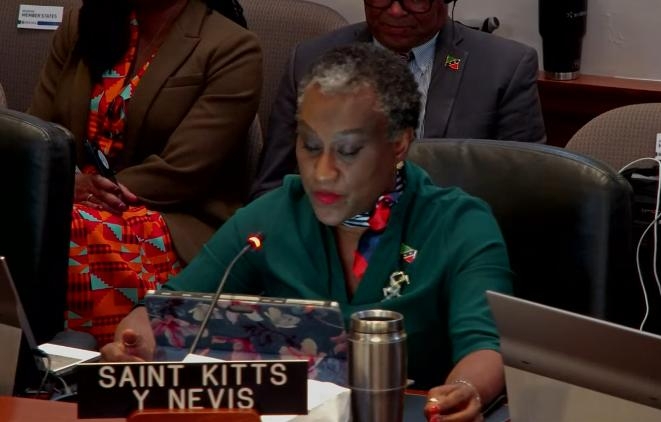
During a special session of the Organization of American States (OAS) Permanent Council held in Washington D.C. on October 20, 2026, St. Kitts and Nevis’ Ambassador to the OAS Jacinth Henry-Martin delivered a landmark address centred on centring unvarnished historical truth as the bedrock of equitable cross-continental cooperation across the Americas and Europe.
Henry-Martin opened her remarks by tracing the layered, often unacknowledged shared history that binds the two regions: the enduring legacy of Indigenous communities who stewarded the Americas for millennia, the violent forced displacement and enslavement of African peoples across the Atlantic, and the unyielding resilience of successive generations of freedom fighters who carved out paths to self-determination, distinct cultural identity, and sovereign nationhood. She emphasized that no amount of time or geographic distance could erase these foundational realities, noting that “truth cannot be washed away by centuries of rain, nor by the waters of the Atlantic across which our ancestors came.”
The ambassador went on to outline how the centuries of interaction between Europe and the Americas shaped the region’s modern linguistic landscapes, rich cultural diversity, and social frameworks, many of which still carry deep structural inequalities that continue to marginalize vulnerable communities today. She argued that refusing to confront this nuanced, often painful history directly hampers collective efforts to address pressing contemporary crises, and that transparent acknowledgment of the past is a non-negotiable prerequisite for forging partnerships rooted in mutual respect rather than historic power imbalances.
For small island nations like St. Kitts and Nevis, Henry-Martin noted, national sovereignty is not merely a symbolic status, but an active, ongoing commitment to honouring the experiences of past generations, redressing inherited systemic inequities, strengthening domestic governance institutions, and expanding equitable access to opportunity for all residents. She further highlighted the dual existential pressures facing small Caribbean states: acute vulnerability to the escalating impacts of climate change, and destabilizing external economic shocks that can derail years of fragile development progress overnight. These overlapping threats, she stressed, make purpose-driven, respectful international cooperation not a discretionary luxury, but an urgent necessity for the entire region.
It was within this framework that Henry-Martin joined OAS representatives in marking the 20th anniversary of the Spanish Fund for the OAS, hailing Spain as a long-standing constructive development partner for regional states. Over its two decades of operation, the fund has aligned its programming with all four core operational pillars of the OAS, bolstering the organization’s institutional capacity to deliver targeted support to member states, and funding critical initiatives that underpin long-term sustainable development. Key achievements of the fund to date include deploying independent electoral observation missions to safeguard democratic processes, expanding programming to remove barriers for women seeking political office, and expanding marginalized communities’ access to fair, transparent justice systems to advance more inclusive societies. Henry-Martin specifically singled out the fund’s work to facilitate confidence-building dialogue between Belize and Guatemala as a landmark success, noting that the peacebuilding effort carries outsized significance for the entire Caribbean Community (CARICOM) and serves as a replicable model of how cross-national partnerships can defuse tensions and nurture long-term peaceful relations.
The ambassador framed the Spanish Fund as a tangible, living bridge connecting Spain and the wider Americas, one that can only deliver on its full transformative potential if it is anchored in a clear-eyed, honest reckoning with the full scope of their shared historical ties. True cross-national friendship, she explained, does not require erasing or whitewashing painful chapters of the past, but rather translating that shared understanding into concrete, collaborative action to build a more just, equitable region for all. As the fund moves into its next decade of programming, Henry-Martin formally called on partners to prioritize key Caribbean development priorities for upcoming funding cycles, including targeted investments in climate resilience infrastructure, universal digital access for underserved communities, youth leadership and skills development programs, and targeted policies to advance full gender equality across all sectors of society.
St. Kitts and Nevis Highlights shared History, Regional Cooperation at OAS Commemoration